The landscape of modern data centers is rapidly transforming, driven by the exponential growth of compute-intensive workloads associated with Artificial Intelligence (AI), Machine Learning (ML), and High-Performance Computing (HPC). As hardware evolves, particularly GPUs, which now push power densities well beyond 700W per chip, and as rack power envelopes exceed 80kW, traditional air cooling systems have reached their fundamental thermal and logistical limits. Air, as a medium for heat transfer, simply pales in comparison to liquid, forcing a critical paradigm shift in data center infrastructure. The adoption of liquid cooling is no longer a futuristic concept or a niche application reserved only for supercomputers or specialized markets like crypto mining; it is fast becoming a necessary, mainstream solution to support current and future compute demands.
This necessity is fundamentally dictated by physics and efficiency. Liquid cooling leverages the substantially higher thermal transfer properties of fluids, which can be up to 3000 times more effective than air. When air cooling fails to keep pace, it consumes an unsustainable portion of data center energy and space budgets. Air-cooled GPU servers often dedicate 10-15% of their total power usage just to run cooling fans. Furthermore, facility limits, often capping out around 40kW per rack, make accommodating ultra-high compute density impossible without liquid intervention. By implementing liquid cooling, operators can drastically reduce or eliminate the need for these energy-intensive server fans and massive Computer Room Air Handler (CRAC) units, resulting in a dramatic reduction in overall energy consumption and operational costs. For instance, studies have shown that Direct Liquid Cooling (DLC) can cut power usage by as much as 12% in GPUs, simultaneously enhancing performance and lowering chip temperatures by 20 °C, demonstrating its superior capability in managing the extreme heat flux generated by contemporary processors.
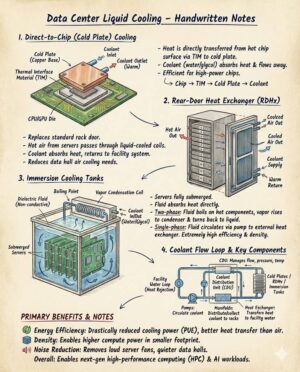
The industry recognizes two primary and increasingly mainstream methodologies for liquid heat removal: Direct-to-Chip (D2C) liquid cooling and Immersion Cooling. D2C cooling is rapidly gaining traction as the most common form deployed in production environments. This method replaces conventional heatsinks with cold plates mounted directly onto heat-generating components like CPUs, GPUs, and voltage regulators. A circulating coolant, often water or glycol mixtures, flows through microchannels within these cold plates, absorbing and carrying away the heat externally. D2C solutions are particularly appealing because they require fewer modifications to existing infrastructure, facilitating easier retrofitting into current air-cooled facilities. While D2C typically captures between 50% and 80% of the heat generated, this is often sufficient to manage the most critical thermal hotspots and significantly improve overall system efficiency, leaving the remaining 20-30% to be managed by supplemental air systems. Advanced D2C systems may use single-phase cooling (like water) or two-phase systems, often utilizing expensive fluorocarbon-based liquids, which offer approximately 100 times better heat absorption due to the latent heat of evaporation.
Immersion cooling represents the other, often more efficient, end of the spectrum. This approach involves completely submerging IT infrastructure—servers, components, and sometimes entire racks—in a non-conductive, dielectric fluid. These specialized fluids, which can be hydrocarbon-based oils or engineered fluorocarbon fluids, directly absorb the heat. There are multiple configurations, including sealed chassis or open liquid baths. Immersion systems offer unparalleled cooling efficiency, capable of capturing around 95% of the heat generated. This ultra-high efficiency makes immersion cooling especially effective for the most power-dense applications, such as large-scale AI model training clusters and HPC environments where rack densities routinely exceed 80kW or even 100kW. While immersion requires more significant upfront investment and system modifications compared to D2C, its ability to support higher compute density and its effectiveness over a broader range of operational conditions often delivers a strong Return on Investment (ROI) within two to four years, especially for hyperscale deployments. Companies like GRC and Vertiv are continuously launching new, specialized immersion systems to support high-density deployments at the edge and in large-scale facilities.
Beyond efficiency, liquid cooling addresses the critical constraints of space and capacity within data center facilities. By transferring heat more effectively, liquid cooling minimizes the physical space required for cooling infrastructure, eliminating the need for large air plenums and extensive ducting. This spatial optimization allows operators to deploy smaller, denser data halls and place power-dense servers in closer proximity. The result is a substantial increase in IT capacity—up to 25% to 50% more compute power—within the same power envelope and physical footprint. This capability is crucial not only in high-cost real estate markets like Singapore and Silicon Valley but also for enabling the growth of Edge computing. As the Edge begins to support increasingly compute-dense, power-hungry AI applications, liquid cooling provides the necessary advanced thermal management for these decentralized locations. This high density is a key enabler for the massive computational requirements of large language models (LLMs) and advanced AI model training, necessitating innovative system designs like the Nvidia GB200 NVL72 racks, which rely on liquid cooling to manage intense heat.
However, the shift toward liquid cooling is intertwined with significant environmental and societal debates, particularly concerning water consumption. While liquid cooling technologies, especially closed-loop systems, can reduce the need for water-based cooling towers and conserve millions of gallons of water per year compared to traditional air methods, the rapid expansion of data centers, driven by AI, is putting immense pressure on freshwater resources. Large data centers can consume up to 5 million gallons of water per day, comparable to a small town of 10,000 to 50,000 people. This consumption is exacerbating water scarcity and groundwater depletion, leading to local opposition in communities where new centers are planned, such as the concerns raised in Indiana and Wisconsin regarding water usage from the Great Lakes watershed. The consumed water is primarily that which evaporates or is otherwise removed from the immediate water cycle. Even the seemingly innocuous activity of running AI models has a water footprint; one report estimated that each 100-word AI prompt uses roughly the equivalent of one bottle of water (519 milliliters). Addressing these concerns requires a holistic approach, prioritizing the use of recycled or non-potable water, and developing systems that maximize heat reuse, following practices already implemented in regions like Scandinavia where data center heat reuse has become a regulatory requirement for urban zones.
Furthermore, evaluating the true efficiency of these new liquid-cooled facilities necessitates a re-evaluation of traditional metrics. The industry-standard Power Usage Effectiveness (PUE) metric, which measures total data center power divided by IT equipment power, is proving ineffective for liquid-cooled environments. Because liquid cooling directly impacts the power draw of the IT equipment itself (the denominator) by eliminating fans, and the total facility power (the numerator) by reducing HVAC needs, PUE scores, while consistently below 1.2 for liquid-cooled sites compared to 1.4-1.6 for air-cooled ones, can be misleading for comparative analysis. As a result, alternative metrics like Total Usage Effectiveness (TUE) are being developed and promoted. TUE provides a more accurate representation of overall energy savings and efficiency gains achieved through liquid cooling, often showing an improvement of over 15% in TUE for fully optimized liquid-cooled systems compared to their air-cooled counterparts. The widespread adoption of these new standards and metrics is essential for guiding future design decisions and optimizing energy savings globally, ensuring that efficiency gains are accurately quantified beyond simple power ratios.
The regulatory and safety aspects are also paramount. Given that these specialized fluids and chemical coolants are in direct contact with critical hardware and are used in proximity to drinking water processes in some municipal systems, their purity and composition must meet stringent national and international standards, such as the ANSI/NSF 60 standard in the U.S., which addresses acceptable impurity levels. Plant operators must confirm adherence to these standards to prevent the process of purification or cooling from introducing new contaminants like heavy metals. Operationally, the complexity increases due to the requirement for a secondary cooling loop and specialized components like the Coolant Distribution Unit (CDU) to precisely control fluid distribution. Modern systems mitigate leakage risks by limiting fluid volumes and integrating sophisticated leak detection technology. Despite higher upfront capital costs, major industry players like Microsoft, Google, and Meta have already made the strategic shift, successfully deploying liquid-cooled racks for their most demanding GPT and LLaMA training workloads. The market projections are clear: the liquid cooling market is expected to surge from $1.5 billion in 2024 to $6.2 billion by 2030, with over 50% of new hyperscale capacity projected to be liquid-cooled by 2027, making it an undeniable industry trend.
Looking ahead, the development of liquid cooling is not static. Innovations continue to emerge, targeting specific challenges. For example, microconvective cooling, or microjet impingement, offers lower thermal resistance by precisely targeting hot spots on processors, avoiding the pressure and filtration issues associated with traditional microchannels. Furthermore, the integration of Adaptive Cooling, utilizing AI to continually learn and adjust cooling needs in real-time, promises to further reduce overcooling and energy waste. The long-term vision involves purpose-built, liquid-only data centers and retrofitting existing air-cooled facilities with the necessary infrastructure to support liquid-cooled racks. This integrated approach, combining advanced physical cooling mechanisms with compliant chemical formulation and cutting-edge operational monitoring (including API-based management and real-time monitoring of flow rates and thermal data), is fundamental to achieving operational excellence and meeting ambitious sustainability goals. The next phase of the data center revolution depends entirely on mastering these colder, denser, and dramatically more efficient hardware environments that liquid cooling enables.
The necessity of this technological pivot is underscored by the immense power demands of emerging hardware. While traditional servers operated within manageable thermal limits, contemporary GPUs and CPUs, driven by parallel processing requirements for AI/ML, push thermal design power (TDP) figures that are impossible for air to effectively dissipate. The shift to liquid cooling allows data centers to maximize their existing global footprint, ensure efficient heat dissipation, and optimize power delivery precisely where needed for AI and hyperscale systems. This enables organizations to achieve higher application performance by ensuring processors and accelerators maintain peak performance for longer periods without throttling due to heat. The conversation is no longer about whether liquid cooling is viable, but how rapidly it will become the undisputed industry standard for any facility aiming to support future compute densities and meet the increasingly strict energy and water consumption regulations being implemented worldwide. The path to sustainable and high-performance computing is paved with liquid-cooled racks.
The successful deployment also relies heavily on the careful selection of coolant types. Liquids used in these systems fall into three categories: water-based solutions (often mixed with glycol or anti-freeze to prevent corrosion and freezing), hydrocarbon-based oils (dielectric fluids), and engineered fluids (highly specialized dielectric compounds, some of which facilitate two-phase cooling by absorbing heat through latent heat of evaporation). Each fluid type carries specific operational considerations, including handling and safety protocols. For instance, high-concentration chlorine or specialized polymers used in water-based systems for biofouling and corrosion prevention require dedicated storage protocols and specialized personal protective equipment. The chemical guide, therefore, must serve as a comprehensive reference, ensuring that plant operators are fully trained in the safe transport, preparation, and injection of these various coolants, thereby mitigating both water quality risks and occupational safety hazards. This holistic approach ensures operational longevity, as salt water, for example, is highly corrosive to standard piping. By addressing power density limits, environmental impacts, and efficiency metrics, liquid cooling solidifies its role as the critical foundation for the future of digital infrastructure.