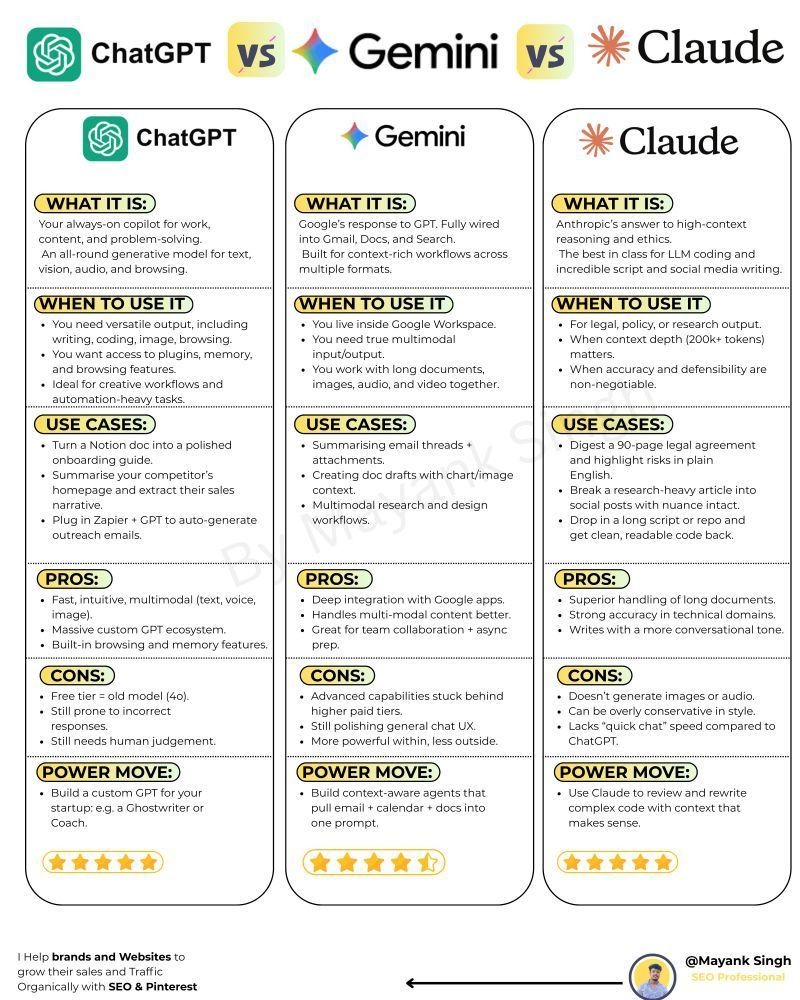
As we move deeper into the 2020s, artificial intelligence has become an integral part of daily life—from drafting emails and writing code to analyzing data and generating creative content. By 2026, the landscape of AI-powered tools is expected to be more advanced, competitive, and specialized than ever. Among the most prominent players are ChatGPT, Google’s Gemini, and Anthropic’s Claude. Each offers unique capabilities, strengths, and limitations. But which one should you choose in 2026? This article compares these three leading AI models to help you make an informed decision based on your needs.
Understanding the Three Leading AI Models
ChatGPT: The Pioneer of Conversational AI
Developed by OpenAI, ChatGPT launched in late 2022 and quickly became the most widely recognized AI chatbot. By 2026, it has evolved significantly, with improved reasoning, multimodal capabilities (text, image, and audio), and integration into various platforms like Microsoft 365 and Teams. ChatGPT is powered by the GPT series, with GPT-5 expected to be the core engine in 2026. It excels in natural language understanding, creative writing, and general-purpose tasks.
One of ChatGPT’s key advantages is its extensive training data and fine-tuning through reinforcement learning from human feedback (RLHF). This allows it to generate human-like responses across a wide range of topics. Additionally, its API and developer tools make it a popular choice for businesses looking to integrate AI into their workflows.
Gemini: Google’s Multimodal Powerhouse
Google’s Gemini, formerly known as Bard, represents the tech giant’s flagship AI model. By 2026, Gemini is expected to be deeply integrated across Google’s ecosystem—including Search, Gmail, Google Docs, and Android. Unlike earlier models, Gemini is natively multimodal, meaning it can process and generate text, images, audio, and even video from the ground up.
Gemini’s architecture is designed for efficiency and scalability, leveraging Google’s vast computational resources. It benefits from real-time access to the web (with user permission), allowing it to provide up-to-date information—a significant advantage over models that rely solely on static training data. For users deeply embedded in Google’s ecosystem, Gemini offers seamless functionality and contextual awareness.
Claude: The Ethical and Safety-Focused AI
Developed by Anthropic, Claude stands out for its strong emphasis on AI safety, constitutional AI principles, and ethical reasoning. By 2026, Claude is expected to be a top choice for organizations prioritizing responsible AI use. Claude’s training incorporates techniques like constitutional AI, where the model is guided by a set of principles to avoid harmful, biased, or misleading outputs.
Claude excels in nuanced reasoning, long-form content analysis, and maintaining conversational consistency over extended interactions. It is particularly strong in legal, academic, and compliance-related tasks. While it may not have the same level of multimodal integration as Gemini or ChatGPT, its focus on reliability and safety makes it a compelling option for sensitive applications.
Performance Comparison in 2026
Accuracy and Knowledge Depth
In terms of factual accuracy, all three models have improved significantly by 2026. However, Gemini holds an edge due to its real-time web access, allowing it to retrieve current information without relying on outdated training data. ChatGPT and Claude, while highly knowledgeable, may occasionally provide outdated answers unless connected to external tools.
For deep analytical tasks—such as interpreting scientific papers or legal documents—Claude often outperforms the others due to its training on complex reasoning and ethical guidelines. ChatGPT remains strong in creative and general knowledge tasks, while Gemini shines in practical, real-world problem-solving.
Multimodal Capabilities
Multimodal functionality—the ability to understand and generate different types of media—is a key differentiator. By 2026, both ChatGPT and Gemini support advanced multimodal interactions. ChatGPT can analyze images, generate audio, and even assist with video content, while Gemini’s native multimodal design allows it to process mixed inputs more fluidly.
Claude, in contrast, remains primarily text-focused, though it may support limited image analysis. For users who need to work across text, images, and audio, ChatGPT and Gemini offer more comprehensive solutions.
Integration and Ecosystem
Integration with existing tools is crucial for productivity. ChatGPT benefits from strong partnerships, especially with Microsoft, enabling smooth use in Office applications. Gemini is deeply embedded in Google Workspace, making it ideal for users who rely on Gmail, Docs, and Drive. Claude integrates well with enterprise platforms and offers robust API support, particularly for regulated industries.
Key Takeaways
- ChatGPT is best for general-purpose AI tasks, creative writing, and users invested in the Microsoft ecosystem.
- Gemini excels in real-time information retrieval, multimodal tasks, and seamless integration with Google services.
- Claude is the top choice for ethical AI, long-form reasoning, and applications requiring high safety and compliance standards.
- Your choice in 2026 should depend on your primary use case: creativity, real-time data, or responsible AI deployment.
FAQ
Which AI is the most accurate in 2026?
Gemini tends to be the most accurate for current events and real-time data due to its web access. However, Claude often provides more reliable answers in complex reasoning tasks, while ChatGPT remains strong in general knowledge and creativity.
Can these AI models replace human writers or analysts?
While all three models can assist with writing and analysis, they are tools—not replacements. They enhance productivity but still require human oversight, especially for nuanced, ethical, or high-stakes decisions.
Are these AI models safe to use in professional settings?
Yes, but with caveats. Claude is designed with safety as a core principle, making it suitable for sensitive industries. ChatGPT and Gemini have improved their safety measures, but users should still review outputs and avoid sharing confidential data without proper safeguards.
By 2026, the AI landscape will offer more choices than ever. Whether you prioritize speed, safety, creativity, or integration, understanding the strengths of ChatGPT, Gemini, and Claude will help you select the right tool for your needs.