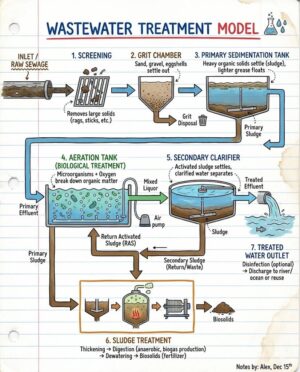
The concept of a Wastewater Treatment Model (WWT model) represents a sophisticated, essential tool in modern environmental engineering, bridging theoretical principles of chemistry, biology, and fluid dynamics with the practical demands of municipal and industrial water purification. These models are not merely static representations but dynamic, mathematical frameworks designed to simulate, predict, and optimize the complex physical, chemical, and biological processes occurring within a treatment facility. For plant operators, engineers, and regulatory bodies, the ability to accurately model a system is indispensable, allowing for cost-effective design, efficient operation, and guaranteed compliance with increasingly stringent discharge standards. A comprehensive understanding of WWT modeling begins with recognizing the inherent complexity of the systems they attempt to replicate.
Wastewater treatment facilities are intricate ecosystems where microbial communities interact with complex matrices of pollutants under controlled, engineered conditions. The raw influent—a variable mixture of domestic, industrial, and stormwater flows—presents a challenge due to fluctuations in volume, temperature, and contaminant concentration (e.g., biochemical oxygen demand (BOD), chemical oxygen demand (COD), total suspended solids (TSS), nitrogen, and phosphorus). A robust WWT model must account for this inherent variability, translating real-world inputs into quantifiable kinetic and stoichiometric equations that govern reaction rates and mass transfer.
Historically, early wastewater models relied on simplified, steady-state calculations. However, the advent of high-speed computing and advanced biokinetics led to the development of sophisticated dynamic models, most notably the Activated Sludge Model (ASM) series established by the International Water Association (IWA). The ASM family (ASM1, ASM2, ASM2d, ASM3) forms the cornerstone of biological wastewater treatment modeling globally. ASM1, the foundational model, specifically focuses on carbon oxidation and nitrogen removal through nitrification and denitrification, tracking 13 components and 8 biological processes, providing a structured approach to simulating the heart of the biological reactor.
The practical application of these models spans the entire spectrum of treatment phases. In the primary phase, models predict the settling efficiency of suspended solids in clarifiers, often employing modified versions of the double exponential settling velocity function. For the secondary biological stage, which is typically the most complex and resource-intensive, dynamic models simulate the growth, decay, and metabolism of various microbial populations (heterotrophs, autotrophs), predicting the effluent quality based on factors like sludge retention time (SRT), hydraulic retention time (HRT), dissolved oxygen (DO) levels, and recycle flows. Modeling is crucial here for optimizing aeration control, which is the single largest energy consumer in many treatment plants.
Nutrient removal models, particularly those for biological phosphorus removal (BPR), such as ASM2 and ASM2d, introduce additional complexity by tracking polyphosphate-accumulating organisms (PAOs) and glycogen-accumulating organisms (GAOs). These models simulate the alternating anaerobic, anoxic, and aerobic zones necessary for efficient biological nutrient removal (BNR). By accurately predicting the uptake and release of phosphorus and the nitrogen cycling kinetics under varying conditions, engineers can design and tune reactors to meet extremely low effluent nutrient limits without relying excessively on expensive chemical precipitation methods.
Beyond the biological reactor itself, WWT models are crucial for simulating secondary clarifiers—the hydraulic bottleneck of many facilities. Clarifier models, often based on one-dimensional or two-dimensional fluid dynamics, predict the solids flux, sludge blanket height, and effluent TSS concentration under peak flow conditions. These simulations ensure that the activated sludge mass, crucial for biological treatment, is effectively separated from the treated water and returned to the aeration basin, maintaining a stable mixed liquor suspended solids (MLSS) concentration.
The modeling process itself involves several critical stages: definition, data collection, calibration, validation, and application. The definition stage involves selecting the appropriate model structure (e.g., ASM1 for simple BNR or a more complex proprietary model for specific industrial waste streams) and defining the plant layout, including tank volumes, pump capacities, and interconnected piping. Data collection is often the most labor-intensive step, requiring extensive, high-frequency monitoring of influent characteristics, operational parameters (DO, pH, temperature, flow rates), and effluent quality over a representative period.
Calibration is the mathematical tuning process where model parameters (e.g., maximum growth rate, decay rates, half-saturation constants) are adjusted within accepted literature ranges until the model outputs closely match the observed historical plant data. This process relies heavily on statistical metrics, minimizing the error between simulation results and measured values. Effective calibration ensures that the model reflects the unique microbial population and operating environment of the specific facility being modeled. A model calibrated for a warm climate facility cannot be directly applied to a cold climate facility without significant recalibration.
Following calibration, validation is essential. The model is tested against a completely separate set of historical data that was not used during the calibration phase. If the model accurately predicts the plant’s performance during this validation period, it is considered reliable for use in prediction and optimization. Failure in validation requires revisiting the calibration parameters or, potentially, the underlying model structure assumptions.
The utility of WWT models extends far beyond simple prediction. They are routinely used for capacity planning and process design. When a plant needs expansion or upgrading to meet new regulatory requirements, a verified model allows engineers to test dozens of different scenarios—from increasing tank volumes to implementing new technologies like membrane bioreactors (MBRs) or integrated fixed-film activated sludge (IFAS)—before committing millions of dollars to physical construction. This simulation capacity significantly reduces financial risk and speeds up the design cycle.
Operationally, models are transforming plant control. They can be integrated into Supervisory Control and Data Acquisition (SCADA) systems to perform real-time optimization. For instance, dynamic models can predict influent spikes hours in advance and calculate the optimal, minimum required aeration rate to meet the effluent ammonia standard, resulting in massive energy savings. This move towards model-based control replaces traditional, often conservative, control strategies that rely on set points derived from worst-case historical data, leading to over-aeration and wasted power.
Furthermore, models are vital for troubleshooting. When unexplained issues arise—such as persistent high effluent nutrient concentrations or poor sludge settleability—running the model with current operational data can help pinpoint the root cause, whether it is an insufficient recycle rate, an inhibitory substance in the influent, or incorrect DO set points. This diagnostic capability saves time and reduces the reliance on costly, lengthy laboratory testing.
Emerging contaminants and the drive towards resource recovery present new challenges and opportunities for WWT modeling. Models are being developed to simulate the fate and transport of trace organic contaminants (TOCs) and micropollutants (e.g., pharmaceuticals, hormones) through various treatment stages, including advanced oxidation processes (AOPs) and granular activated carbon (GAC) adsorption. The focus on sustainability also mandates modeling the entire water-energy-nutrient nexus.
Modern WWT models now increasingly incorporate modules for anaerobic digestion, simulating methane production from sludge stabilization. This allows facilities to optimize biogas generation for energy self-sufficiency, moving the wastewater plant from an energy consumer to an energy producer. Similarly, modeling the recovery of phosphorus (e.g., struvite precipitation) is critical for transforming a waste stream into a valuable fertilizer product, supporting the circular economy framework.
Despite their sophistication, WWT models have inherent limitations. They are only as good as the data fed into them; poor quality or infrequent input data leads to uncertain predictions (the “garbage in, garbage out” principle). Furthermore, biological parameters are inherently difficult to measure directly and often exhibit non-ideal behavior not perfectly captured by current kinetics. The complex interactions within the mixed microbial community mean that sometimes, unexpected shifts—such as the prevalence of filamentous bacteria leading to bulking—are difficult to predict accurately without highly specialized, integrated models.
The future of wastewater modeling lies in integration and increased fidelity. Integration with Computational Fluid Dynamics (CFD) models is becoming standard, especially for designing aeration basins and mixers. CFD models provide detailed, three-dimensional simulations of flow patterns, preventing short-circuiting and dead zones within the reactor, which significantly improves the accuracy of biological models that typically assume perfect mixing. Combining the detailed kinetics of ASM models with the physical realism of CFD offers a powerful, holistic design platform.
Another crucial trend is the incorporation of uncertainty analysis. Given the inherent variability of influent water and the environmental parameters, advanced modeling now employs Monte Carlo simulations or similar statistical techniques to provide not just a single predicted outcome, but a probability distribution of potential outcomes. This probabilistic approach is far more valuable for risk assessment and setting robust operational margins.
In conclusion, the wastewater treatment model is a continuously evolving scientific and operational necessity. From the foundational IWA Activated Sludge Models to advanced dynamic simulations integrating nutrient recovery and energy production, these tools empower professionals to manage intricate biological and physical processes with precision. By systematically defining the system, diligently collecting and calibrating data, and validating their predictive capabilities, WWT models ensure that treatment plants can consistently achieve public health and environmental protection goals while maximizing efficiency and minimizing the massive operational costs associated with treating the world’s most variable, yet most essential, resource.
The mathematical architecture underlying these models often involves solving systems of coupled ordinary differential equations (ODEs). These ODEs describe the mass balance of each component within the reactor (e.g., biomass, substrate, dissolved oxygen). The mass balance equation generally states that the accumulation rate of a component inside the reactor equals the flow rate in minus the flow rate out, plus the net reaction rate (production minus consumption). Solving these highly non-linear, stiff equations requires specialized numerical solvers, which is why commercial simulation software packages are critical for practical implementation.
Consider the process of nitrification, where ammonia (NH4+) is oxidized to nitrite (NO2-) and then to nitrate (NO3-), catalyzed by autotrophic bacteria. The rate of ammonia consumption in the model is dependent on the concentration of nitrifying bacteria (biomass), the concentration of ammonia (substrate), and environmental factors like temperature and dissolved oxygen. The model uses Monod kinetics to describe the growth limitation factors. If the dissolved oxygen drops below a certain half-saturation constant, the nitrification rate severely decreases, a critical prediction the model makes for operational control.
Temperature modeling is another vital element often overlooked in simplified steady-state approaches. Biological reaction rates are highly sensitive to temperature; a 10-degree Celsius change can effectively double or halve the reaction kinetics. WWT models typically include a temperature correction factor (often based on the Arrhenius equation) to adjust kinetic parameters dynamically, ensuring accurate predictions across seasonal variations in raw water temperature.
The interface between the model and the human operator is also undergoing significant transformation. Modern modeling platforms feature user-friendly graphical interfaces, allowing plant staff, not just specialized engineers, to perform ‘what-if’ scenarios easily. For example, an operator can quickly simulate the impact of taking an aeration basin offline for maintenance or the expected increase in energy consumption if the set point for dissolved oxygen is increased by 1.0 mg/L. This democratization of complex modeling tools enhances resilience and responsiveness.
Furthermore, WWT models serve as powerful training simulators. New plant operators can utilize the model to run simulations of critical, infrequent events—such as major storm surges leading to high flows, or chemical spills leading to influent toxicity—allowing them to practice critical decision-making in a risk-free environment. This capability significantly elevates the overall competence and preparedness of the operational team.
Regulatory compliance heavily relies on the outcomes of WWT modeling, especially during permitting. Regulators often require model-based evidence demonstrating that a proposed plant design or expansion will reliably meet the permitted effluent limits under various critical conditions, including peak wet weather flows or minimum design temperatures. This requirement ensures a high degree of confidence in the long-term performance and environmental sustainability of the investment.
The concept of “digital twins” is emerging as the ultimate realization of WWT modeling. A digital twin is a virtual, real-time replica of the physical wastewater treatment plant, continuously updated with sensor data. This twin uses the underlying WWT model to provide instant insights, predict future performance (e.g., predicting effluent quality 24 hours in advance), and recommend precise control adjustments directly to the SCADA system. This level of sophisticated, predictive control minimizes errors, maximizes resource utilization, and optimizes the performance of complex processes like anaerobic digesters and membrane filtration systems.
In industrial wastewater treatment, the complexity is compounded by highly specific, often inhibitory, chemical components. Specialized WWT models are developed to incorporate unique kinetic terms describing the degradation of specific refractory organic compounds, heavy metal fate, and high-strength waste flows. These models are crucial for designing effective pretreatment systems before discharge to municipal sewers or direct environmental release, mitigating the risk of regulatory fines and environmental damage.
Finally, the economic imperative drives the continuous refinement of WWT models. By optimizing chemical dosing (e.g., coagulants, disinfectants), reducing aeration energy consumption, and improving sludge handling efficiency, models deliver quantifiable financial returns. For a large municipal plant, even a small percentage increase in efficiency derived from model-based optimization can translate into hundreds of thousands, or even millions, of dollars in annual savings on power and chemical reagents, cementing the WWT model’s position as an indispensable asset in modern water resource management.