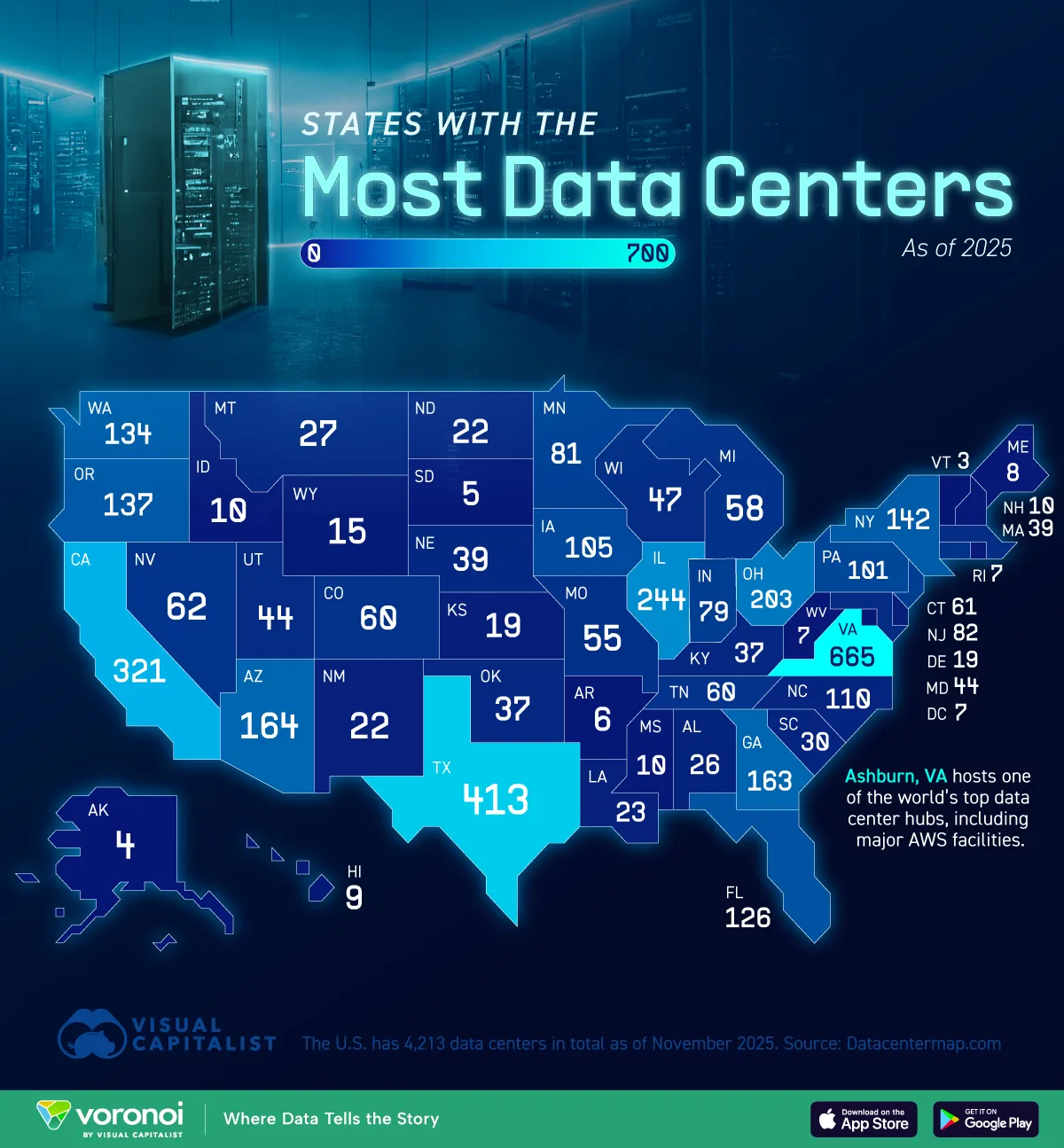
As the digital economy accelerates—driven by the explosive growth of artificial intelligence, cloud computing, and hyperscale demands—the physical infrastructure supporting the internet has never been more critical. While data centers are ubiquitous, their distribution across the United States is far from even.
According to 2025 data mapped by Visual Capitalist, a select few states have emerged as the undisputed powerhouses of America’s digital infrastructure, creating a hierarchy of “digital capitals” where the vast majority of the nation’s internet traffic flows.
1. Virginia: The World’s Digital Capital
Number of Data Centers: 665
Virginia continues to hold its title as the unrivaled king of the data center world. With 665 facilities, it hosts the largest concentration of digital infrastructure on the planet—far outpacing any other state.
The dominance of Northern Virginia (often referred to as “Data Center Alley”) is not an accident. It is the result of powerful network effects, including:
-
Hyperscale Clusters: Massive deployments from every major player, including Amazon Web Services (AWS), Microsoft Azure, Google Cloud, Meta, and Oracle.
-
Infrastructure: An incredibly dense fiber network combined with reliable power infrastructure.
-
Policy: A business-friendly environment with fast permitting processes that make it nearly impossible for other regions to replicate its scale.
2. Texas: The Rapidly Growing Contender
Number of Data Centers: 413
Ranking second is Texas, which has cemented itself as a major alternative to the East and West Coast hubs. With 413 data centers, the Lone Star State appeals to developers for three primary reasons:
-
Abundant Land: Unlike the space-constrained coasts, Texas offers vast tracts of land suitable for massive facilities.
-
Energy Costs: Competitive electricity rates are a major draw for power-hungry AI processors.
-
Speed: Flexible grid management and faster construction timelines allow hyperscalers to deploy capacity quickly.
Major cloud activity is concentrated in the “Texas Triangle” of Dallas, Austin, and San Antonio.
3. California: The Legacy Tech Hub
Number of Data Centers: 321
Despite facing challenges, California retains the third spot with 321 facilities. Its position is buoyed by the deep-rooted tech ecosystems of Silicon Valley and immense demand from local enterprises.
However, the state’s growth narrative is different from Texas or Virginia. While it remains a critical node for mission-critical data, power constraints and regulatory hurdles have limited the development of new mega-projects compared to other regions.
The Rising Midwest and Pacific Northwest
Beyond the “Big Three,” strategic clusters are forming in specific regions to serve secondary markets and capitalize on local geographic advantages.
-
Illinois (244 facilities): anchored by Chicago, serves as the central interconnection point for the interior United States.
-
Ohio (203 facilities): has emerged as a major cloud region, offering a “Goldilocks” solution of available land and stable power grids.
-
Oregon (137) & Washington (134): constitute a strong Pacific Northwest hub. These states are favored for their cooler climates—which significantly reduce cooling costs—and their access to abundant renewable energy (hydropower).
Full Ranking: Top U.S. States for Data Centers (2025)
| Rank | State | Data Centers |
| 1 | Virginia | 665 |
| 2 | Texas | 413 |
| 3 | California | 321 |
| 4 | Illinois | 244 |
| 5 | Ohio | 203 |
| 6 | Arizona | 164 |
| 7 | Georgia | 163 |
| 8 | New York | 142 |
| 9 | Oregon | 137 |
| 10 | Washington | 134 |
| 11 | Florida | 126 |
| 12 | North Carolina | 110 |
| 13 | Iowa | 105 |
| 14 | Pennsylvania | 101 |
Conclusion
The 2025 map of U.S. data centers reveals a strategic consolidation of power. While Virginia remains the global epicenter, the rapid ascent of Texas and the calculated growth of Ohio and the Pacific Northwest highlight a shift toward markets that can offer cheap power, land, and sustainability. As AI models grow larger and energy demands skyrocket, these geographic advantages will likely dictate the next decade of digital infrastructure investment.