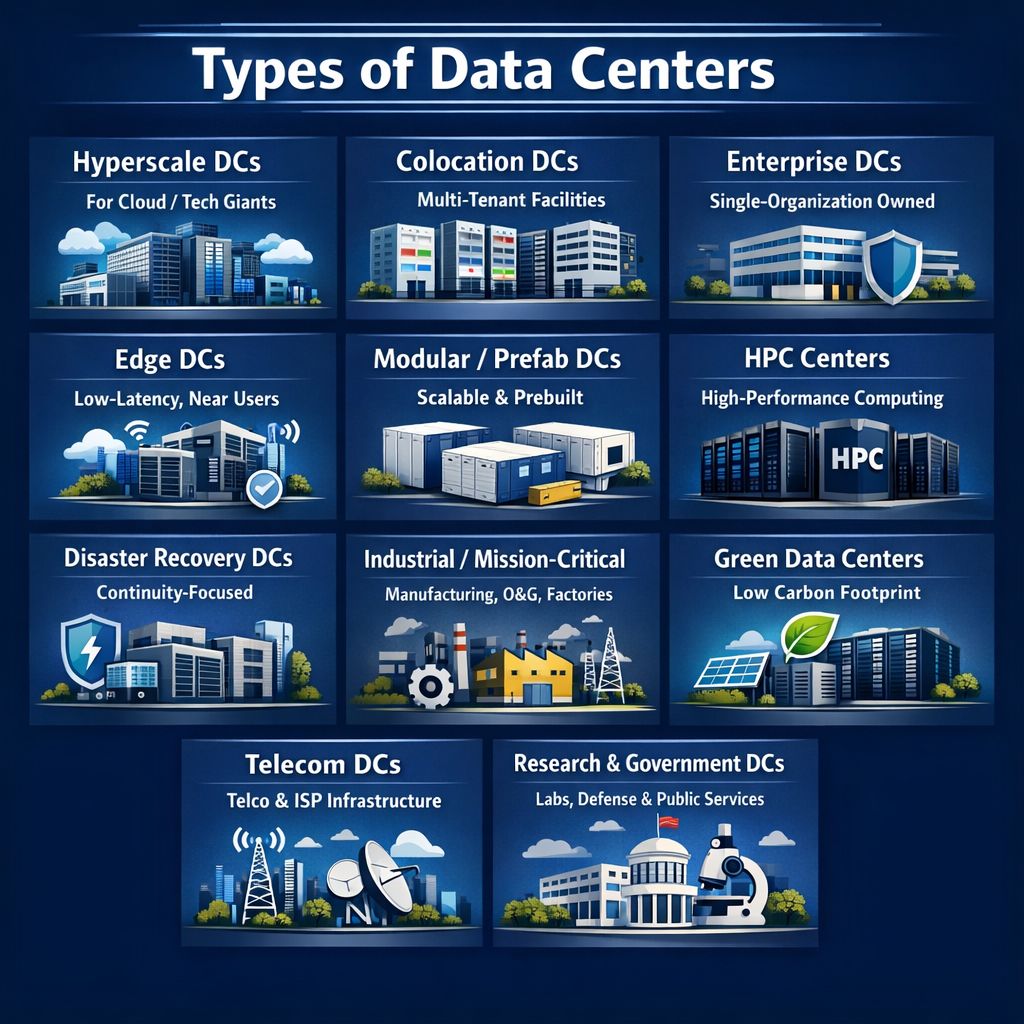
Data centers are designed based on scale, ownership model, workload type, latency needs, and resiliency requirements. Below are the major categories of DC projects used globally.
1️⃣ Hyperscale Data Centers
Purpose: Support massive cloud and internet-scale workloads
-
Built and operated by large cloud/tech companies
-
Extremely large capacity (often >50 MW)
-
Highly standardized and automated
-
Optimized for cost per MW and energy efficiency
Typical use cases: Cloud computing, AI training, global platforms
2️⃣ Colocation Data Centers
Purpose: Shared infrastructure for multiple tenants
-
Third-party owned and operated
-
Customers lease racks, cages, or private suites
-
High redundancy and carrier neutrality
-
Flexible scaling without capital expenditure
Typical use cases: Enterprises, SaaS providers, startups
3️⃣ Enterprise Data Centers
Purpose: Dedicated IT infrastructure for a single organization
-
Owned and operated by one company
-
Customized to internal security and compliance needs
-
Often located on corporate campuses
Typical use cases: Banks, large enterprises, regulated industries
4️⃣ Edge Data Centers
Purpose: Low-latency computing close to end users
-
Smaller facilities distributed geographically
-
Reduce data transmission delay
-
Support real-time applications
Typical use cases: 5G, IoT, autonomous systems, content delivery
5️⃣ Modular / Prefabricated Data Centers
Purpose: Rapid deployment and scalable capacity
-
Pre-engineered modules (IT, power, cooling)
-
Factory-built and site-assembled
-
Shorter construction timelines
Typical use cases: Fast-growing demand, remote locations
6️⃣ High-Performance Computing (HPC) Centers
Purpose: Compute-intensive scientific and engineering workloads
-
Extremely high power density
-
Advanced cooling (liquid, direct-to-chip)
-
Optimized for parallel processing
Typical use cases: AI/ML, weather modeling, genomics, simulations
7️⃣ Disaster Recovery / Backup Data Centers
Purpose: Business continuity and resilience
-
Secondary or tertiary sites
-
Data replication and failover capability
-
Often geographically separated from primary DCs
Typical use cases: Financial services, critical enterprises
8️⃣ Industrial / Mission-Critical Facilities
Purpose: Support operational technology (OT) systems
-
Integrated with industrial processes
-
Designed for harsh environments
-
High availability and safety compliance
Typical use cases: Manufacturing plants, oil & gas, utilities
9️⃣ Green / Sustainable Data Centers
Purpose: Minimize environmental impact
-
High energy efficiency (low PUE)
-
Renewable energy integration
-
Advanced cooling and heat reuse
Typical use cases: ESG-focused operators, future-ready DCs
🔟 Telecom / Network Data Centers
Purpose: Support telecom and network infrastructure
-
Host core network, switching, and routing equipment
-
High interconnection density
-
Often integrated with cable landing stations
Typical use cases: Telcos, ISPs, mobile network operators
1️⃣1️⃣ Research & Government Data Centers
Purpose: Specialized public-sector and scientific workloads
-
High security and compliance requirements
-
Custom architectures for research data
-
Long-term operational stability
Typical use cases: Defense, space research, national labs, e-governance