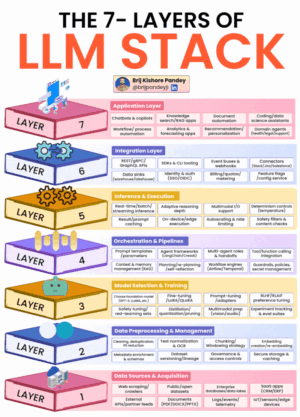
The architecture of sophisticated Generative AI systems, particularly those powered by Large Language Models (LLMs), extends far beyond the core model itself. While early discussions focused narrowly on parameters and training data, the reality of deploying AI at an enterprise scale—where regulatory compliance, safety, and business integration are paramount—necessitates a comprehensive framework. The “7 Layers of the LLM Stack” provides this blueprint, shifting the focus from academic technology to operational architecture. This layered structure, often drawing parallels to the OSI model of networking, decomposes the complex lifecycle of an LLM solution into distinct, interconnected stages. Its core objective is to map out the journey from raw input to final user experience, ensuring that crucial elements like data quality, governance, security, and scalability are addressed systematically at every step. Understanding this stack is vital for builders, leaders, and regulators seeking to transform raw capability into trustworthy, high-performing, and compliant AI applications. The layers are not merely sequential; they represent specialized domains of engineering and risk management that together form a complete, production-ready AI solution.
The foundation of any LLM application rests squarely on the quality and provenance of its raw input: the data. This Layer 1 encompasses the vast, often chaotic, collection of information sources that feed the system. These sources are highly diverse, ranging from public web scrapes and licensed datasets to proprietary enterprise logs, customer documents, APIs, and real-time streams from IoT sensors. This stage is characterized by maximal entropy, representing unstructured chaos and noise before any intelligence has acted upon it. The primary challenge here is not volume, but quality, provenance, and representativeness. If the data acquired is biased, low-quality, or ethically compromised, those structural inequities will inevitably propagate through the entire stack, undermining the model’s fairness and reliability. Therefore, Layer 1 demands rigorous practices, including responsible acquisition via web scrapers and ingestion tools, coupled with initial metadata tagging, lineage tracking, and ethical review at the point of capture. Without high-quality data input, all subsequent efforts to train or fine-tune the model are inherently compromised, making robust data pipelines the indispensable starting point for enterprise AI initiatives.
Raw data is rarely in a state usable by a large language model; therefore, Layer 2 is dedicated to transforming unstructured chaos into structured, manageable knowledge. This stage is often referred to as Data Operations, and it is a critical step in reducing the high entropy of the raw inputs. Key processes here include extensive data cleaning, normalization, and deduplication to remove noise and fix broken text. Crucially, this layer handles the transformation of text into a format accessible by the LLM during query time, involving the chunking of large documents into smaller, meaningful segments and generating high-dimensional embeddings. These embeddings are then securely organized and stored in specialized systems, such as vector databases, which enable efficient similarity searches necessary for Retrieval-Augmented Generation (RAG). Furthermore, Layer 2 is where comprehensive data governance, privacy protection (aligning with regulations like CCPA or HIPAA equivalents), and secure access controls are strictly enforced. The success of RAG—a technique fundamental to connecting LLMs to proprietary, real-time enterprise knowledge—is directly dependent on the efficiency and accuracy of the preprocessing and indexing decisions made at this layer.
Layer 3 is where the AI’s cognitive core, or “brain,” is formed and refined. This involves the selection and preparation of the Large Language Model itself, whether it is a state-of-the-art proprietary model accessed via API, or an open-source model deployed and managed on internal infrastructure. This layer determines the raw capability, reasoning power, and cost profile of the resulting application. Core activities include fine-tuning the chosen foundation model using techniques such as LoRA or QLoRA with domain-specific data to specialize its intelligence for enterprise tasks. Moreover, this stage is essential for alignment and safety tuning, often involving Reinforcement Learning from Human Feedback (RLHF) or AI Feedback (RLAIF) to ensure the model’s outputs adhere to ethical guidelines and organizational rules, mitigating risks like harmful or discriminatory content generation. For many companies, the strategic decision between leveraging a powerful, generalized foundational model or investing in the specialization of a smaller, custom model occurs entirely within this layer, balancing performance requirements with budget and control considerations. The technical complexity here involves managing compute resources like GPUs and TPUs, along with deployment pipelines and various model architectures, ensuring that the raw capability is transformed into fit-for-purpose intelligence ready for application.
The Orchestration layer moves the LLM beyond simple prompt-response interactions, enabling it to act as an intelligent agent capable of multi-step, goal-oriented behavior. Layer 4 utilizes agent frameworks, such as LangChain or CrewAI, to coordinate the model’s actions, memory management, and use of external tools. Essential functions housed here include explicit planning mechanisms, which allow agents to break down complex objectives into manageable steps (e.g., Chain-of-Thought reasoning), and memory modules (both short-term context windows and persistent long-term memory via vector stores). Crucially, orchestration is where Retrieval-Augmented Generation (RAG) is actively executed, dynamically bridging the model’s internal knowledge with external data sources in real time. This layer is also responsible for implementing guardrails and prompt optimization strategies, ensuring that the AI can interact safely and reliably with APIs, databases, and other components in a repeatable, scalable workflow. Orchestration represents the fundamental shift from simple task automation to the deployment of continuous, autonomous digital agents, accelerating the system’s overall functionality and complexity while managing multi-agent collaboration and task delegation.
Often referred to as the runtime engine, Layer 5 is where the model’s intelligence is executed, delivering real-time, batch, or streaming predictions to the user or downstream systems. This layer is focused intently on performance, speed, and reliability—the “rubber meets the road” phase of the stack. Key technical components include high-efficiency inference engines, which manage the computational resources and optimize latency, essential for real-time user experiences, particularly in contexts like real-time diagnostics where milliseconds matter. To ensure efficiency and resilience, techniques such as result caching, rate limiting, and autoscaling are critical for managing high throughput under variable demand. Furthermore, the layer manages crucial controls that determine the predictability and safety of the output, such as setting determinism controls (like temperature and top-p sampling) and enforcing final safety filters against adversarial inputs. Effective model deployment pipelines, including pruning and quantization to reduce model size and increase speed, are managed here, ensuring the system remains responsive and cost-effective as it operates in a production environment, balancing performance with safety requirements.
Layer 6 addresses how the LLM system connects to the broader enterprise ecosystem and, critically, how it is secured and governed across all functional layers. The Integration component ensures that the AI’s capabilities are made useful by connecting them to existing business software through standardized interfaces like APIs, SDKs, event buses, and custom connectors, facilitating the flow of data and commands across the enterprise. Operationally, this layer provides necessary control functions like identity management (SSO/OIDC) for enforcing accountability, feature flagging, billing, and resource quotas. Concurrently, the Security and Compliance component embeds defense-in-depth protocols. While often conceptualized as a vertical layer influencing all others, it includes centralized policy enforcement, threat modeling, and auditing to adhere to mandated standards such as HIPAA, GDPR equivalents, or NIST guidelines for trustworthy AI. Robust governance and security ensures that the deployment does not expose new vulnerabilities, misuse sensitive data, or violate regulatory requirements, centralizing the guardrails necessary for enterprise adoption and promoting accountability in regulated industries.
Layer 7 is the visible frontier of the LLM stack—the direct interface where human users engage with the AI system. This layer translates the complex machinery of the underlying layers into tangible business value and user experience. It encompasses a wide array of final products, including consumer chatbots, enterprise copilots, RAG-powered knowledge applications, advanced document automation tools, coding assistants, and domain-specific agents tailored for verticals like legal or healthcare. Applications bring immense productivity gains, often estimated to automate or augment significant portions of work activities across industries. However, while this layer delivers value, it also introduces unique human-centric risks, such as user over-reliance, managing hallucinations, and the potential for application misuse. Consequently, the Application Layer requires a strong emphasis on Human Experience (HX), ensuring that the design augments user agency and trust rather than eroding it, and demands robust user education and organizational change management to realize the full benefits safely. This layer, also known as the Agent Ecosystem, is where AI agents interface with the real world.
The 7-layer LLM stack serves as far more than just a technical diagram; it functions as a comprehensive governance framework essential for navigating the complexities of modern AI deployment. By segmenting the system into distinct areas—from the raw data at Layer 1 up to the final user interface at Layer 7—organizations can pinpoint specific risks and allocate appropriate resources for mitigation. This architecture directly addresses the triad of contemporary AI challenges: technical performance, regulatory adherence, and governance maturity. It mandates embedding security, ethics, and compliance checks at every level—not just as an afterthought in the application front-end. For enterprises, mastering this layered approach is the key to achieving scalable performance while maintaining NIST-compliant security and driving accelerated business innovation. As AI continues its rapid evolution, particularly towards agentic and autonomous systems, the stack remains a crucial living document, clarifying investment decisions, future-proofing architectures, and ensuring that the promise of intelligent systems is delivered safely, reliably, and ethically by providing a clear mental map for builders and leaders.