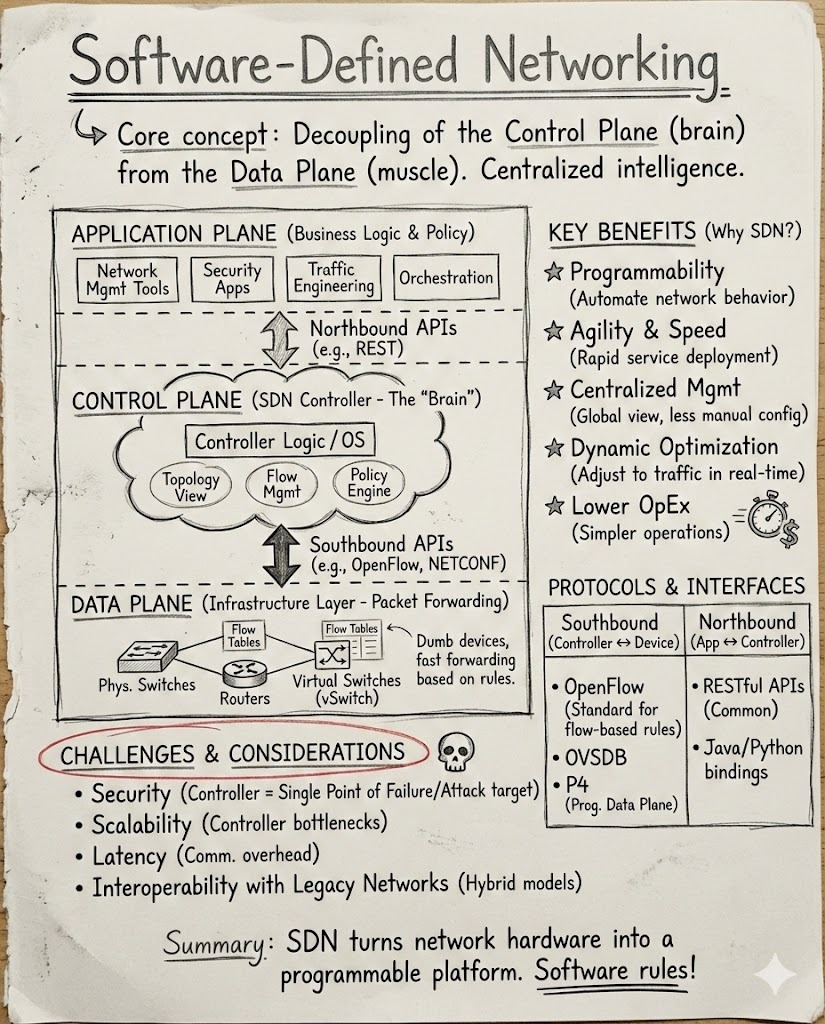
Software-Defined Networking has become one of the most influential innovations in enterprise IT and cloud infrastructure over the last decade. As organizations demand faster deployment, better security, and more flexible network management, traditional hardware-centric networking models are increasingly unable to keep up.
This guide explores what Software-Defined Networking is, how it works, why it matters, and how businesses are using it today to build scalable, secure, and future-ready networks.
What Is Software-Defined Networking?
Software-Defined Networking, commonly abbreviated as SDN, is a network architecture approach that separates the network control plane from the data plane.
In traditional networks:
-
Network devices such as routers and switches both decide where traffic goes and forward the traffic.
-
Configuration is performed device by device.
-
Changes are slow, error-prone, and difficult to scale.
In Software-Defined Networking:
-
The control logic is centralized in a software-based controller.
-
Network devices focus only on forwarding packets.
-
Administrators manage the network through software instead of manual hardware configuration.
This separation allows organizations to control the entire network dynamically using software APIs and automation tools.
How Software-Defined Networking Works
At its core, SDN is built on three main layers:
1. Application Layer
This layer includes network applications such as:
-
Traffic analytics tools
-
Security platforms
-
Load balancing systems
-
Network monitoring software
These applications communicate network requirements to the controller.
2. Control Layer
The SDN controller acts as the brain of the network. It:
-
Maintains a global view of network traffic
-
Makes routing decisions
-
Applies security policies
-
Communicates with applications and network devices
Popular SDN controllers include OpenDaylight, ONOS, and vendor-specific platforms.
3. Infrastructure Layer
This consists of the physical and virtual network devices that forward traffic, such as:
-
Switches
-
Routers
-
Virtual network appliances
These devices receive instructions from the controller using standardized protocols like OpenFlow or proprietary alternatives.
Key Benefits of Software-Defined Networking
Organizations adopt Software-Defined Networking because it delivers measurable advantages over traditional networking models.
Centralized Network Management
Administrators control the entire network from a single interface, eliminating the need to configure devices individually.
Faster Network Provisioning
New services and configurations can be deployed in minutes instead of days or weeks.
Improved Scalability
SDN allows networks to grow easily across data centers, cloud platforms, and branch offices without complex reconfiguration.
Enhanced Security
Security policies can be enforced consistently across all devices, enabling:
-
Network segmentation
-
Real-time threat response
-
Automated isolation of compromised systems
Lower Operational Costs
Automation reduces manual labor, while commodity hardware can replace expensive proprietary networking equipment.
Greater Network Visibility
Administrators gain full insight into traffic patterns, performance bottlenecks, and security risks.
Common Use Cases for Software-Defined Networking
SDN is now widely used across multiple industries and environments.
Data Centers
Modern data centers rely on SDN to manage:
-
Virtual machines
-
Containers
-
Storage networks
-
High-volume traffic flows
Cloud Computing
Cloud providers use Software-Defined Networking to deliver:
-
Multi-tenant isolation
-
On-demand network provisioning
-
Automated scaling
Enterprise Networks
Large organizations use SDN to simplify:
-
Branch connectivity
-
Remote workforce access
-
Network segmentation
Telecommunications
Service providers deploy SDN to:
-
Optimize bandwidth usage
-
Reduce service deployment time
-
Improve customer experience
Network Security
SDN enables dynamic firewall rules, zero-trust architectures, and real-time threat containment.
Software-Defined Networking vs Traditional Networking
The differences between SDN and legacy networking are substantial.
Traditional networking characteristics:
-
Hardware-driven control logic
-
Manual configuration
-
Limited automation
-
Complex troubleshooting
-
High operational overhead
Software-Defined Networking characteristics:
-
Software-driven centralized control
-
API-based automation
-
Programmable network behavior
-
Faster troubleshooting and diagnostics
-
Reduced complexity
These improvements make SDN particularly attractive for organizations undergoing digital transformation.
Challenges and Limitations of Software-Defined Networking
Despite its advantages, SDN is not without challenges.
Initial Implementation Complexity
Migrating from legacy networks requires:
-
Careful planning
-
Staff training
-
Compatibility testing
Controller Security
Because the controller manages the entire network, it becomes a high-value target for attackers if not properly secured.
Vendor Lock-In
Some SDN solutions use proprietary technologies that limit interoperability.
Performance Concerns
Poorly designed SDN architectures may introduce latency or bottlenecks at the controller level.
Skill Requirements
Network teams must learn software development concepts, automation frameworks, and new tools.
These challenges can be mitigated with proper design, vendor selection, and security practices.
Leading Software-Defined Networking Solutions
The SDN ecosystem includes both open-source and commercial platforms.
Popular solutions include:
-
VMware NSX for enterprise virtualization environments
-
Cisco ACI for data center automation
-
OpenDaylight for open-source SDN deployments
-
Juniper Contrail for cloud-native networking
-
ONOS for carrier-grade networks
Each solution offers different levels of automation, integration, and scalability depending on organizational needs.
The Future of Software-Defined Networking
Software-Defined Networking continues to evolve as new technologies emerge.
Trends shaping the future include:
-
Integration with artificial intelligence for predictive optimization
-
Deeper cloud-native networking support
-
Edge computing connectivity
-
5G and network slicing
-
Zero-trust security architectures
As infrastructure becomes more distributed and dynamic, SDN will remain a foundational technology for modern networking strategies.
Conclusion
Software-Defined Networking has transformed how organizations design, manage, and secure their networks. By separating control from hardware and enabling centralized, programmable management, SDN delivers unmatched flexibility, scalability, and efficiency.
While implementation requires careful planning and skilled personnel, the long-term benefits far outweigh the initial complexity. For businesses adopting cloud services, expanding globally, or modernizing legacy infrastructure, Software-Defined Networking is no longer optional. It is a strategic necessity for building resilient and future-proof networks.
Frequently Asked Questions
What is Software-Defined Networking in simple terms?
Software-Defined Networking is a method of managing networks using software instead of configuring each device manually. It centralizes control, allowing administrators to automate changes, improve security, and manage large networks more efficiently.
How does Software-Defined Networking improve network security?
SDN improves security by enabling centralized policy enforcement, real-time monitoring, automated threat response, and network segmentation. This allows organizations to quickly isolate compromised systems and apply consistent security rules across the entire network.
Is Software-Defined Networking suitable for small businesses?
Yes, Software-Defined Networking can benefit small businesses, especially those using cloud services or managing multiple locations. Many vendors offer scalable solutions designed for smaller environments with simplified management tools.
What is the difference between SDN and network virtualization?
Software-Defined Networking focuses on separating network control from hardware and enabling centralized management. Network virtualization creates multiple virtual networks on top of physical infrastructure. The two technologies often work together, but they serve different purposes within modern network architecture.
If you are considering upgrading your infrastructure, Software-Defined Networking provides the flexibility and control needed to support modern applications, growing workloads, and evolving security requirements.