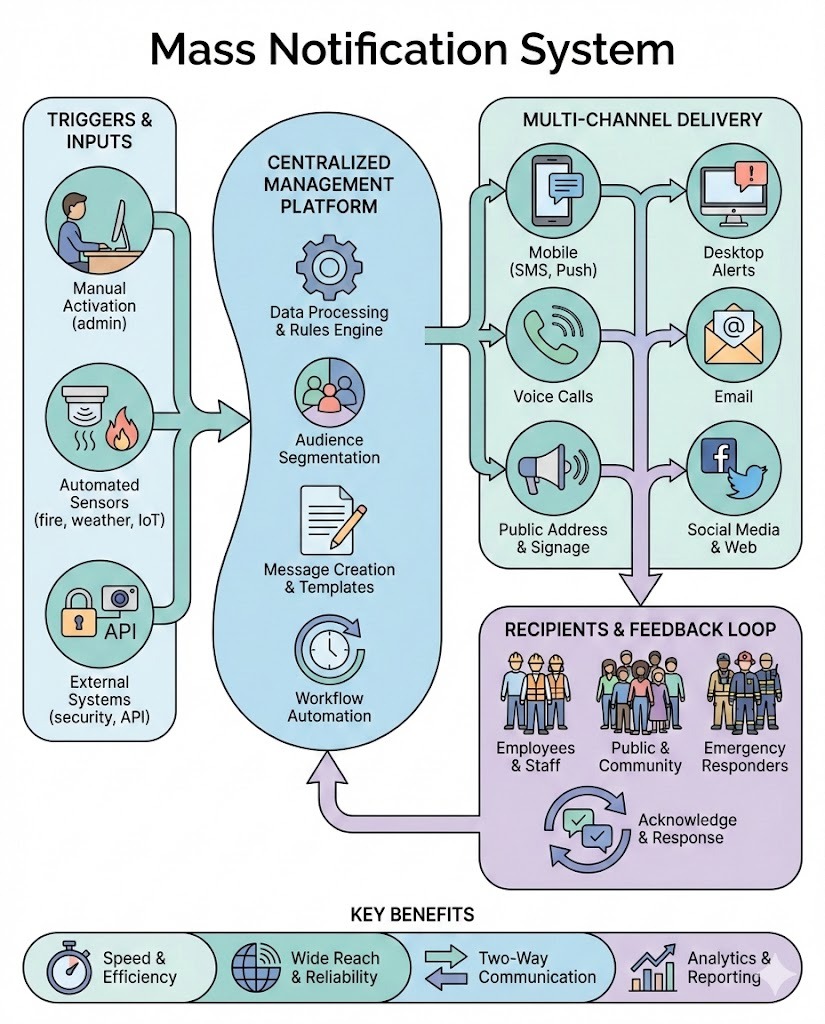
A Mass Notification System is a critical communication platform designed to deliver urgent messages to large groups of people in real time. Organizations across healthcare, education, manufacturing, government, and enterprise environments rely on these systems to protect lives, maintain operational continuity, and ensure compliance with safety standards.
As workplaces become more distributed and risk scenarios more complex, the ability to communicate clearly and instantly is no longer optional. It is a foundational requirement of responsible operations.
This guide explains what a Mass Notification System is, how it works, why it matters, and what to look for when evaluating solutions.
What Is a Mass Notification System?
A Mass Notification System is software and supporting infrastructure that enables organizations to send alerts and instructions to many recipients simultaneously across multiple channels.
These channels commonly include:
-
SMS text messages
-
Voice calls
-
Email
-
Mobile push notifications
-
Desktop alerts
-
Digital signage
-
Public address systems
The goal is simple but powerful. Deliver the right message to the right people at the right time, especially during emergencies or critical events.
Unlike traditional communication tools, mass notification platforms are built for speed, redundancy, and reliability. They are designed to function even when parts of the network are congested or unavailable.
Why Mass Notification Systems Are Essential
Emergencies rarely provide advance warning. Fires, severe weather, security incidents, system outages, and health crises require immediate and coordinated action.
A modern Mass Notification System helps organizations:
-
Reduce response time during emergencies
-
Provide clear instructions to employees, students, or the public
-
Minimize confusion and misinformation
-
Coordinate response teams efficiently
-
Meet regulatory and compliance requirements
-
Protect brand reputation and organizational trust
In many industries, the ability to notify people quickly is directly tied to legal and safety obligations. Failure to communicate effectively can result in serious consequences including injuries, operational downtime, and regulatory penalties.
How a Mass Notification System Works
While implementations vary, most platforms follow a similar process.
First, administrators create predefined message templates for common scenarios such as evacuation, lockdown, system outages, or weather alerts. These templates reduce decision time during stressful situations.
Second, recipient groups are organized based on location, department, role, or risk profile. This allows targeted messaging rather than sending the same alert to everyone.
Third, when an incident occurs, the sender selects the appropriate message and recipient group. The system then distributes the alert across multiple channels simultaneously.
Finally, many platforms collect delivery and response data. This includes confirmation of receipt, acknowledgment, or user replies, allowing teams to track who has received the message and who may still need assistance.
Key Features to Look For
Not all solutions offer the same capabilities. When evaluating a Mass Notification System, consider the following essential features.
Multi-channel delivery
The system should support SMS, voice, email, mobile apps, and desktop alerts. Redundant channels increase the chance that the message is received quickly.
Real-time delivery and scalability
Speed is critical. The platform must be capable of sending thousands or millions of messages within seconds without delays.
Targeted messaging
Look for tools that support location-based and role-based targeting to avoid unnecessary alerts and reduce confusion.
Automation and triggers
Advanced systems integrate with sensors, security platforms, or IT monitoring tools to automatically send alerts when predefined conditions occur.
Reporting and analytics
Delivery confirmation, read receipts, and response tracking help administrators measure effectiveness and identify gaps.
Ease of use
During emergencies, complexity becomes a liability. The interface should be intuitive and accessible even for non-technical users.
Compliance and security
Data encryption, audit logs, and compliance with industry standards are essential for protecting sensitive contact information.
Common Use Cases
A Mass Notification System supports far more than disaster alerts. Organizations use it for a wide range of operational and safety communications.
Typical use cases include:
-
Emergency evacuations and lockdowns
-
Severe weather warnings
-
Cybersecurity incident notifications
-
Facility closures or access restrictions
-
IT system outages
-
Public health advisories
-
Workforce scheduling changes
-
Business continuity updates
This flexibility makes the system valuable not only during crises but also for everyday operational coordination.
Benefits for Organizations
Implementing a Mass Notification System delivers both immediate and long-term value.
Operational resilience improves because teams receive timely instructions and can act quickly. Employee confidence increases when people know their safety is taken seriously. Leadership gains better situational awareness through response tracking and analytics.
From a financial perspective, faster communication reduces downtime, limits liability exposure, and can lower insurance costs in some industries.
The return on investment is often realized during the first major incident when rapid communication prevents escalation.
Challenges and Considerations
While powerful, these systems require thoughtful implementation.
Organizations must maintain accurate contact databases, conduct regular testing, and train staff to use the platform effectively. Without preparation, even the best technology can fail to deliver its full value.
Another consideration is message fatigue. Overusing alerts for non-critical matters can lead to recipients ignoring messages. Clear policies on when and how to send notifications help preserve trust and attention.
Finally, integration with existing systems such as HR databases or security platforms should be evaluated to reduce manual work and improve reliability.
Choosing the Right Mass Notification System
There is no one-size-fits-all solution. The right platform depends on organizational size, industry, geographic distribution, and risk profile.
Before selecting a provider, consider:
-
Number of users and expected message volume
-
Types of incidents you need to cover
-
Required communication channels
-
Regulatory environment
-
Budget and total cost of ownership
-
Quality of customer support and onboarding
Requesting demonstrations and running pilot programs can reveal usability and performance issues that are not obvious in marketing materials.
Conclusion
A Mass Notification System is no longer a luxury reserved for large enterprises or government agencies. It is a fundamental component of modern safety, security, and operational strategy.
By enabling rapid, reliable, and targeted communication, these platforms help organizations protect people, maintain continuity, and respond effectively to both emergencies and everyday disruptions.
Investing in the right solution, combined with proper training and planning, creates a communication foundation that supports resilience in an unpredictable world.
Frequently Asked Questions
What is a mass notification system used for?
A mass notification system is used to send urgent or important messages to large groups of people at the same time. Common uses include emergency alerts, safety instructions, system outage notifications, and operational updates.
How does a mass notification system improve emergency response?
It improves emergency response by delivering clear instructions instantly across multiple channels. This reduces confusion, speeds up decision-making, and helps people take appropriate action faster.
Are mass notification systems only for large organizations?
No. While large enterprises benefit greatly, small and medium-sized organizations also use mass notification systems to protect employees, manage incidents, and maintain business continuity.
What features should a reliable mass notification system include?
A reliable system should support multi-channel delivery, real-time messaging, targeted alerts, automation, reporting, strong security controls, and an easy-to-use interface.