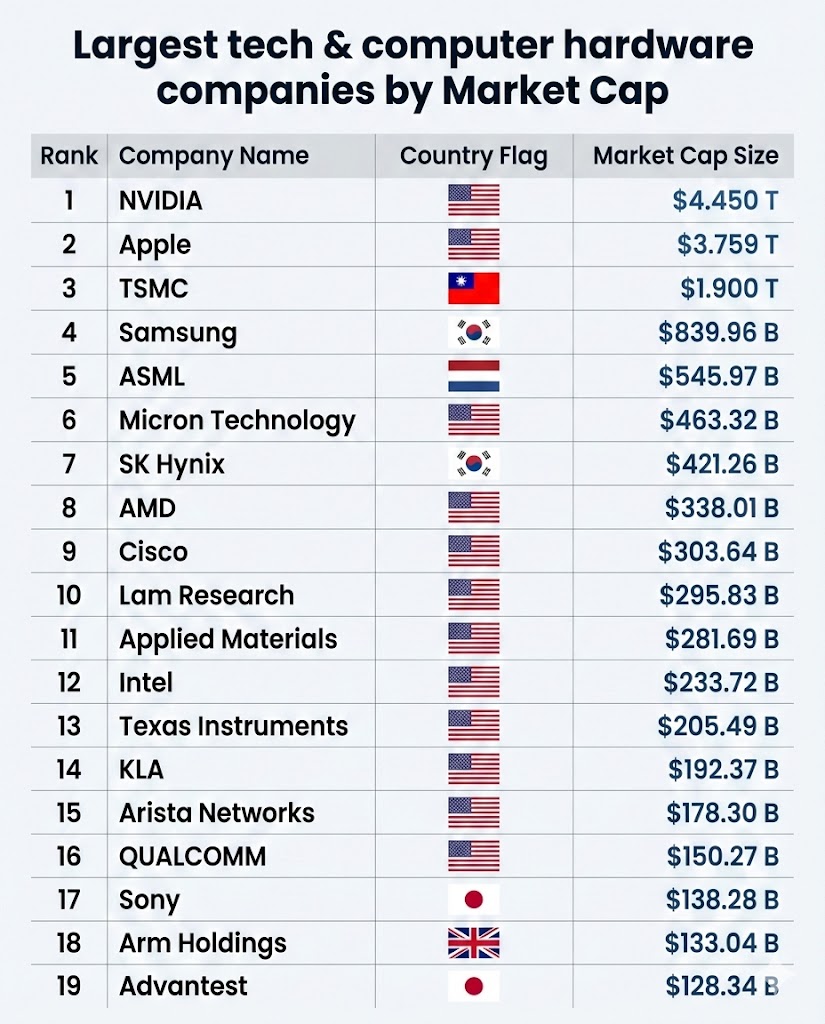
The landscape of technology and computer hardware is evolving at an unprecedented pace, with innovation driving both market value and global influence. By 2026, the largest tech & computer hardware companies by market cap are expected to reflect not only financial strength but also leadership in artificial intelligence, semiconductor advancements, cloud infrastructure, and next-generation computing. These companies are no longer just manufacturers—they are ecosystem builders, shaping how we work, communicate, and live. As we look ahead, market capitalization becomes a powerful indicator of technological dominance, investor confidence, and long-term strategic vision.
Market cap, or market capitalization, is calculated by multiplying a company’s current share price by its total number of outstanding shares. It offers a snapshot of a company’s perceived value in the stock market. For tech and hardware giants, this metric is especially telling—reflecting not just current revenue, but future growth potential in areas like AI chips, quantum computing, and edge devices. By 2026, several key players are poised to dominate the rankings, driven by sustained R&D investment, global supply chain resilience, and expansion into emerging markets.
This article explores the projected leaders in the tech and computer hardware sector by 2026, analyzing their market positions, innovation strategies, and the forces shaping their growth. We’ll examine how companies like Apple, NVIDIA, Microsoft, and others are leveraging cutting-edge technologies to maintain or climb the market cap ladder. Whether you’re an investor, industry analyst, or tech enthusiast, understanding these trends is essential for grasping the future of digital infrastructure.
What Drives Market Cap in Tech & Hardware?
Market capitalization in the technology sector is influenced by a combination of financial performance, innovation output, and strategic positioning. Unlike traditional industries, tech companies often derive significant value from intangible assets—such as intellectual property, software ecosystems, and brand equity. For hardware-focused firms, physical products like processors, servers, and consumer devices remain central, but integration with software and services is now critical.
One of the primary drivers of market cap growth is artificial intelligence (AI). Companies investing heavily in AI chips, machine learning platforms, and AI-powered hardware are seeing accelerated valuation increases. NVIDIA, for example, has transformed from a graphics card manufacturer into a leader in AI computing, with its GPUs powering data centers worldwide. Similarly, Apple’s integration of custom silicon—like the M-series chips—has enhanced performance while reducing reliance on third-party suppliers.
Other key factors include:
- Cloud and data center expansion: As businesses migrate to the cloud, demand for servers, storage, and networking hardware surges.
- Semiconductor independence: Geopolitical tensions have pushed nations and companies to invest in domestic chip production, boosting firms with advanced fabrication capabilities.
- Consumer electronics innovation: Smartphones, wearables, and AR/VR devices continue to drive revenue for hardware leaders.
- Sustainability and ESG compliance: Investors increasingly favor companies with strong environmental, social, and governance practices.
By 2026, these trends will likely intensify, with market cap reflecting not just quarterly earnings, but long-term technological leadership and global influence.
Top Contenders: Projected Leaders in 2026
Apple Inc.
Apple remains a dominant force in both consumer electronics and computer hardware. With a market cap already exceeding $3 trillion in 2023, Apple is well-positioned to maintain its leadership through 2026. The company’s vertical integration—designing its own chips, operating systems, and retail channels—gives it a unique competitive edge.
The M-series processors have revolutionized Mac performance, enabling Apple to compete directly with traditional PC manufacturers. As the company expands into augmented reality (AR) with devices like the Vision Pro, its hardware ecosystem is becoming more immersive and interconnected. Additionally, Apple’s services segment—including iCloud, Apple Music, and the App Store—provides a steady revenue stream that supports hardware innovation.
Looking ahead, Apple’s focus on health technology, autonomous systems, and AI integration will likely drive further growth. Analysts project that Apple could reach a $4 trillion market cap by 2026, solidifying its place among the largest tech & computer hardware companies by market cap 2026.
NVIDIA Corporation
NVIDIA has emerged as the undisputed leader in AI hardware, with its GPUs powering everything from gaming rigs to supercomputers. The company’s market cap surged past $2 trillion in 2024, driven by explosive demand for AI accelerators. By 2026, NVIDIA is expected to remain at the forefront of the AI revolution.
Its CUDA platform and software stack have created a high barrier to entry, making it difficult for competitors to replicate its ecosystem. NVIDIA’s data center revenue now accounts for the majority of its income, fueled by partnerships with cloud providers like AWS, Google Cloud, and Microsoft Azure.
Beyond AI, NVIDIA is investing in robotics, autonomous vehicles, and digital twins—technologies that will shape the next decade of computing. With ongoing advancements in chip architecture and energy efficiency, NVIDIA is poised to maintain strong investor confidence and market valuation growth.
Microsoft Corporation
Microsoft’s transformation from a software-centric company to a hybrid tech giant has been remarkable. While best known for Windows and Office, Microsoft has become a major player in computer hardware through its Surface lineup and Azure cloud infrastructure.
Azure’s growth has been a key driver of Microsoft’s market cap, with demand for cloud-based computing and AI services skyrocketing. The company’s acquisition of OpenAI stakes and integration of AI into its productivity tools (like Copilot) have further strengthened its position.
By 2026, Microsoft is expected to continue expanding its hardware footprint, particularly in enterprise solutions and AI-powered devices. Its strategic focus on hybrid work environments and cybersecurity will also contribute to sustained growth. With a market cap likely to exceed $4 trillion, Microsoft will remain one of the largest tech & computer hardware companies by market cap 2026.
Taiwan Semiconductor Manufacturing Company (TSMC)
TSMC is the world’s largest contract chipmaker, producing semiconductors for Apple, NVIDIA, AMD, and Qualcomm. Despite being less visible to consumers, TSMC’s role in the global tech supply chain is indispensable. Its advanced fabrication nodes (3nm and below) are critical for next-generation processors.
As geopolitical tensions push the U.S. and Europe to onshore chip production, TSMC is expanding its global footprint with new fabs in Arizona and Japan. These investments, while capital-intensive, are expected to pay off in the long term by securing long-term contracts and reducing supply chain risks.
By 2026, TSMC’s market cap could surpass $800 billion, driven by sustained demand for high-performance chips. Its technological leadership in semiconductor manufacturing ensures it will remain a cornerstone of the tech ecosystem.
Advanced Micro Devices (AMD)
AMD has steadily gained market share in both CPUs and GPUs, challenging Intel and NVIDIA in key segments. Its EPYC server processors and Ryzen desktop chips have been widely adopted by cloud providers and enterprises. The company’s acquisition of Xilinx has also strengthened its position in adaptive computing and AI.
AMD’s focus on energy efficiency and performance-per-watt has resonated with data center operators looking to reduce operational costs. As AI workloads grow, AMD’s Instinct accelerators are gaining traction as a viable alternative to NVIDIA’s offerings.
While AMD’s market cap is smaller than its rivals—currently around $250 billion—it is projected to grow significantly by 2026. With continued innovation and strategic partnerships, AMD could become a top-five player in the hardware space.
Emerging Players and Disruptors
While established giants dominate the market, several emerging companies are poised to make an impact by 2026. These include firms specializing in quantum computing, edge AI, and sustainable hardware.
Quantum Computing Inc. and Rigetti Computing are advancing quantum processors that could revolutionize cryptography, drug discovery, and optimization problems. Though still in early stages, these companies are attracting significant venture capital and government funding.
Graphcore and Cerebras Systems are developing AI-specific chips that challenge traditional GPU architectures. Their wafer-scale engines offer unprecedented computational density, making them attractive for large-scale AI training.
Additionally, companies like ASUS, Lenovo, and Dell Technologies continue to innovate in consumer and enterprise hardware. While their market caps are smaller, their global reach and brand recognition ensure they remain relevant in the competitive landscape.
Regional Trends and Global Shifts
The geographic distribution of tech and hardware companies is also evolving. While the U.S. remains the dominant hub, Asia—particularly Taiwan, South Korea, and China—is playing an increasingly important role.
South Korea’s Samsung Electronics is a major player in memory chips, displays, and smartphones. Despite facing challenges in the foundry business, Samsung’s vertical integration and R&D spending keep it competitive. By 2026, Samsung could reclaim a top-three spot in market cap among hardware firms.
China’s Huawei and SMIC are making strides in semiconductor self-sufficiency, despite U.S. sanctions. Huawei’s resurgence in the smartphone market and its investments in 5G and AI hardware signal a strong comeback. SMIC, while lagging in advanced nodes, is expanding its mature process capacity to meet domestic demand.
Europe is also investing in tech sovereignty, with initiatives like the European Chips Act aiming to boost local semiconductor production. Companies like Infineon and ASML (the sole producer of EUV lithography machines) are critical to this effort.
Challenges Facing the Industry
Despite optimism, the tech and hardware sector faces several challenges that could impact market cap growth by 2026.
Supply chain vulnerabilities remain a concern, especially for advanced semiconductors. Natural disasters, trade restrictions, and geopolitical conflicts can disrupt production and increase costs.
Regulatory scrutiny is intensifying, particularly around antitrust, data privacy, and AI ethics. Companies like Apple and Microsoft are under pressure to demonstrate fair competition and responsible innovation.
Environmental impact is another growing issue. Data centers consume vast amounts of energy, and hardware production generates significant e-waste. Investors are demanding greener practices, pushing companies to adopt circular economy models.
Finally, talent shortages in engineering and AI research could slow innovation. Companies must invest in education, diversity, and global recruitment to maintain their edge.
Key Takeaways
- The largest tech & computer hardware companies by market cap 2026 will be defined by leadership in AI, cloud infrastructure, and semiconductor innovation.
- Apple, NVIDIA, Microsoft, and TSMC are projected to lead the rankings, with market caps exceeding $3–4 trillion.
- Emerging technologies like quantum computing and edge AI will create new opportunities for growth and disruption.
- Geopolitical, environmental, and regulatory factors will play a critical role in shaping the industry’s future.
- Investors should focus on companies with strong R&D pipelines, sustainable practices, and global scalability.
FAQ
Which company is expected to have the highest market cap in tech and hardware by 2026?
Apple is widely projected to maintain the highest market cap among tech and hardware companies by 2026, potentially reaching $4 trillion. Its integrated ecosystem, strong brand, and innovation in custom silicon give it a significant advantage.
How does AI impact the market cap of hardware companies?
AI drives demand for specialized hardware like GPUs, TPUs, and AI accelerators. Companies that lead in AI chip development—such as NVIDIA and AMD—see rapid valuation growth due to their critical role in powering AI applications across industries.
Will semiconductor companies like TSMC remain dominant by 2026?
Yes, TSMC is expected to remain a dominant force due to its technological leadership in advanced chip manufacturing. Its expansion into global markets and partnerships with major tech firms ensure continued relevance and growth.
Conclusion
The race to become one of the largest tech & computer hardware companies by market cap 2026 is not just about revenue—it’s about shaping the future of technology. As AI, quantum computing, and sustainable innovation take center stage, the companies that invest wisely in R&D, talent, and global strategy will emerge as leaders.
From Apple’s seamless integration of hardware and software to NVIDIA’s AI dominance and TSMC’s manufacturing prowess, the industry is entering a new era of technological convergence. While challenges remain, the opportunities for growth and transformation are immense.
For investors and observers alike, keeping a close eye on these trends will be essential. The next few years will redefine what it means to be a tech giant—and the market cap rankings of 2026 will reflect not just financial success, but visionary leadership in an increasingly digital world.