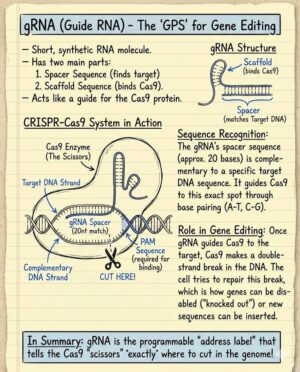
Guide RNA, commonly abbreviated as gRNA, is arguably the most critical component that lends precision and versatility to the revolutionary CRISPR-Cas gene editing technology. Without this simple yet elegant piece of nucleic acid, the Cas enzyme—typically Cas9 or Cas12—would be nothing more than a non-specific nuclease, cleaving DNA indiscriminately. The gRNA acts as the molecular GPS, directing the Cas enzyme to an exact location within the vast expanse of the genome, enabling targeted modifications that have transformed molecular biology, biotechnology, and medicine.
The term gRNA generally refers to a single-guide RNA, or sgRNA, which is a synthetic fusion of two naturally occurring RNA molecules found in bacterial and archaeal CRISPR systems: the CRISPR RNA (crRNA) and the trans-activating CRISPR RNA (tracrRNA). In its native form in prokaryotes, crRNA is responsible for sequence recognition, while tracrRNA forms a necessary complex with the Cas enzyme, scaffolding the entire mechanism. Scientists realized that these two components could be linked by a short RNA hairpin loop, creating the much simpler and more efficient sgRNA molecule, which simplifies the delivery and function of the system in eukaryotic cells.
The structure of the gRNA dictates its function. A typical sgRNA is approximately 100 nucleotides long and is generally composed of two distinct functional domains. The first and most crucial domain is the ‘spacer’ sequence, often referred to as the targeting sequence. This domain is approximately 20 nucleotides in length and is designed to be fully complementary to the target DNA sequence in the host genome. This 20-nucleotide sequence establishes the specificity of the entire CRISPR reaction; the Cas enzyme will only bind tightly and efficiently where this sequence perfectly matches the genomic DNA.
The second functional domain is the scaffold sequence. This highly conserved region does not interact with the target DNA but instead forms a complex secondary structure—including several hairpin loops—that physically binds to and anchors the Cas enzyme. For Cas9, the scaffold region is essential for holding the enzyme in a conformation ready for cleavage. The tight interaction between the scaffold and the Cas enzyme ensures that when the targeting sequence finds its match in the DNA, the nuclease domain of the Cas enzyme is positioned correctly to induce a double-strand break (DSB) at the desired location, usually three nucleotides upstream of the Protospacer Adjacent Motif (PAM).
The PAM sequence is a short, non-negotiable DNA motif (typically NGG for Cas9 from S. pyogenes) located immediately adjacent to the target site. It is critical to recognize that the gRNA does *not* encode or match the PAM sequence itself; rather, the presence of the PAM sequence on the genomic DNA is what allows the Cas enzyme to initiate local unwinding of the DNA helix, thereby permitting the gRNA to check for complementarity. If the PAM is missing or incorrect, the Cas-gRNA complex cannot bind effectively, preventing off-target cleavage and ensuring that only specific, pre-selected sites are modified.
Designing an effective gRNA is paramount for successful genome editing and represents a major area of ongoing research and computational development. The primary challenge in gRNA design is balancing high on-target efficiency with minimized off-target activity. Off-target effects occur when the gRNA binds to and directs cleavage at unintended sites in the genome that possess sequences highly similar, but not identical, to the target. These unintended modifications can lead to cellular toxicity, chromosomal rearrangements, or potentially hazardous mutations, particularly in therapeutic applications.
To optimize specificity, scientists employ sophisticated bioinformatics tools that analyze the entire reference genome for potential binding sites. These tools calculate “off-target scores” based on the number and position of mismatches between the designed gRNA and non-target genomic sequences. A key finding is that mismatches are often tolerated more poorly near the PAM sequence (the ‘seed’ region, usually the first 8-12 nucleotides of the spacer) than at the distal end, meaning designers focus intensely on perfect complementarity in this seed region.
Furthermore, gRNA efficiency—how well it prompts the Cas enzyme to cut the DNA—is also sequence-dependent and highly variable. Certain sequences appear to be intrinsically better at recruiting and activating the nuclease. Predicting this efficiency involves algorithms that consider nucleotide composition, secondary structure formation within the gRNA itself, and local chromatin accessibility at the target locus. High-efficiency gRNAs maximize the desired modification, reducing the required concentration of the CRISPR components and often lowering the risk of subsequent off-target effects.
The method of delivery also impacts gRNA formulation and stability. For laboratory research, gRNAs are often produced through *in vitro* transcription or synthesized chemically. In living cells, they can be delivered via plasmids (DNA encoding the gRNA), viral vectors (like AAV or lentivirus), or as pre-formed ribonucleoprotein (RNP) complexes, where the gRNA is already bound to the purified Cas protein. Delivery as RNP is increasingly popular for therapeutic applications because it is transient, reducing the exposure time of the nuclease and consequently decreasing the likelihood of off-target activity and improving safety profiles.
In terms of modifications and enhancements, the field of gRNA technology is continuously evolving. Researchers have developed truncated gRNAs (tru-gRNAs) which utilize spacers shorter than 20 nucleotides. These tru-gRNAs generally exhibit higher specificity because the shorter sequence tolerates fewer mismatches, thereby effectively requiring a more precise match to the target sequence. Other innovative designs include modifications to the scaffold region to improve Cas enzyme binding affinity or stability in the cellular environment, sometimes by incorporating chemically modified bases to resist degradation by cellular nucleases.
Beyond simple gene knockout, gRNA technology is central to more complex genome engineering tools. For instance, the “dead” Cas9 (dCas9), which has been engineered to lose its DNA cleavage activity while retaining its DNA binding ability, is leveraged for epigenetic modification or transcriptional control. Here, the gRNA guides the dCas9 to a specific promoter region, and dCas9 can be fused to an effector domain (such as an activator or repressor) to turn target genes on or off. In these systems, the gRNA remains the key determinant of specificity, enabling highly localized manipulation of gene expression without permanent changes to the DNA sequence itself.
Another powerful application involves base editing and prime editing. Base editors utilize a gRNA to guide a catalytically impaired Cas enzyme (often a nickase, which cuts only one strand of DNA) fused to a deaminase enzyme. This complex allows for the precise chemical conversion of one base to another (e.g., C to T or A to G) without generating a full double-strand break. Prime editors utilize a different gRNA—a prime editing guide RNA (pegRNA)—which is longer and carries an extension template. This pegRNA guides the nickase and reverse transcriptase complex, not only dictating where to nick but also providing the template for the new DNA sequence to be written, allowing for highly precise insertions, deletions, or substitutions.
The versatility provided by the gRNA’s structure has allowed CRISPR systems to be adapted for diagnostic purposes. For example, systems like SHERLOCK use Cas13, an RNA-targeting enzyme, guided by a gRNA to detect specific RNA sequences indicative of a virus or disease. Once the Cas13-gRNA complex binds its target, it becomes activated and starts non-specifically cleaving nearby ‘reporter’ molecules, generating a fluorescent or colorimetric signal that can be easily detected, demonstrating how gRNA moves beyond simple DNA editing into targeted molecular sensing.
In the biomedical realm, gRNA delivery is critical for developing gene therapies. For *ex vivo* therapies, cells are removed from the patient, edited using gRNAs and Cas enzymes in a lab setting, and then returned to the patient. For *in vivo* therapies, the gRNA and Cas components must be packaged and delivered directly into the patient’s body to reach the target cells, often necessitating lipid nanoparticles (LNPs) or engineered viral capsids capable of precise organ or tissue targeting. The quality, purity, and stability of the manufactured gRNA are essential for the therapeutic success and regulatory approval of these advanced treatments.
While the gRNA is remarkably efficient, challenges persist. One major hurdle is high-throughput screening for the best gRNA designs. Although computational tools are useful, the true effectiveness and specificity of a gRNA often still require laborious experimental validation (e.g., using deep sequencing to map off-target cuts). Furthermore, delivery into certain cell types, especially non-dividing cells like neurons, remains complex, requiring specialized gRNA delivery vehicles that can bypass cellular defense mechanisms and reach the nucleus efficiently.
In conclusion, the guide RNA is the intelligent core of the CRISPR-Cas system. Its ability to marry specific recognition (via the spacer) with enzyme activation (via the scaffold) provides unprecedented control over the genome. As research continues to refine gRNA design, improve its delivery mechanisms, and explore new Cas homologs, the gRNA will continue to drive the rapid advancement of gene editing, offering solutions ranging from basic biological research to curing human genetic diseases and developing sustainable agricultural traits. The continuing evolution of this small RNA molecule underscores its immense significance in the current biological revolution.