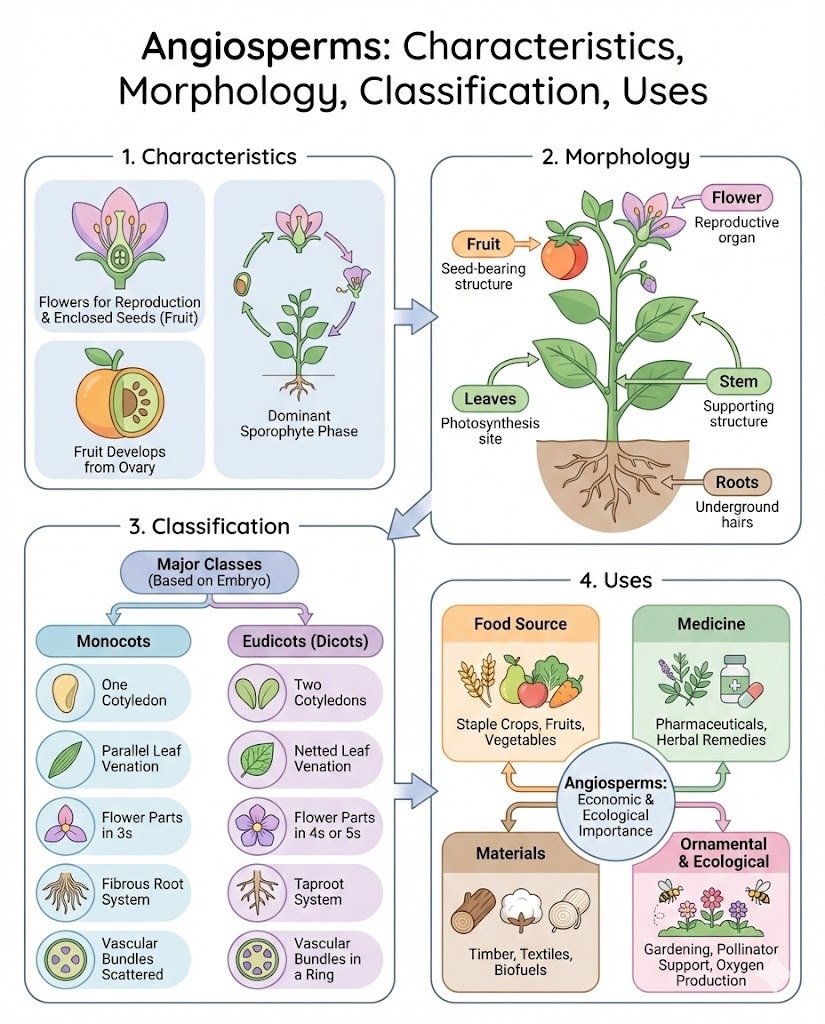
Angiosperms, belonging to the clade Angiospermae and formerly known as Magnoliophyta, represent the largest and most diverse division of the Plant Kingdom. Encompassing over 300,000 known species, they constitute approximately 80% of all living green plants on Earth. The name “angiosperm” is derived from the Greek words angeion (container, vessel) and sperma (seed), directly referencing their defining characteristic: seeds that are enclosed within a protective structure, the fruit. Unlike gymnosperms (non-flowering seed plants) whose seeds are naked, the evolutionary success and ecological dominance of angiosperms are primarily attributed to two novel reproductive structures: the flower, which ensures fertilization, and the fruit, which aids in seed dispersal and protection. They thrive in virtually every terrestrial and even some marine habitats, ranging in size from the tiny Wolffia to the towering Eucalyptus trees.
Key Characteristics of Angiosperms
The defining characteristics of angiosperms set them apart from other plant groups. The life cycle exhibits an alternation of generations, where the diploid sporophyte is the large, dominant, and free-living plant body, fully differentiated into true stems, roots, and leaves. They possess a highly specialized and efficient vascular system crucial for supporting their often massive size and complex structure; the xylem contains true vessels, and the phloem contains companion cells. Reproduction is uniquely characterized by the presence of the flower, which houses the sexual organs (stamens and carpels), and the process of double fertilization, which is entirely absent in other plants. Angiosperms are heterosporous, producing two distinct types of spores: microspores that develop into pollen grains (male gametophytes) and megaspores that develop into the embryo sac (female gametophyte), which is permanently retained within the ovule.
Angiosperm Morphology: The Flower and Fruit
The morphology of the angiosperm plant body is typically organized into two principal systems: the root system, generally located underground for anchorage and water/mineral absorption, and the shoot system, which includes the stem, leaves, and flowers. The leaves are generally flattened and laterally born structures, and the stem is the aerial axis. The flower, which may arise singularly or in a cluster known as an inflorescence, is a modified shoot consisting of four main whorls of organs, all borne on the receptacle, which is the central axis.
The outermost whorl is the calyx , composed of individual sepals , which are often green and leaf-like, serving to protect the flower bud. Inside the calyx is the corolla , made up of brightly colored petals ; these are designed to attract animal pollinators through color, scent, or nectar. Together, the calyx and corolla form the perianth. The third whorl is the male reproductive structure, the androecium , which comprises the stamens . Each stamen consists of a thin stalk called a filament and an anther , which is the site of microspore production and subsequent pollen development. The innermost whorl is the female reproductive structure, the gynoecium , which is composed of one or more carpels (or collectively, a pistil). The carpel consists of the ovary (enclosing the ovules), the style (a stalk), and the sticky stigma (the receptive surface for pollen).
Following fertilization, the ovary wall develops into the fruit , or pericarp, which functions to protect the developing seeds and is crucial for dispersal. The fruit’s form—whether fleshy (like berries and apples) or dry (like nuts and grains)—is closely linked to the specific mechanism of seed dispersal by wind, water, or animals.
The Unique Process of Double Fertilization
Reproduction in angiosperms is characterized by the complex and efficient mechanism of double fertilization. After a pollen grain is deposited on the stigma, it germinates and grows a pollen tube down the style toward the ovary. The pollen grain contains a tube nucleus and a generative cell. As the pollen tube grows, the generative cell divides by mitosis to produce two haploid (n) sperm cells. Upon reaching the ovule, the pollen tube releases the two sperm cells into the embryo sac (megagametophyte).
The double fertilization event then occurs: 1) One sperm cell fuses with the haploid egg cell (n), resulting in a diploid zygote (2n), which will develop into the new plant embryo. 2) The second sperm cell fuses with the two haploid central cell nuclei (n + n), forming a triploid (3n) primary endosperm nucleus. This triploid cell rapidly develops into the endosperm , which is a specialized, nutrient-rich tissue that serves as the essential food source for the developing embryo and the germinating seedling. This dual fusion ensures that an energy investment is made in the food supply only when a viable embryo is secured, offering a significant adaptive advantage and contributing to the rapid seed production observed in flowering plants.
Classification: Monocots and Dicotyledons
The entire group of angiosperms is broadly classified into two major classes based on the number of embryonic leaves, or cotyledons, found within the seed: Monocotyledons (Monocots) and Dicotyledons (Dicots) , the latter often more accurately referred to as Eudicots.
Monocots are distinguished by having a single cotyledon in the seed. Their leaves are typically simple with characteristic parallel venation . The root system is generally adventitious (fibrous), arising from the stem rather than the primary radicle. Floral parts are usually arranged in multiples of three (trimerous). In the stem, vascular bundles are typically numerous and scattered throughout the ground tissue, lacking cambium, which results in the absence of secondary growth. Examples include grasses (rice, corn, wheat), lilies, and palms.
Dicotyledons, conversely, possess two cotyledons in the seed. Their leaves display netted or reticulate venation (a branched network). They typically have a prominent tap root system that develops from the radicle. Floral parts are commonly arranged in multiples of four or five (tetramerous or pentamerous). The vascular bundles in the stem are generally organized in a distinct ring pattern, and secondary growth is often present. Examples include roses, oaks, sunflowers, and most fruits and vegetables.
Economic and Ecological Uses of Angiosperms
Angiosperms are unparalleled in their economic and ecological significance. As the primary source of food for humans and most terrestrial animals, they provide all major grains (rice, wheat, corn), fruits, vegetables, legumes, and nuts. The production of the endosperm, the triploid food supply, is a major factor in their importance as a crop source. Beyond food, angiosperms are vital sources of timber and wood products (from hardwood trees), fibers for textiles (cotton, flax, hemp), and medicines , with many traditional and modern pharmaceuticals derived from flowering plants. Beverages like coffee and tea, and numerous spices, herbs, and essential oils, are also angiosperm products. Ecologically, they form the foundation of most terrestrial ecosystems. Their co-evolution with animal pollinators (insects, birds, bats) makes them central to supporting biodiversity, and they play a critical role in the global water cycle, oxygen production, and soil stabilization.