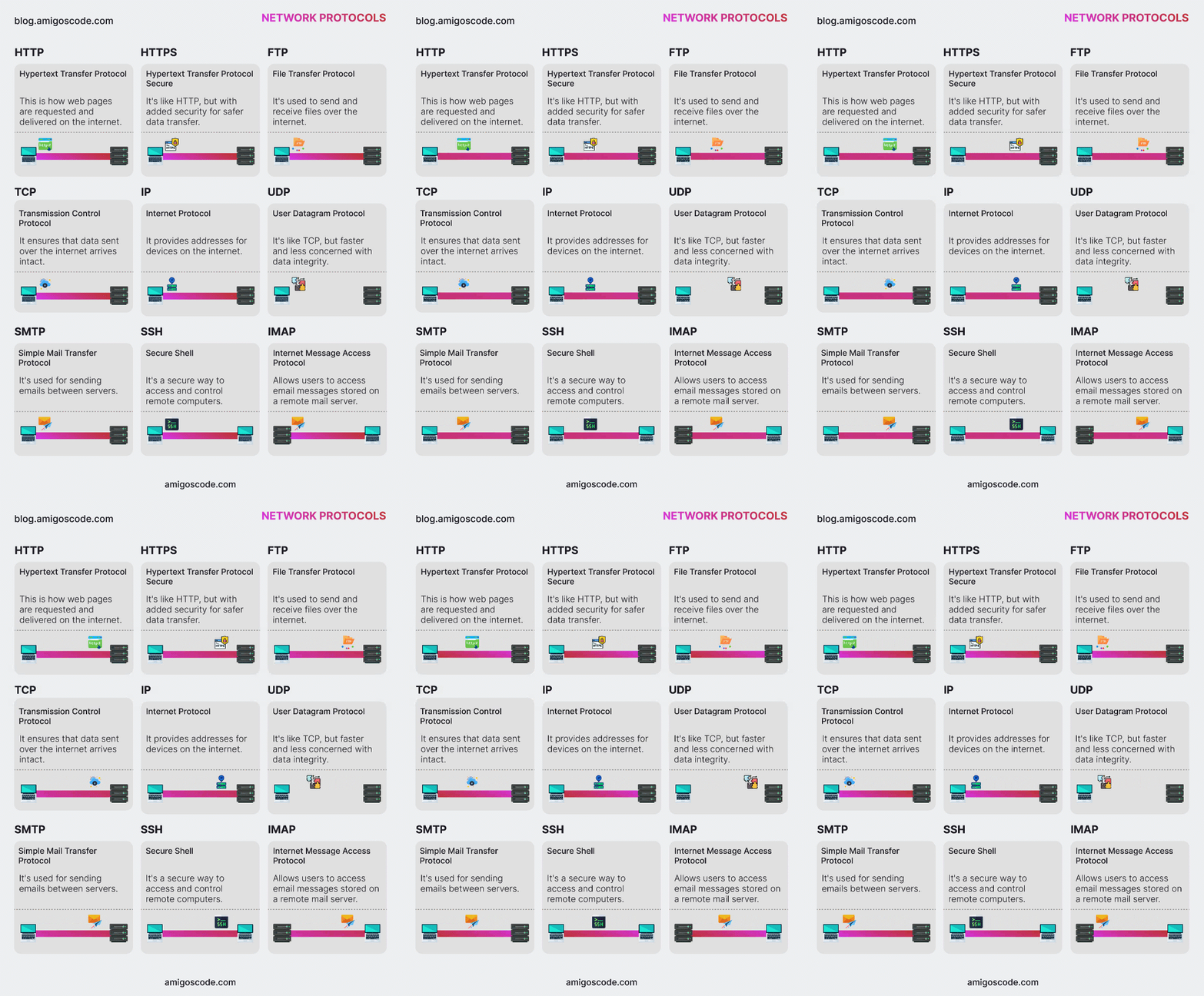
Whether you’re gearing up for coding interviews or brushing up on core computer networking concepts, understanding networking protocols is non-negotiable. Interviewers often test not just your coding ability, but also how well you understand how systems communicate. These nine protocols form the backbone of modern networks and frequently appear in technical discussions, system design rounds, and backend interviews.
1️⃣ HTTP (Hypertext Transfer Protocol)
HTTP is the foundation of data communication on the web. It follows a request–response model where a client (like a browser) requests resources from a server. HTTP is stateless, meaning each request is independent and does not retain user session data by default.
Interview tip: Be ready to explain HTTP methods (GET, POST, PUT, DELETE), status codes (200, 404, 500), and why statelessness matters for scalability.
2️⃣ HTTPS (Hypertext Transfer Protocol Secure)
HTTPS is the secure version of HTTP, adding encryption via TLS/SSL. It ensures data confidentiality, integrity, and authentication between client and server.
Interview tip: Know how HTTPS prevents man-in-the-middle attacks and the role of certificates and public-key cryptography.
3️⃣ FTP (File Transfer Protocol)
FTP is used to transfer files between systems over a network. It operates on a client–server model and typically uses separate channels for control and data transfer.
Interview tip: Understand active vs passive FTP and why FTP is considered insecure compared to modern alternatives like SFTP.
4️⃣ TCP (Transmission Control Protocol)
TCP is a connection-oriented, reliable transport-layer protocol. It guarantees data delivery, correct order, and error recovery through mechanisms like acknowledgments and retransmissions.
Interview tip: Be clear about the TCP three-way handshake and why TCP is used for applications like web browsing and email.
5️⃣ IP (Internet Protocol)
IP handles addressing and routing of packets across networks. It defines how data packets are formatted and delivered from source to destination.
Interview tip: Know the difference between IPv4 and IPv6 and how IP works together with TCP or UDP.
6️⃣ UDP (User Datagram Protocol)
UDP is a connectionless transport protocol that prioritizes speed over reliability. It does not guarantee delivery, ordering, or error correction.
Interview tip: Be ready to justify why UDP is preferred for real-time applications like video streaming, gaming, and VoIP.
7️⃣ SMTP (Simple Mail Transfer Protocol)
SMTP is responsible for sending emails from clients to servers and between mail servers.
Interview tip: Understand the difference between SMTP (sending) and IMAP/POP3 (receiving), and common ports used by SMTP.
8️⃣ SSH (Secure Shell)
SSH provides secure remote login and command execution over unsecured networks. It uses strong encryption and key-based authentication.
Interview tip: Explain how SSH improves security over legacy protocols like Telnet and how public-private key authentication works.
9️⃣ IMAP (Internet Message Access Protocol)
IMAP allows users to retrieve and manage emails directly on the mail server, keeping messages synchronized across devices.
Interview tip: Compare IMAP with POP3 and explain why IMAP is preferred for multi-device access.
🚀 Why These Protocols Matter in Interviews
Interviewers aren’t just testing definitions—they want to see if you understand real-world system behavior. These protocols often come up in backend development, DevOps roles, system design interviews, and debugging scenarios.
If you can confidently explain what a protocol does, where it’s used, and why it matters, you’ll stand out as someone who understands not just code, but the systems behind it.