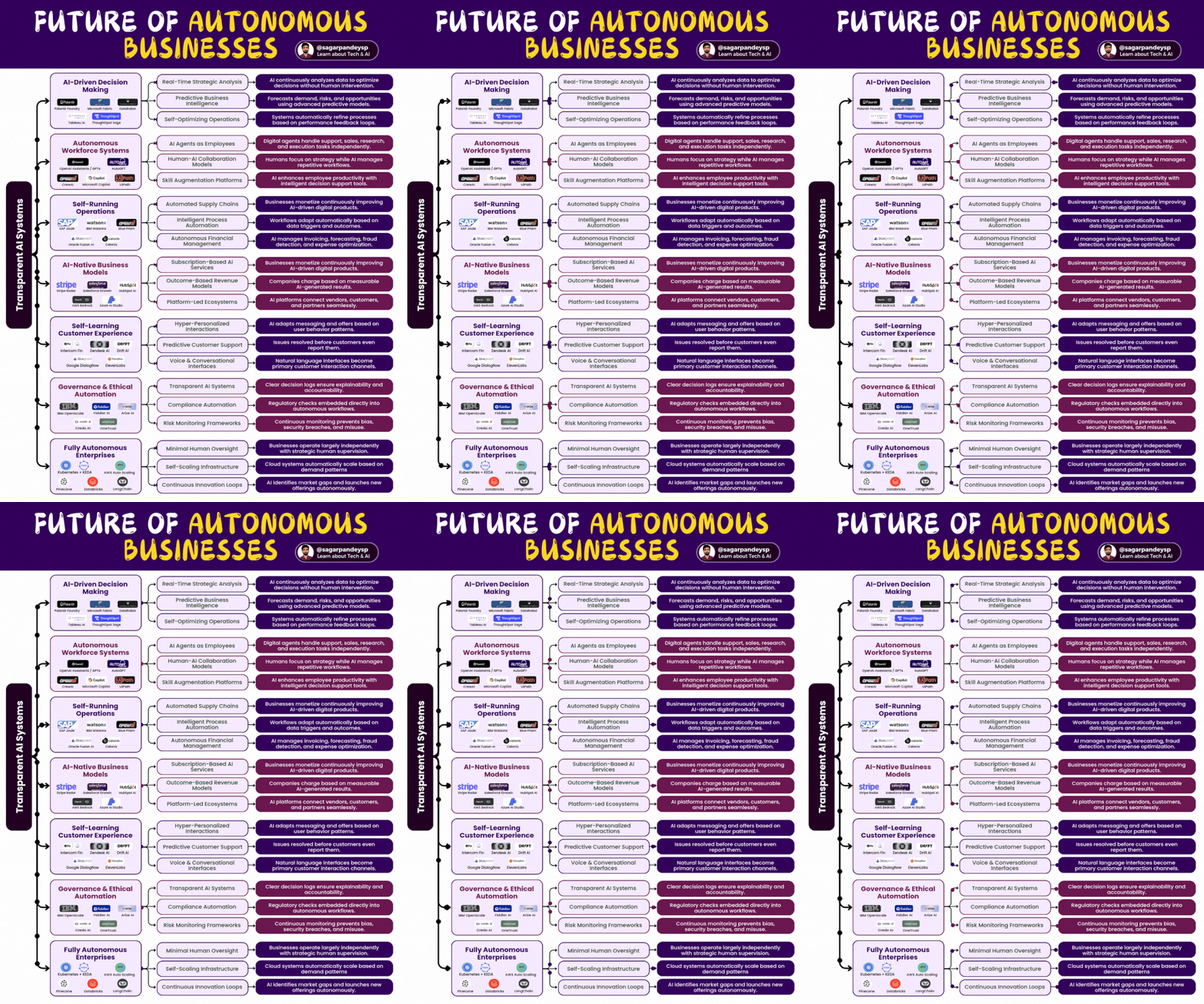
The way companies operate is changing faster than ever. From self-driving delivery trucks to AI-powered customer service, businesses are increasingly relying on systems that can function with minimal human intervention. This shift marks the rise of autonomous businesses—organizations that use advanced technologies like artificial intelligence, machine learning, and robotics to manage operations, make decisions, and deliver services with little or no human oversight.
While the concept may sound futuristic, autonomous business models are already emerging across industries. Whether it’s a fully automated warehouse or a financial platform that adjusts investment strategies in real time, the foundation for self-sustaining enterprises is being laid today. But what exactly defines an autonomous business, and how might they reshape the global economy in the coming decades?
Defining Autonomous Businesses
An autonomous business is an organization that leverages technology to operate independently across core functions such as production, logistics, customer service, and decision-making. Unlike traditional businesses that rely heavily on human labor and manual processes, autonomous businesses use intelligent systems to monitor, analyze, and act on data in real time.
These systems often include:
- Artificial Intelligence (AI): Used for predictive analytics, customer behavior modeling, and automated decision-making.
- Machine Learning (ML): Enables systems to improve over time by learning from data patterns.
- Robotics and Automation: Handles physical tasks in manufacturing, warehousing, and delivery.
- Internet of Things (IoT): Connects devices and sensors to collect operational data continuously.
- Blockchain: Ensures secure, transparent transactions and smart contracts.
For example, a fully autonomous e-commerce platform might use AI to manage inventory, predict demand, route deliveries via self-driving vehicles, and handle customer inquiries through chatbots—all without human intervention.
Current Examples and Real-World Applications
Several companies are already testing or implementing autonomous business models. Amazon, for instance, operates highly automated fulfillment centers where robots transport shelves to human workers (or increasingly, to other robots), drastically reducing order processing time. Their cashier-less Amazon Go stores use computer vision and sensor fusion to track what customers take off the shelves, automatically charging them upon exit.
In finance, robo-advisors like Betterment and Wealthfront use algorithms to manage investment portfolios based on user goals and risk tolerance, adjusting allocations in response to market changes. These platforms operate 24/7, require minimal staffing, and scale efficiently.
The transportation sector is another frontier. Companies like Waymo and Tesla are advancing autonomous vehicle technology, which could eventually lead to fleets of self-driving taxis or delivery trucks operating under centralized AI control. Similarly, drone delivery services—piloted by firms such as Zipline—are already transporting medical supplies in remote areas with little human involvement.
Technological Enablers Driving the Shift
The growth of autonomous businesses is not accidental. It is powered by rapid advancements in several key technologies.
Artificial Intelligence and Decision-Making
Modern AI systems can process vast amounts of data, identify patterns, and make decisions faster than humans. In business contexts, this means AI can optimize supply chains, detect fraud, personalize marketing, and even negotiate contracts using natural language processing.
Cloud Computing and Scalability
Cloud infrastructure allows businesses to scale their operations instantly. Autonomous systems depend on real-time data access and processing power, both of which are enabled by cloud platforms like AWS, Google Cloud, and Microsoft Azure.
5G and Connectivity
High-speed, low-latency networks are essential for autonomous operations, especially in logistics and remote monitoring. 5G technology ensures that sensors, vehicles, and control systems can communicate instantly, reducing delays and improving reliability.
Cybersecurity and Trust
As businesses become more autonomous, the risk of cyberattacks increases. Robust cybersecurity frameworks are critical to protect data integrity, ensure system reliability, and maintain customer trust. Technologies like encryption, multi-factor authentication, and decentralized ledgers play a growing role in securing autonomous operations.
Challenges and Limitations
Despite their potential, autonomous businesses face significant hurdles. One major concern is regulatory oversight. Governments are still developing frameworks to govern AI-driven decisions, liability in case of errors, and data privacy. For example, who is responsible if an autonomous delivery drone causes property damage?
Ethical considerations also come into play. Automated systems may unintentionally reinforce biases present in training data, leading to unfair outcomes in hiring, lending, or customer service. Ensuring transparency and accountability in AI decision-making remains a challenge.
Additionally, the transition to autonomy requires substantial investment. Small and medium-sized enterprises may struggle to adopt these technologies due to high upfront costs and a lack of technical expertise. There is also the social impact: widespread automation could displace workers in certain sectors, necessitating workforce retraining and policy interventions.
The Road Ahead
Looking forward, autonomous businesses are likely to become more common, particularly in sectors with repetitive tasks, high data volume, and predictable environments. However, full autonomy may remain limited to specific functions rather than entire organizations. Most experts predict a hybrid model—where humans and machines collaborate—will dominate in the near term.
Over time, as technology matures and public trust grows, we may see fully autonomous enterprises operating across industries. These businesses could offer greater efficiency, lower operational costs, and 24/7 availability. They may also enable new business models, such as on-demand manufacturing or personalized services at scale.
Key Takeaways
- Autonomous businesses use AI, robotics, and IoT to operate with minimal human intervention.
- They are already being implemented in logistics, finance, retail, and transportation.
- Technological enablers include AI, cloud computing, 5G, and cybersecurity tools.
- Challenges include regulation, ethics, cost, and workforce displacement.
- The future likely involves a mix of autonomous and human-managed systems.
FAQ
What is an autonomous business?
An autonomous business is an organization that uses advanced technologies like artificial intelligence, machine learning, and robotics to manage operations, make decisions, and deliver services with little or no human oversight.
Are autonomous businesses safe and reliable?
While autonomous systems are designed to be reliable, they are not infallible. Safety depends on rigorous testing, continuous monitoring, and strong cybersecurity measures. Regulatory frameworks are still evolving to ensure accountability and transparency.
Will autonomous businesses replace human workers?
Autonomous technologies may reduce the need for certain types of jobs, especially those involving repetitive tasks. However, they are also expected to create new roles in AI maintenance, data analysis, and system oversight. The overall impact on employment will depend on how societies adapt through education and policy.