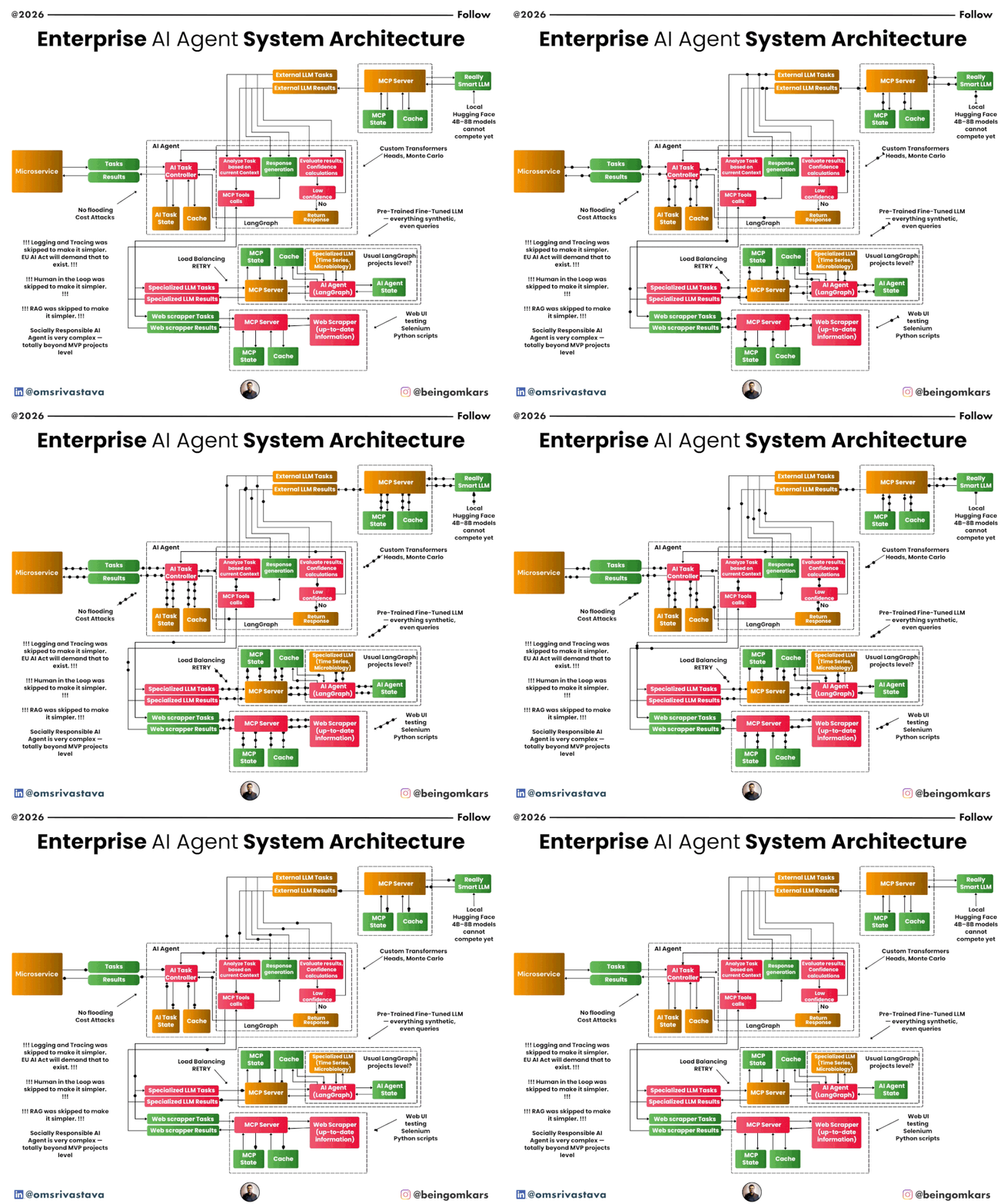
Imagine a team member who never sleeps, processes information at lightning speed, and handles repetitive tasks without complaint. This isn’t science fiction—it’s the reality of enterprise AI agents. These digital assistants are transforming how organizations operate, making processes faster, more accurate, and increasingly autonomous. But what exactly are they, and how do they differ from the chatbots or virtual assistants we’ve seen before?
Enterprise AI agents are intelligent software systems designed to perform complex, goal-oriented tasks within business environments. Unlike simple automation tools that follow rigid rules, these agents use artificial intelligence—particularly machine learning and natural language processing—to understand context, adapt to new information, and make decisions with minimal human intervention. They don’t just respond to commands; they initiate actions, learn from experience, and collaborate across departments.
The rise of enterprise AI agents marks a shift from task-specific automation to cognitive collaboration. While early AI applications focused on narrow functions like data entry or basic customer support, today’s agents can manage supply chains, draft legal documents, analyze financial reports, and even negotiate contracts. Their ability to integrate with existing enterprise systems—such as ERP, CRM, and HR platforms—makes them powerful tools for enhancing productivity and strategic decision-making.
This evolution didn’t happen overnight. It builds on decades of progress in AI research, cloud computing, and data infrastructure. As organizations generate and store more data than ever before, the need for intelligent systems to interpret and act on that data has grown. Enterprise AI agents fill that gap by turning raw information into actionable insights, often in real time.
But their impact goes beyond efficiency. These agents are redefining roles within organizations. Employees are freed from routine tasks and can focus on higher-value work like innovation, strategy, and customer engagement. At the same time, leaders gain access to deeper analytics and predictive capabilities, enabling more informed decisions. The result is a more agile, responsive, and competitive enterprise.
As adoption grows, so does the conversation around implementation, ethics, and governance. How do companies ensure these agents act responsibly? What safeguards are needed to protect data and maintain transparency? These questions are central to the responsible deployment of enterprise AI agents, and they underscore the importance of thoughtful planning and oversight.
In this article, we’ll explore the core components of enterprise AI agents, their applications across industries, the technologies that power them, and the challenges organizations face when integrating them into their operations. Whether you’re a business leader, IT professional, or simply curious about the future of work, understanding these agents is essential in today’s rapidly evolving digital landscape.
Core Components of Enterprise AI Agents
To function effectively, enterprise AI agents rely on a combination of advanced technologies and architectural principles. These components work together to enable perception, reasoning, learning, and action—hallmarks of intelligent behavior. Understanding these elements is key to appreciating how these agents deliver value in real-world business settings.
Perception and Data Ingestion
The first step in any intelligent system is gathering information. Enterprise AI agents use perception mechanisms to collect data from a wide range of sources. This includes structured data from databases and enterprise software, as well as unstructured data from emails, documents, voice recordings, and social media. Sensors, APIs, and web crawlers often serve as the entry points for this data.
Natural language processing (NLP) plays a critical role here. It allows agents to interpret human language, extract meaning from text, and identify key entities such as names, dates, and locations. For example, an agent might scan incoming customer emails to detect complaints, extract product names, and route the message to the appropriate support team. Similarly, computer vision enables agents to analyze images or video feeds, useful in quality control or security monitoring.
Reasoning and Decision-Making
Once data is collected, the agent must make sense of it and decide what to do next. This is where reasoning engines come into play. These systems use logic, rules, and probabilistic models to evaluate options and select the best course of action. Some agents rely on predefined business rules, while others use machine learning models trained on historical data to predict outcomes.
For instance, a supply chain AI agent might analyze inventory levels, supplier lead times, and demand forecasts to determine when to reorder materials. It could weigh multiple factors—cost, delivery speed, risk of shortage—and recommend an optimal purchasing strategy. In more complex scenarios, agents may simulate different outcomes before making a decision, a process known as predictive modeling.
Learning and Adaptation
One of the defining features of AI agents is their ability to learn from experience. Through machine learning, they improve over time by identifying patterns in data and adjusting their behavior accordingly. Supervised learning allows agents to classify information based on labeled examples, while unsupervised learning helps them discover hidden structures in data.
Reinforcement learning takes this a step further by enabling agents to learn through trial and error. In a customer service context, an agent might experiment with different response strategies and receive feedback based on customer satisfaction scores. Over time, it refines its approach to maximize positive outcomes. This adaptability is crucial in dynamic environments where conditions change frequently.
Action and Execution
After deciding on a course of action, the agent must carry it out. This often involves interacting with other systems or people. Integration with enterprise software—such as SAP, Salesforce, or Microsoft Dynamics—allows agents to update records, trigger workflows, or send notifications automatically. They can also communicate with users through chat interfaces, voice assistants, or email.
Some agents go beyond digital actions and control physical devices. In manufacturing, for example, an AI agent might adjust machinery settings based on real-time sensor data to maintain product quality. In logistics, it could coordinate with autonomous vehicles or drones to optimize delivery routes.
Memory and Context Management
Effective agents maintain a sense of context across interactions. This requires memory systems that store relevant information about past events, user preferences, and ongoing tasks. Short-term memory helps agents remember the current conversation or workflow, while long-term memory supports continuity over days or weeks.
For example, a financial advisory agent might recall a client’s investment history, risk tolerance, and previous recommendations when suggesting new portfolio adjustments. Without this contextual awareness, interactions would feel fragmented and inefficient.
Security and Governance
Given the sensitive nature of enterprise data, security is a foundational component. AI agents must operate within strict access controls, ensuring they only retrieve and act on information they’re authorized to handle. Encryption, authentication, and audit trails are standard practices.
Governance frameworks also play a role in defining how agents behave. Policies may dictate ethical guidelines, data usage limits, and escalation procedures when human oversight is needed. These safeguards help maintain trust and compliance with regulations like GDPR or HIPAA.
Together, these components form a cohesive system capable of performing sophisticated tasks with increasing autonomy. As technology advances, we can expect even greater integration between perception, reasoning, and action, leading to more capable and reliable enterprise AI agents.
Applications Across Industries
Enterprise AI agents are not limited to a single sector. Their versatility allows them to address unique challenges in healthcare, finance, manufacturing, retail, and more. By automating complex workflows and providing intelligent insights, they help organizations improve efficiency, reduce costs, and enhance customer experiences.
Healthcare
In healthcare, AI agents support clinical decision-making, administrative tasks, and patient engagement. They can analyze medical records to identify potential diagnoses, flag drug interactions, or recommend treatment plans based on clinical guidelines. Administrative agents streamline scheduling, billing, and insurance claims, reducing the burden on staff.
For example, an AI agent might monitor patient vitals in real time through wearable devices and alert clinicians to anomalies. It could also assist in triaging emergency room cases by prioritizing patients based on symptom severity. These applications improve response times and help allocate resources more effectively.
Finance and Banking
The financial sector uses AI agents for fraud detection, risk assessment, and customer service. Agents analyze transaction patterns to identify suspicious activity and flag potential fraud in real time. They also evaluate creditworthiness by processing income data, credit history, and market trends.
In customer-facing roles, AI agents handle inquiries about account balances, loan applications, and investment options. They can explain complex financial products in simple terms and guide users through application processes. Some banks deploy agents that provide personalized financial advice, helping customers manage budgets or plan for retirement.
Manufacturing and Supply Chain
Manufacturers rely on AI agents to optimize production lines, predict equipment failures, and manage inventory. Sensors on machinery feed data to agents that detect early signs of wear and schedule maintenance before breakdowns occur. This predictive maintenance reduces downtime and extends equipment life.
Supply chain agents coordinate logistics by tracking shipments, forecasting demand, and adjusting procurement plans. They can reroute deliveries in response to weather disruptions or port delays, ensuring timely fulfillment. In global operations, these agents help navigate customs regulations and optimize shipping costs.
Retail and E-commerce
Retailers use AI agents to personalize shopping experiences and manage operations. They analyze browsing behavior, purchase history, and demographic data to recommend products tailored to individual customers. Chatbots assist with order tracking, returns, and product inquiries, available 24/7.
Behind the scenes, agents optimize pricing strategies by monitoring competitor prices, demand fluctuations, and inventory levels. They can also forecast seasonal trends and adjust marketing campaigns accordingly. In warehouses, AI agents guide robots to locate and pack items efficiently.
Human Resources
HR departments benefit from AI agents that streamline recruitment, onboarding, and employee support. Agents can screen resumes, conduct initial interviews via chat, and rank candidates based on job requirements. They assist new hires by answering policy questions and guiding them through training modules.
Performance management is another area where agents add value. They analyze feedback, goal completion rates, and peer reviews to provide insights into employee development. Some systems even suggest personalized learning paths or career advancement opportunities.
Legal and Compliance
Legal teams use AI agents to review contracts, conduct legal research, and ensure regulatory compliance. Agents can scan thousands of documents to identify clauses, highlight risks, and suggest revisions. They also monitor changes in laws and notify relevant departments when updates affect company policies.
In compliance, agents track data handling practices and generate audit reports. They help organizations adhere to standards like SOX, GDPR, or ISO by flagging potential violations and recommending corrective actions.
These examples illustrate the broad applicability of enterprise AI agents. As organizations continue to digitize and collect more data, the potential for intelligent automation will only grow. The key to success lies in aligning agent capabilities with specific business needs and ensuring seamless integration into existing workflows.
Technologies Powering Enterprise AI Agents
Behind every capable enterprise AI agent is a stack of advanced technologies working in harmony. These include machine learning frameworks, cloud platforms, data management systems, and integration tools. Understanding the technological foundation helps explain how agents achieve their impressive performance and scalability.
Machine Learning and Deep Learning
At the heart of most AI agents is machine learning (ML), a subset of artificial intelligence that enables systems to learn from data without explicit programming. Supervised learning algorithms are trained on labeled datasets to make predictions or classifications. For example, an agent might learn to identify fraudulent transactions by analyzing thousands of past cases.
Deep learning, a more advanced form of ML, uses neural networks with multiple layers to process complex patterns. It excels at tasks like image recognition, speech processing, and natural language understanding. Large language models (LLMs), such as those based on transformer architectures, power many conversational agents by generating human-like responses.
Reinforcement learning is another key technique, particularly for agents that operate in dynamic environments. By receiving rewards for successful actions, these agents learn optimal strategies over time. This approach is used in robotics, game playing, and autonomous systems.
Natural Language Processing (NLP)
NLP enables agents to understand, interpret, and generate human language. It combines linguistics, computer science, and AI to process text and speech. Key NLP tasks include sentiment analysis, named entity recognition, and language translation.
Modern NLP systems leverage pre-trained models like BERT, GPT, and T5, which are fine-tuned for specific enterprise applications. These models can summarize reports, extract key information from contracts, or answer customer queries in multiple languages. Their ability to grasp context and nuance makes them ideal for customer service and content generation.
Cloud Computing and Scalability
Cloud platforms provide the infrastructure needed to deploy and scale AI agents. Services from providers like Amazon Web Services (AWS), Microsoft Azure, and Google Cloud offer computing power, storage, and managed AI tools. This allows organizations to run complex models without investing in expensive hardware.
Cloud environments support elastic scaling, meaning resources can be adjusted based on demand. During peak periods—such as holiday sales or financial reporting seasons—agents can access additional computing power to maintain performance. This flexibility is essential for handling large volumes of data and user interactions.
Data Management and Integration
AI agents rely on high-quality, accessible data. Data lakes and warehouses store structured and unstructured information, making it available for analysis. Integration platforms connect disparate systems, allowing agents to pull data from CRM, ERP, and other enterprise applications.
APIs (Application Programming Interfaces) play a crucial role in enabling communication between systems. RESTful APIs, for example, allow agents to request information or trigger actions in external software. Middleware solutions further streamline integration by managing data flow and ensuring compatibility.
Edge Computing and Real-Time Processing
For time-sensitive applications, edge computing brings processing closer to the data source. Instead of sending data to a central cloud server, agents can analyze information locally on devices like smartphones, sensors, or industrial machines. This reduces latency and improves response times.
In manufacturing, edge AI agents monitor equipment in real time and make immediate adjustments. In retail, they process in-store camera feeds to track customer behavior without relying on cloud connectivity. This approach is especially valuable in environments with limited bandwidth or strict privacy requirements.
Security and Privacy Technologies
Protecting data is paramount when deploying AI agents. Encryption ensures that information remains confidential during transmission and storage. Techniques like federated learning allow models to be trained on decentralized data without exposing sensitive details.
Differential privacy adds noise to datasets to prevent the identification of individuals, useful in healthcare or financial applications. Access control systems restrict agent permissions based on user roles, ensuring compliance with data protection regulations.
Together, these technologies create a robust ecosystem for enterprise AI agents. As innovation continues, we can expect faster processing, better accuracy, and tighter integration with business systems. The result will be agents that are not only smarter but also more reliable and secure.
Challenges and Considerations
Despite their potential, enterprise AI agents come with significant challenges. Organizations must navigate technical, ethical, and operational hurdles to deploy them successfully. Addressing these issues early can prevent costly mistakes and ensure long-term value.
Data Quality and Availability
AI agents are only as good as the data they’re trained on. Incomplete, outdated, or biased data can lead to inaccurate decisions. For example, a hiring agent trained on historical data might perpetuate gender or racial biases if past hiring practices were discriminatory.
Ensuring data quality requires robust data governance, including regular audits, cleansing, and validation. Organizations must also establish clear data ownership and access policies to maintain consistency across systems.
Explainability and Transparency
Many AI models, especially deep learning systems, operate as “black boxes,” making it difficult to understand how they arrive at decisions. This lack of explainability can be problematic in regulated industries like finance or healthcare, where accountability is critical.
Efforts to improve transparency include developing interpretable models, using visualization tools, and documenting decision logic. Some frameworks, like LIME or SHAP, help explain individual predictions by highlighting influential factors.
Integration with Legacy Systems
Many enterprises rely on older software that wasn’t designed for AI integration. Connecting AI agents to these systems can be technically challenging and time-consuming. Custom APIs, middleware, or gradual system upgrades may be required.
Change management is also a factor. Employees may resist adopting new tools, especially if they fear job displacement. Training, clear communication, and involving staff in the implementation process can ease the transition.
Ethical and Legal Concerns
The use of AI agents raises ethical questions about privacy, autonomy, and fairness. Organizations must consider how agents collect and use personal data, whether they make decisions that affect people’s lives, and how to handle errors or biases.
Legal compliance is another concern. Regulations like GDPR in Europe and CCPA in California impose strict requirements on data handling and user consent. Companies must ensure their AI systems adhere to these laws to avoid penalties.
Scalability and Maintenance
As agent usage grows, so do demands on infrastructure and support. Scaling AI systems requires careful planning to avoid performance bottlenecks. Regular maintenance is also needed to update models, fix bugs, and adapt to changing business needs.
Monitoring tools help track agent performance, detect anomalies, and measure ROI. Continuous evaluation ensures that agents remain effective and aligned with organizational goals.
Addressing these challenges requires a multidisciplinary approach, involving IT, legal, HR, and business leaders. With proper planning and oversight, organizations can harness the benefits of AI agents while minimizing risks.
Key Takeaways
- Enterprise AI agents are intelligent software systems that perform complex, goal-oriented tasks using AI technologies like machine learning and natural language processing.
- They differ from simple automation tools by adapting to new information, learning from experience, and making decisions with minimal human input.
- Core components include perception, reasoning, learning, action, memory, and security—each playing a vital role in agent functionality.
- Applications span healthcare, finance, manufacturing, retail, HR, and legal sectors, improving efficiency, decision-making, and customer experiences.
- Technologies such as machine learning, NLP, cloud computing, and edge processing power these agents and enable scalability.
- Challenges include data quality, explainability, system integration, ethical concerns, and maintenance—requiring careful planning and governance.
- Successful deployment depends on aligning agent capabilities with business needs, ensuring data integrity, and maintaining transparency and compliance.
FAQ
What is the difference between an AI agent and a chatbot?
While both use AI, a chatbot is typically designed for conversational interactions and follows predefined scripts or simple decision trees. An enterprise AI agent, on the other hand, can perform complex, multi-step tasks, learn from data, and integrate with multiple systems to achieve broader business goals.
Can enterprise AI agents replace human workers?
AI agents are more likely to augment human roles than replace them. They handle repetitive or data-intensive tasks, freeing employees to focus on creativity, strategy, and interpersonal skills. In most cases, human oversight remains essential for ethical, legal, and quality assurance reasons.
How do organizations ensure AI agents act ethically?
Organizations implement ethical guidelines, conduct bias audits, use transparent models, and establish governance frameworks. They also train agents on diverse datasets and include human review processes for high-stakes decisions to ensure fairness and accountability.