Water Treatment Chemicals Formulation is a highly specialized field essential for the effective management of water resources, aimed at transforming raw source water into safe, palatable, and potable finished water for public consumption or suitable effluent for environmental discharge. The discipline requires a synthesized understanding of fundamental chemistry, fluid dynamics, and stringent regulatory requirements. For operational decision-makers in water treatment plants, mastering the intricacies of chemical selection, application, and dosing is paramount, often demanding foundational knowledge that supplements practical operational experience. This comprehensive guide outlines the core elements necessary for precise chemical formulation, underscoring its role as the critical foundation upon which all subsequent physical separation processes depend.
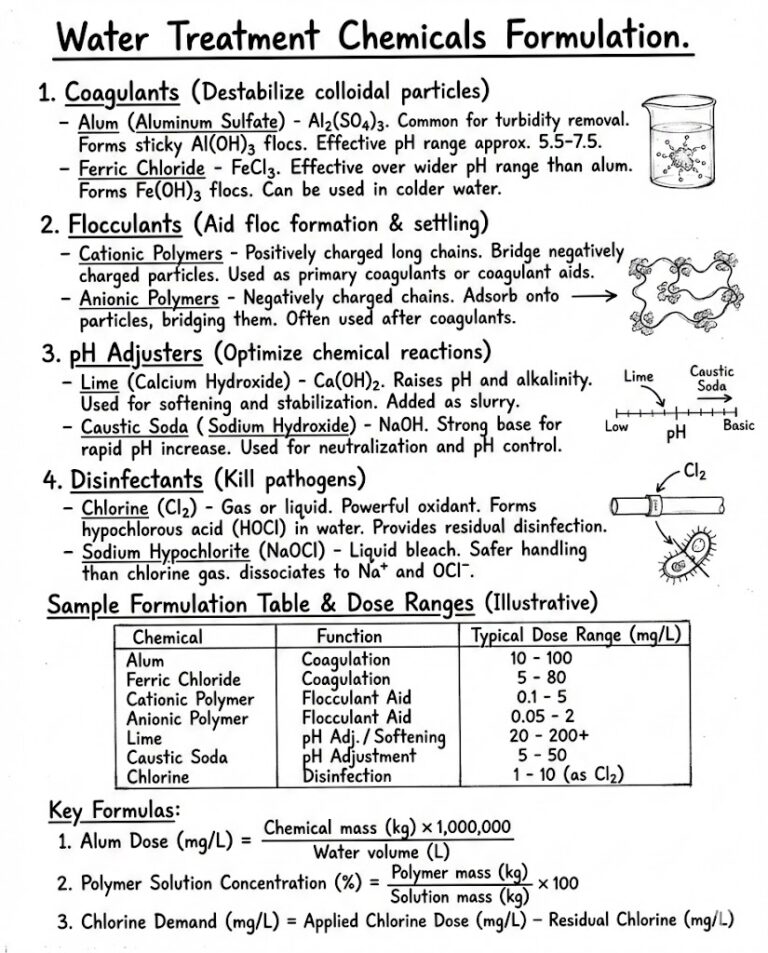
The imperative for chemical treatment stems from the diverse nature of impurities found in natural waters. These impurities exist primarily in three states: suspended solids, colloidal matter, and dissolved substances. Suspended solids are generally addressed through physical means like sedimentation and filtration, but colloidal particles—minute solids typically stabilized by repulsive negative surface charges—cannot settle naturally or be easily filtered. Chemical formulation, specifically the processes of Coagulation and Flocculation, is engineered precisely to destabilize and aggregate these colloidal particles, thereby making them amenable to subsequent physical removal stages like Clarification and Filtration. The success of the entire treatment train hinges on optimal chemical dosing; sub-optimal chemical performance compromises filter efficiency, leading to excessive turbidity and potential regulatory non-compliance.
Coagulation serves as the crucial initial chemical step in solids removal. It is defined by the process of adding highly charged species, known as primary coagulants, to the water to neutralize the negative surface charges (zeta potential) of the colloidal particles. This neutralization eliminates the repulsive forces between particles, allowing them to begin adhering to one another. The most widely adopted coagulants fall into two major classes: aluminum-based salts and iron-based salts, although advanced synthetic organic polymers are increasingly utilized as alternatives or complements. The efficiency of coagulation is kinetically demanding, requiring immediate and vigorous dispersion of the chemical into the raw water stream, a process known as Flash Mixing, typically executed within a brief window of one to two seconds.
Aluminum-based chemicals, such as aluminum sulphate (commonly referred to as alum), represent a cornerstone of global water treatment formulation. Alum is often supplied as a bulk liquid solution and hydrolyzes rapidly upon introduction to water, generating highly positive mononuclear and polynuclear aluminum hydroxide species. These cationic species attach to the negatively charged particles, effectively destabilizing the colloidal suspension. The subsequent formation of nascent micro-flocs, or agglomerates, is vital for the removal of not only turbidity and color but also associated pathogenic microorganisms that cling to these particles. A modern refinement of this class includes Polyaluminium Chlorides (PAC) or Aluminium Chlorohydrate (ACH). These specialized, pre-hydrolyzed chemicals offer operational advantages, such as effectiveness over a broader pH range and the potential to generate less residual sludge compared to traditional alum, simplifying residual handling logistics.
Iron-based coagulants, notably ferric chloride and ferric sulphate, operate via an analogous mechanism to their aluminum counterparts, introducing trivalent ferric ions to neutralize colloidal charges. However, a critical consideration in formulating with ferric salts is their impact on water chemistry: their hydrolysis reactions release hydrogen ions (H+), which consume the inherent alkalinity of the source water and consequently drive the pH downwards. Since coagulation kinetics for metal salts are highly pH-dependent, maintaining the water within a specific optimal pH window is mandatory for efficient performance. Therefore, when using acidic coagulants like ferric salts, the chemical formulation must frequently include the simultaneous dosing of an alkalinity control agent, such as lime (calcium hydroxide) or soda ash (sodium carbonate), to buffer the pH and prevent the treated water from becoming corrosive post-treatment.
Polyelectrolytes, commonly termed ‘polymers,’ introduce a layer of sophistication to the formulation strategy, functioning either as primary coagulants or, more commonly, as flocculant aids. These high molecular weight, synthetic organic compounds are synthesized through the polymerization of monomer units, often derived from petrochemical precursors. Their primary role in flocculation is mechanical: they bridge the already destabilized micro-flocs created by the primary coagulant, forming larger, denser, and more robust structures called macro-flocs. This strengthening process significantly improves the settleability and filterability of the aggregated particles, leading to substantial improvements in clarification and filtration efficiency.
The effectiveness of a specific polyelectrolyte is intrinsically linked to its ionic charge, which dictates its application. Cationic polymers, carrying a net positive charge, excel as primary coagulants, especially against negatively charged organic contaminants, requiring minimal supplemental dosing for charge neutralization. Anionic polymers, bearing a negative charge, are generally relegated to flocculant aids, acting synergistically after initial charge neutralization has been achieved by a metal salt or cationic polymer. Nonionic polymers, which possess little or no net charge, rely almost entirely on physical bridging and particle entrapment mechanisms, reserved for specialized applications where charge interaction is less critical. Selecting the ideal polymer requires rigorous jar testing—a critical lab procedure—to match the chemical’s charge density and molecular weight to the specific colloidal material and raw water characteristics.
Alkalinity control agents are indispensable components in a complete chemical formulation, primarily serving to optimize pH and support the hydrolysis reactions of metal-salt coagulants. Historically, lime has been the chemical of choice. Lime is produced by the calcination of limestone (calcium carbonate) to create quicklime (calcium oxide), which is then ‘slaked’ or hydrated with water to yield hydrated lime (calcium hydroxide). The addition of lime ensures that an adequate concentration of hydroxyl ions (OH-) is available to facilitate the necessary coagulation reactions. Beyond process optimization, precise pH management protects public health infrastructure by preventing the finished water from becoming excessively corrosive, thereby safeguarding the distribution network from degradation and metal leaching.
Disinfection represents the final, non-negotiable chemical process, central to public health protection by inactivating pathogenic disease-causing organisms. The disinfection process is logically divided into primary and secondary functions. Primary disinfection achieves the required high reduction level of microorganisms during the treatment process itself. Secondary disinfection ensures a stable disinfectant residual is maintained throughout the entirety of the distribution network, which actively prevents the re-growth of microbial contaminants before the water reaches the consumer’s tap. Common chemical disinfectants include gaseous chlorine, hypochlorites, chloramines, and chlorine dioxide. Ozone and ultraviolet (UV) light are also widely utilized, though ozone is a chemical oxidant and UV is primarily a physical process.
The dosage calculation for disinfectants is one of the most critical aspects of chemical formulation and public health security. Plant operators must rigorously adhere to standards often involving CT calculations (Concentration multiplied by Time) to guarantee sufficient contact time and adequate residual concentration. The required Chlorine Dose must precisely account for both the water’s natural Chlorine Demand—the amount consumed by reactions with organic and inorganic matter—and the mandated Chlorine Residual that must persist in the distribution system. Achieving this balance demands precise chemical feeder calibration and continuous, high-accuracy monitoring equipment, highlighting the need for detailed reference material on kinetics and monitoring protocols.
The efficacy of any water treatment chemical formulation is highly sensitive to fluctuating operational parameters and raw water quality variables. Four primary variables exert significant influence over the success of coagulation: the pH level, the initial turbidity (particle load), the water temperature, and the inherent alkalinity. For conventional mineral salts, the pH window for optimal performance is often narrow and unforgiving; deviations outside this range can precipitate the failure of hydrolysis, resulting in poor floc formation and considerable chemical waste. Although advanced chemicals like cationic polymers exhibit greater resilience, optimization is still required. Temperature fluctuations, for instance, significantly impact the reaction kinetics and water viscosity, necessitating seasonal adjustments to dosing rates or chemical selection.
Beyond chemical selection, the physical mechanics of chemical application are equally crucial for successful formulation. Flash Mixing ensures the rapid, homogenous dispersion of primary coagulants, maximizing the initial collision rate between chemicals and colloidal particles. Following this, the slower, gentle mixing of Flocculation must aggregate the micro-flocs without generating shear forces intense enough to break them apart. The chemical formulation must therefore be cross-referenced with the plant’s mechanical operational procedures, ensuring that the kinetic requirements inherent in the chemical reactions are optimally supported by the physical design and hydraulic throughput of the facility.
Regulatory compliance and chemical safety are non-negotiable constraints governing water treatment formulation. Because these chemicals are introduced directly into drinking water, their purity and the absence of harmful contaminants—such as heavy metals like lead, mercury, or antimony—must be stringently validated. In the United States, the ANSI/NSF 60 standard dictates the health effects of water treatment chemicals, specifically addressing acceptable impurity levels. Plant operators are required to verify that all proprietary and bulk chemicals sourced adhere to these national standards, thereby mitigating the risk of introducing new health hazards into the finished water and fulfilling a critical public health responsibility regarding residuals and potential by-product formation.
The chemical choices made during formulation directly impact the success of all subsequent physical processes. For example, the structure and strength of the floc formed during coagulation and flocculation fundamentally dictate the efficiency of both sedimentation (clarification) and filtration stages. A formulation error—whether an incorrect dose rate or an improper pH adjustment—will yield weak, insufficient floc. This poor floc will either fail to settle effectively in the clarifier or break up under hydraulic stress, subsequently passing through the filters. Such failure demands immediate operational intervention, often leading to increased energy consumption due to higher backwash frequencies and potentially requiring emergency process adjustments, confirming the cyclical and interdependent relationship between chemical input and physical output.
Chemical intervention extends beyond primary solids removal and disinfection to address specialized issues and necessary peripheral operations. Activated carbon, while fundamentally an adsorbent, is routinely integrated into the formulation strategy to manage aesthetic concerns, effectively removing specific dissolved organic carbon substances responsible for unwanted color, unpleasant taste, and odor. Moreover, chemicals are essential for residual management; the stabilization and dewatering of waste sludge generated during primary treatment often requires the addition of polymers, coagulants, or lime. Thus, a comprehensive formulation guide must cover the chemicals necessary for environmentally sound and cost-effective management of both the main process stream and the waste streams.
In essence, mastering water treatment chemical formulation requires translating complex chemical science into reliable, actionable operational knowledge. The process demands meticulous attention, from the initial selection of the primary coagulant—be it mineral salts like alum or advanced organic polyelectrolytes—to the precise calculation of pH control dosages and the stringent monitoring of disinfectant residuals. The ultimate goal is process optimization: managing the inherent variability of raw water quality to consistently deliver finished drinking water that meets all safety and quality standards, maximizing efficiency while minimizing chemical and energy expenditure.
Furthermore, chemical formulation is not a static endeavor but an evolving process driven by technological advancement and shifting environmental demands. Contemporary trends in formulation focus on minimizing total cost performance, reducing environmental influence (e.g., through less sludge production), ensuring chemical safety assessments are rigorous, and supporting continuous, long-term operation, particularly in specialized industrial applications. This necessitates that formulation guides function as living documents, continuously integrating new chemical knowledge, adapting to emerging contaminants (like PFAS), and understanding pre-treatment requirements for advanced physical methods such as membrane technology (Ultrafiltration and Reverse Osmosis), where precise chemical dosing is essential for protecting expensive membrane longevity and preventing scaling or fouling.
A final, yet paramount, consideration in chemical formulation involves ensuring robust handling and storage protocols. Many critical water treatment chemicals, including concentrated acids, bases, and high-strength disinfectants like chlorine solutions, pose significant occupational hazards. The formulation guide must comprehensively address safety aspects, detailing specific requirements for storage—including materials compatibility (e.g., fiberglass-reinforced plastic or high-density polyethylene), temperature controls, and dedicated containment areas—as well as strict guidelines for personnel protective equipment (PPE) during transport, preparation, and injection. This holistic approach ensures not only the safety and quality of the treated water but also the occupational health and safety of the personnel managing the chemical supply chain and dosing infrastructure.
The continuous refinement of chemical formulation methodologies, supported by ongoing jar testing and real-time process control mechanisms, ensures that plants can adapt rapidly to changes in source water quality, which can be influenced by weather events, upstream pollution, or seasonal shifts. By adhering to the principles outlined in a robust chemical formulation guide, operators can guarantee high-quality results, uphold regulatory compliance, and provide a secure supply of safe drinking water to the community, making this fundamental chemical understanding the backbone of modern water treatment operations.