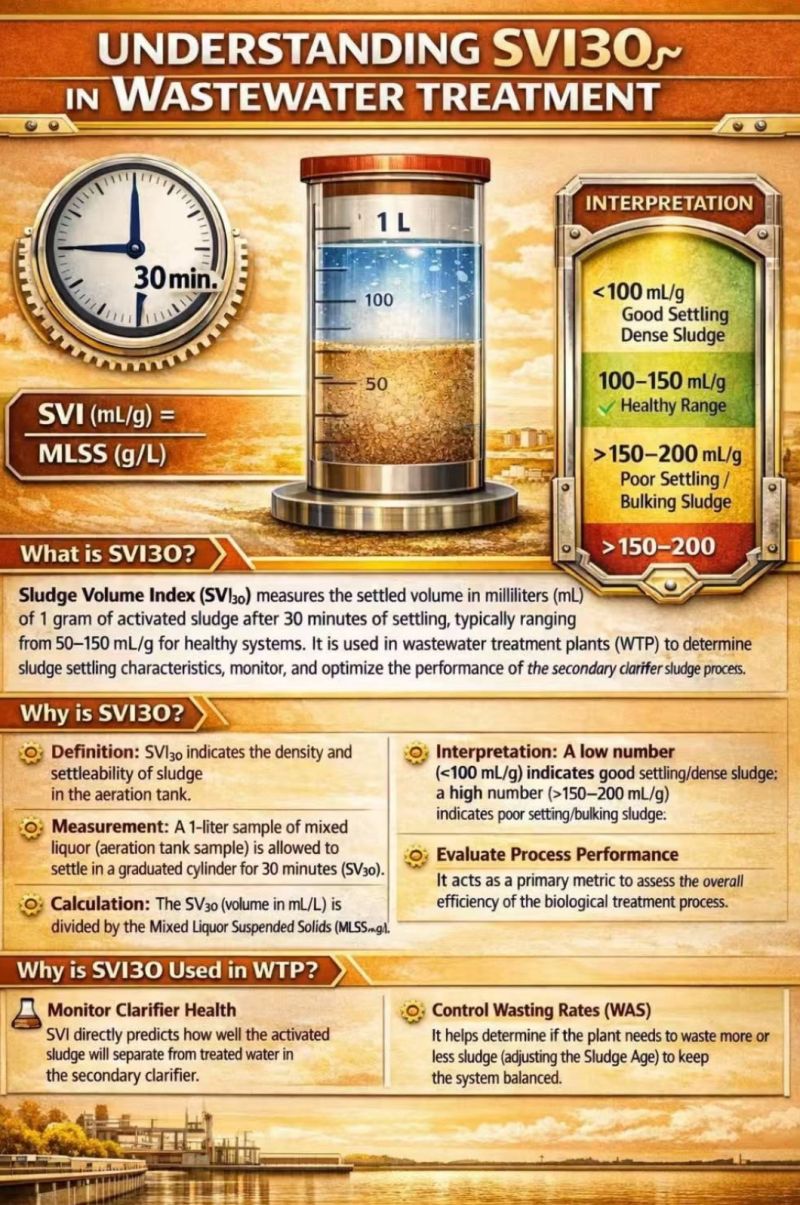
SVI₃₀ (Sludge Volume Index) is one of the most practical and widely used indicators for evaluating sludge settling characteristics in activated sludge systems. Despite its simplicity, it provides powerful insight into biological process health and clarifier performance.
🔹 What is SVI₃₀?
SVI₃₀ represents the volume (in mL) occupied by 1 gram of activated sludge after 30 minutes of settling in a graduated cylinder.
It is calculated as:
SVI₃₀ (mL/g) = Settled Sludge Volume (mL/L) ÷ MLSS (g/L)
This single value links biomass concentration with settling behavior, making it an essential operational parameter.
🔹 Typical Interpretation
• < 100 mL/g → Good settling, compact and dense sludge
• 100–150 mL/g → Healthy and stable operating range
• 150–200 mL/g → Poor settling, onset of bulking
• > 200 mL/g → Severe bulking, high risk of solids washout
🔹 Why is SVI₃₀ Important?
✔ Indicates sludge density and settleability
✔ Predicts secondary clarifier performance
✔ Helps identify bulking, pin floc, or dispersed growth early
✔ Supports optimization of biological treatment efficiency
✔ Guides sludge wasting rate (WAS) and sludge age (SRT) control
🔹 Operational Insight
-
Rising SVI₃₀ often signals filamentous growth, low DO, nutrient imbalance, or young sludge
-
Very low SVI₃₀ may indicate over-aeration, old sludge, or excessive wasting
-
Tracking SVI₃₀ trends is more valuable than a single reading
🔹 Key Takeaway
In daily plant operation, SVI₃₀ is a simple but powerful diagnostic tool. When monitored consistently, it allows operators to detect settling issues before effluent quality or clarifier performance is affected.
Good treatment control doesn’t always require complex instruments—sometimes, a 30-minute test tells you everything you need to know.