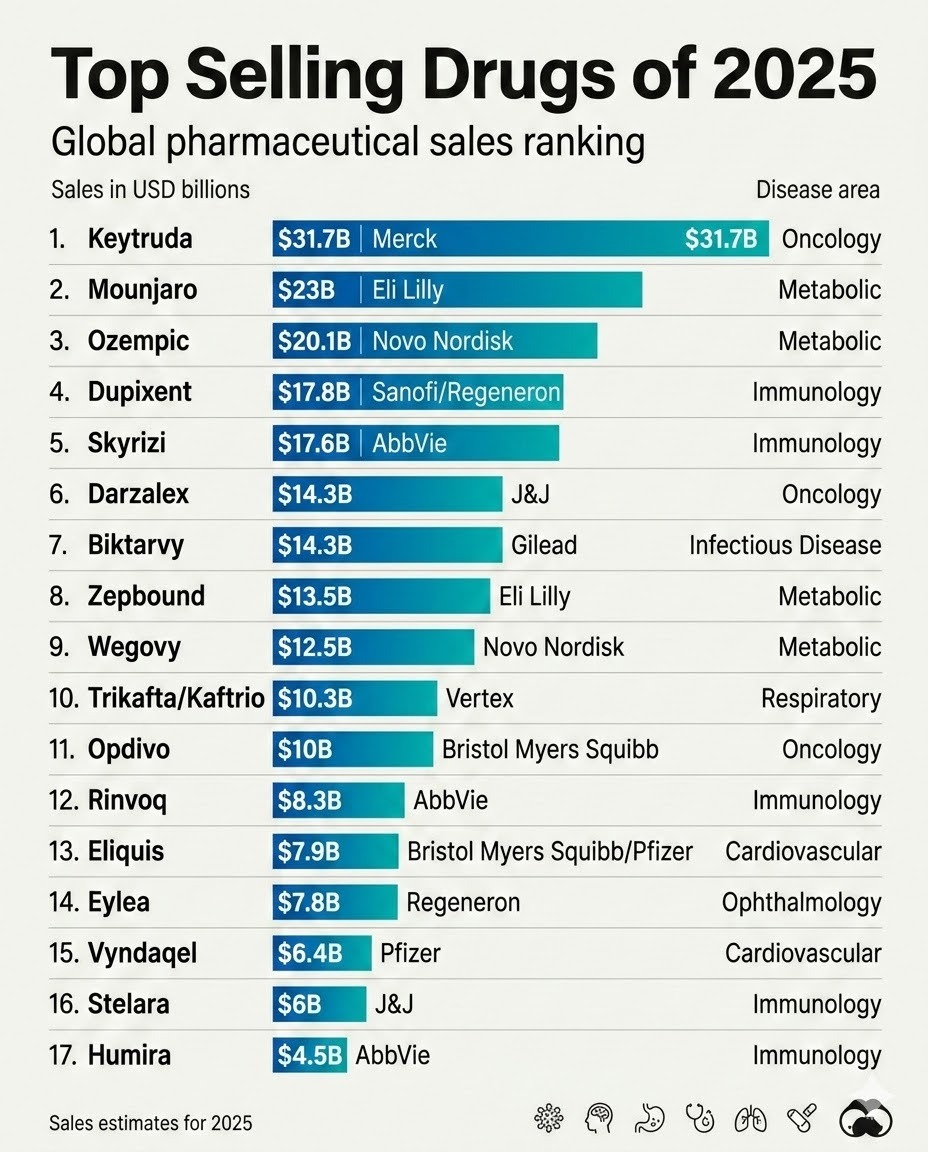
Merck’s Keytruda pulled in $31.7 billion in 2025, making it the world’s best-selling drug. It’s kept that title for years. But Eli Lilly is right on its heels.
That’s the real story. Lilly’s GLP-1 drugs are crushing it. Mounjaro hit $23 billion, and Zepbound added $13.5 billion. That’s $36.5 billion between just two drugs. If the trend continues, Lilly could actually unseat Keytruda next year.
Novo Nordisk is doing the same thing. Ozempic brought in $20.1 billion, and Wegovy added $12.5 billion. The GLP-1 drugs are where the money is now.
Keytruda isn’t going anywhere fast. The drug works by unleashing the immune system to attack cancer, and oncologists use it constantly. Merck also has Opdivo bringing in $10 billion, so they control a big chunk of the cancer market. J&J’s Darzalex hits $14.3 billion too.
Immunology drugs are still profitable. AbbVie’s got Rinvoq and Stelara doing well, Sanofi and Regeneron’s Dupixent is strong, and Skyrizi keeps growing. They’re treating real diseases that affect millions of people, but they’re not the growth story anymore.
Vertex’s Trikafta made $10.3 billion. It treats cystic fibrosis, which changed from basically untreatable to manageable. That’s less headline-grabbing than the GLP-1 boom, but it matters.
Will Lilly take the top spot? Probably, but not immediately. Merck’s got Keytruda locked in, oncology is still a goldmine, and there’s no shortage of cancer patients. But Lilly is hitting a bigger market. Obesity and diabetes affect way more people than cancer. If these drugs keep working and people keep using them, Lilly will be number one within a couple of years.
The shift is obvious. Five years ago, the top-selling drugs were all oncology and immunology. Now it’s GLP-1s. That’s where the pharmaceutical industry’s focus is going to be.