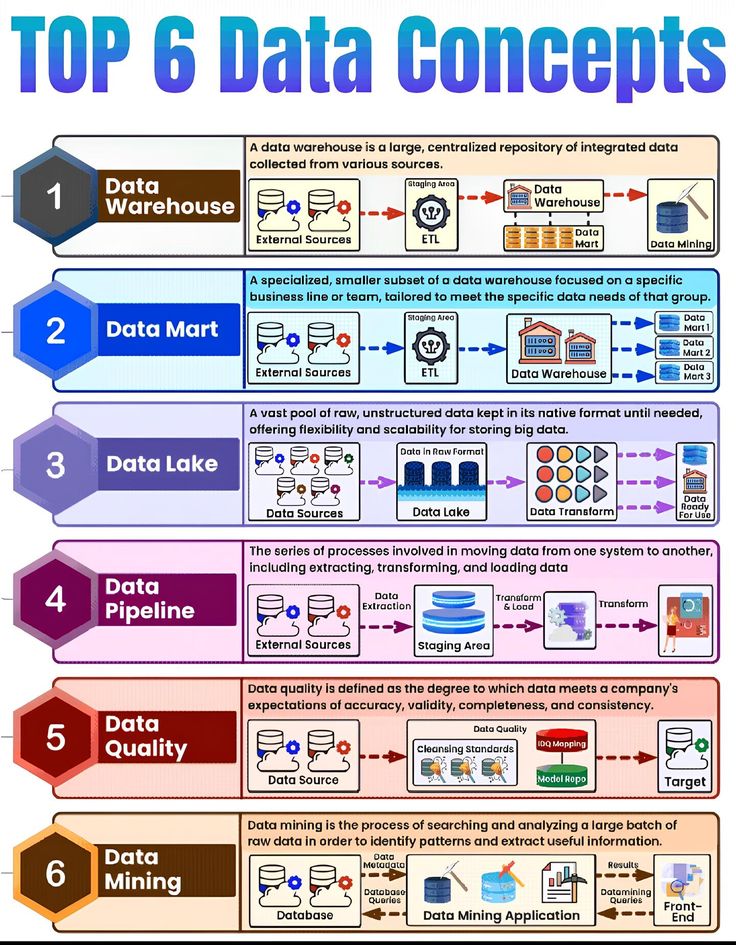
Top data concepts refer to foundational architectures and processes used in data management, analytics, and decision-making systems. These concepts form the backbone of modern data ecosystems and are widely adopted across industries such as finance, healthcare, manufacturing, retail, and technology.
Data Warehouse
A data warehouse is a centralized repository designed to store integrated, structured data collected from multiple sources. Data is typically processed using extract, transform, and load (ETL) procedures before being stored in the warehouse.
Data warehouses are optimized for query and analysis rather than transaction processing. They support business intelligence (BI), reporting, and historical analysis by providing a consistent and consolidated view of organizational data.
Data Mart
A data mart is a smaller, subject-oriented subset of a data warehouse, created to serve the analytical needs of a specific business unit or functional area. Data marts may be dependent on a central data warehouse or operate independently.
By focusing on a particular domain such as sales, finance, or marketing, data marts improve query performance and simplify data access for targeted analytical use cases.
Data Lake
A data lake is a storage system that holds large volumes of raw data in its native format, including structured, semi-structured, and unstructured data. Unlike data warehouses, data lakes apply schema-on-read rather than schema-on-write.
Data lakes are commonly used in big data analytics, machine learning, and advanced data processing scenarios due to their scalability and flexibility.
Data Pipeline
A data pipeline refers to a series of automated processes that move data from source systems to destination systems. Pipelines typically involve data extraction, staging, transformation, and loading.
Data pipelines enable continuous and reliable data flow between operational systems, data lakes, data warehouses, and analytical platforms, supporting real-time or batch processing use cases.
Data Quality
Data quality describes the degree to which data meets defined standards for accuracy, completeness, consistency, validity, and timeliness. Data quality management involves processes such as data cleansing, validation, standardization, and governance.
High data quality is critical for reliable analytics, regulatory compliance, and informed decision-making.
Data Mining
Data mining is the process of analyzing large datasets to identify patterns, relationships, anomalies, and trends. It employs techniques from statistics, machine learning, and database systems.
Data mining is widely applied in areas such as customer behavior analysis, fraud detection, risk management, and predictive analytics.