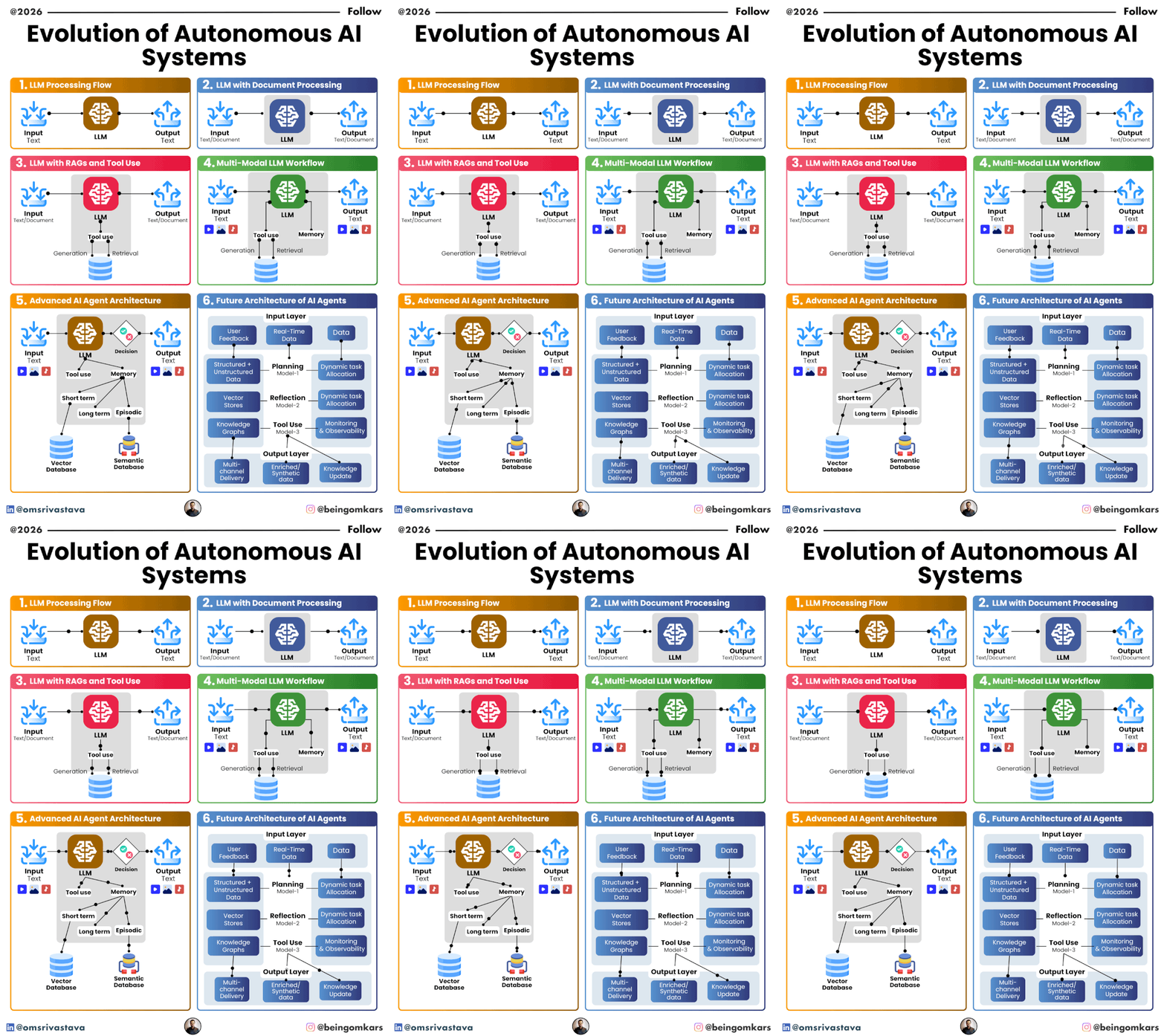
The Six Stages of AI Evolution: From Simple Text Generation to Autonomous AI Agents
Artificial Intelligence has rapidly evolved from simple rule-based systems to sophisticated agents capable of reasoning, learning, and making complex decisions. The journey of AI development—particularly Large Language Models (LLMs)—can be understood through six progressive stages. Each stage adds new capabilities, enabling AI systems to become more intelligent, context-aware, and autonomous.
Understanding this evolution helps businesses, developers, and decision-makers see how AI is moving from basic automation tools toward intelligent digital agents that can support real-world decision-making.
1. LLM Processing Flow: The Foundation of AI Interaction
The earliest stage of modern AI systems is the basic LLM processing flow. In this model, the workflow is straightforward: a user provides text input, and the AI generates a text output.
At this stage, AI primarily functions as a conversational or generative tool. It can answer questions, summarize information, write content, and generate ideas based on patterns learned from vast datasets during training.
However, the system operates mainly on its pre-trained knowledge and immediate context within the conversation. It does not have access to external databases, real-time data, or advanced reasoning systems.
Despite these limitations, this stage laid the foundation for many widely used AI applications such as chatbots, writing assistants, and automated customer service systems.
2. LLM with Document Processing: Turning AI into a Knowledge Tool
The second stage expands AI’s capabilities by enabling it to process both structured and unstructured documents. Instead of relying solely on general knowledge, the AI can now analyze files such as PDFs, spreadsheets, research papers, and business documents.
This enhancement transforms AI from a simple conversational tool into a powerful document intelligence system.
Organizations use this capability for tasks such as:
- Contract analysis
- Research summarization
- Financial document review
- Knowledge management systems
By allowing AI to read and interpret large volumes of documents, businesses can automate tasks that previously required significant human effort and time.
3. LLM with RAGs and Tool Use: Access to External Knowledge
The third stage introduces Retrieval-Augmented Generation (RAG) and tool integration. This is a major milestone because AI systems are no longer limited to their training data.
With RAG, the AI retrieves relevant information from external sources—such as databases, company knowledge bases, APIs, or search engines—before generating a response. This significantly improves accuracy and relevance.
Tool integration further expands AI capabilities by allowing the system to interact with external services. For example, AI can now:
- Query databases
- Run calculations
- Retrieve real-time information
- Interact with software tools
This stage allows AI to handle more complex queries and produce responses that are grounded in current, verifiable information rather than only pre-trained knowledge.
4. Multi-Modal LLM Workflow: Integrating Different Types of Data
The fourth stage represents a shift from text-only AI to multi-modal intelligence.
Multi-modal AI systems can process and understand multiple types of inputs simultaneously, including:
- Text
- Images
- Audio
- Video
For example, a user could upload a photo, ask a question about it, and receive a detailed explanation. Similarly, AI could analyze voice commands, interpret visual information, and generate written responses.
These systems are often enhanced with memory and tool usage, allowing them to maintain context across interactions and perform more complex workflows.
The result is a more natural and intuitive interaction between humans and AI, similar to communicating with a knowledgeable assistant rather than a simple text generator.
5. Advanced AI Agent Architecture: Toward Autonomous Intelligence
At this stage, AI evolves into a more autonomous agent capable of performing complex tasks across multiple steps.
Advanced AI agent architecture introduces several critical components:
Long-Term Memory
AI systems can store and recall information across interactions, enabling them to build context over time.
Episodic Memory
Agents can remember past experiences and outcomes, helping them improve decision-making in future tasks.
Tool Integration
AI agents can interact with multiple tools, services, and APIs to complete tasks efficiently.
External Knowledge Systems
Integration with vector databases and semantic search systems enables AI to retrieve highly relevant information quickly.
Together, these capabilities allow AI agents to perform sophisticated tasks such as workflow automation, research analysis, and strategic decision support.
Instead of responding to single prompts, AI agents can plan, execute, and adapt tasks over time.
6. Future Architecture of AI Agents: Self-Improving Intelligent Systems
The future of AI lies in highly advanced agent architectures capable of planning, reflecting, and continuously improving their performance.
These systems will likely consist of multiple integrated layers:
Input Layer
Handles user interactions, real-time data streams, and feedback loops.
Planning and Reflection Layer
AI models will be able to analyze their own performance, refine strategies, and adjust task execution dynamically.
Tool Use Layer
Agents will access specialized tools, software platforms, and databases to gather information and perform actions.
Output Layer
Results will be delivered through multiple channels, including dashboards, reports, automated workflows, and digital assistants.
In this architecture, AI will function less like a tool and more like a collaborative partner capable of managing complex objectives.
Why This Evolution Matters
The progression of AI from simple text generation to autonomous agents marks a fundamental shift in how technology supports human decision-making.
Modern AI systems are becoming:
- More context-aware
- More connected to external data sources
- More capable of executing multi-step tasks
- More autonomous in planning and problem-solving
For businesses, this evolution means AI will increasingly move beyond productivity tools into strategic decision support systems.
Organizations that understand and adopt these advanced AI architectures will gain significant advantages in automation, innovation, and data-driven decision-making.
As AI continues to evolve, the future will likely see intelligent agents that can learn continuously, collaborate with humans, and execute complex workflows across industries.