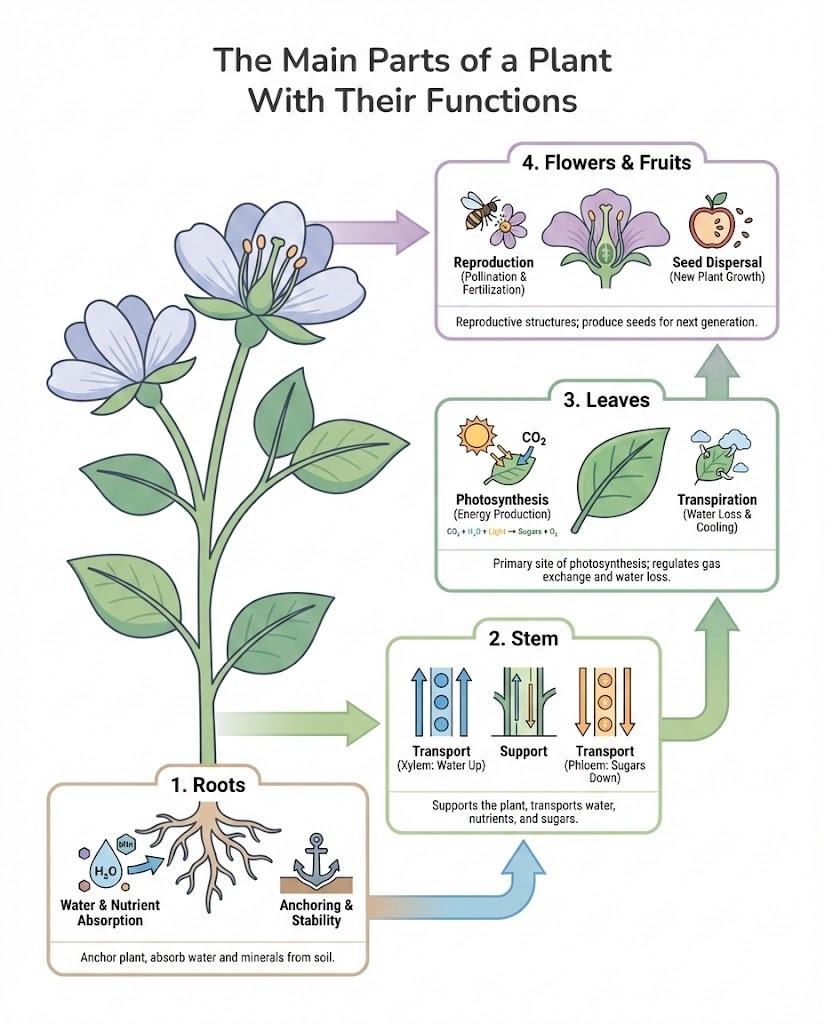
Plants are essential living organisms that support life on Earth by producing food, oxygen, and raw materials for humans and animals. They also help maintain ecological balance and improve air quality. To survive, grow, and reproduce, plants depend on several main parts, each designed to perform specific and important functions. These parts work together as an integrated system to ensure the plant’s proper development and survival.
The root is usually the first part of the plant to develop and grows beneath the soil. It anchors the plant firmly in place, preventing it from being uprooted by wind, rain, or moving water. Roots absorb water and dissolved minerals such as nitrogen, phosphorus, and potassium from the soil, which are vital for healthy growth. They also conduct this water upward to the stem. In many plants, roots act as storage organs, holding extra food in the form of starch, as seen in carrots, radishes, and beets. Some plants have special roots, such as aerial roots for breathing in swampy areas and prop roots for additional support in tall plants like maize.
The stem is the main upright part of the plant that grows above the ground. It provides structural support, holding leaves, flowers, and fruits in positions where they can receive sunlight and air. Inside the stem are vascular tissues called xylem and phloem. Xylem transports water and minerals from the roots to the leaves, while phloem distributes the food made in the leaves to all parts of the plant. The stem also helps in storage of food and water in plants like sugarcane and cactus. In some plants, stems are modified into structures such as tendrils for climbing or thorns for protection.
The leaves are the primary food-making organs of the plant. They are usually broad and flat to capture maximum sunlight. Leaves contain chlorophyll, a green pigment that absorbs sunlight for photosynthesis. During this process, leaves combine carbon dioxide from the air and water from the soil to produce glucose, which serves as the plant’s food, and oxygen, which is released into the atmosphere. Leaves also carry out respiration, which provides energy for the plant’s activities, and transpiration, which helps cool the plant and assists in the movement of water from the roots to the upper parts of the plant.
The flower is the reproductive structure of flowering plants. It contains male and female reproductive organs that produce pollen and ovules. Flowers are often brightly colored and fragrant to attract pollinators such as bees, butterflies, birds, and insects. Pollination occurs when pollen is transferred from the male part to the female part of the flower. This leads to fertilization, which results in the formation of seeds. Flowers play a crucial role in ensuring the continuation of plant species.
The fruit develops from the fertilized flower and surrounds the seeds. Its main function is to protect the developing seeds from damage and drying. Fruits also aid in seed dispersal by various methods, including wind, water, and animals. For example, juicy fruits attract animals that eat them and later release the seeds in different locations, helping plants spread and grow in new areas.
The seed is the reproductive unit of the plant and contains a tiny, undeveloped plant called an embryo. It also stores food to nourish the young plant during germination, before it can make its own food through photosynthesis. Seeds are adapted to survive harsh conditions such as drought or cold, allowing the plant species to persist over time. When suitable conditions such as moisture, warmth, and oxygen are present, the seed germinates and grows into a new plant.
In summary, each part of a plant performs a unique and vital function that contributes to the plant’s survival, growth, and reproduction. Roots absorb water and minerals, stems support and transport, leaves produce food, flowers enable reproduction, fruits protect and spread seeds, and seeds give rise to new plants. Together, these parts form a complete and efficient system that sustains plant life and supports ecosystems across the planet.