Have you ever wondered how clean water reaches your tap, or how the air in your home stays free from dust and allergens? The answer lies in a process called filtration. From industrial plants to household appliances, filtration plays a silent but vital role in maintaining health, safety, and efficiency across countless applications. But what exactly is filtration, and how does it work?
Filtration is the physical or mechanical process of separating solids from fluids—such as liquids or gases—by passing the mixture through a medium that retains the particles while allowing the fluid to pass through. This medium, known as a filter, can be made from a variety of materials, including paper, cloth, sand, activated carbon, or synthetic membranes. The size and type of particles removed depend on the filter’s pore size and the method used.
Types of Filtration
Filtration methods vary widely depending on the application, the nature of the substance being filtered, and the desired outcome. Broadly, filtration can be categorized into several types, each suited to specific environments and needs.
Gravity Filtration
This is one of the simplest and oldest forms of filtration. It relies on gravity to pull a liquid through a filter medium, such as filter paper in a funnel. Gravity filtration is commonly used in laboratories for separating precipitates from solutions. It’s slow but effective for removing larger particles and is often used in preliminary stages of purification.
Vacuum Filtration
Vacuum filtration accelerates the process by applying a vacuum beneath the filter, increasing the rate at which the liquid passes through. This method is more efficient than gravity filtration and is frequently used when time is a factor or when dealing with fine particles. It’s common in analytical chemistry and microbiology labs.
Pressure Filtration
In industrial settings, pressure filtration uses pumps or compressed air to force liquids through filters. This method is faster and more suitable for large-scale operations, such as in water treatment plants or pharmaceutical manufacturing. It allows for higher throughput and better control over the filtration process.
Membrane Filtration
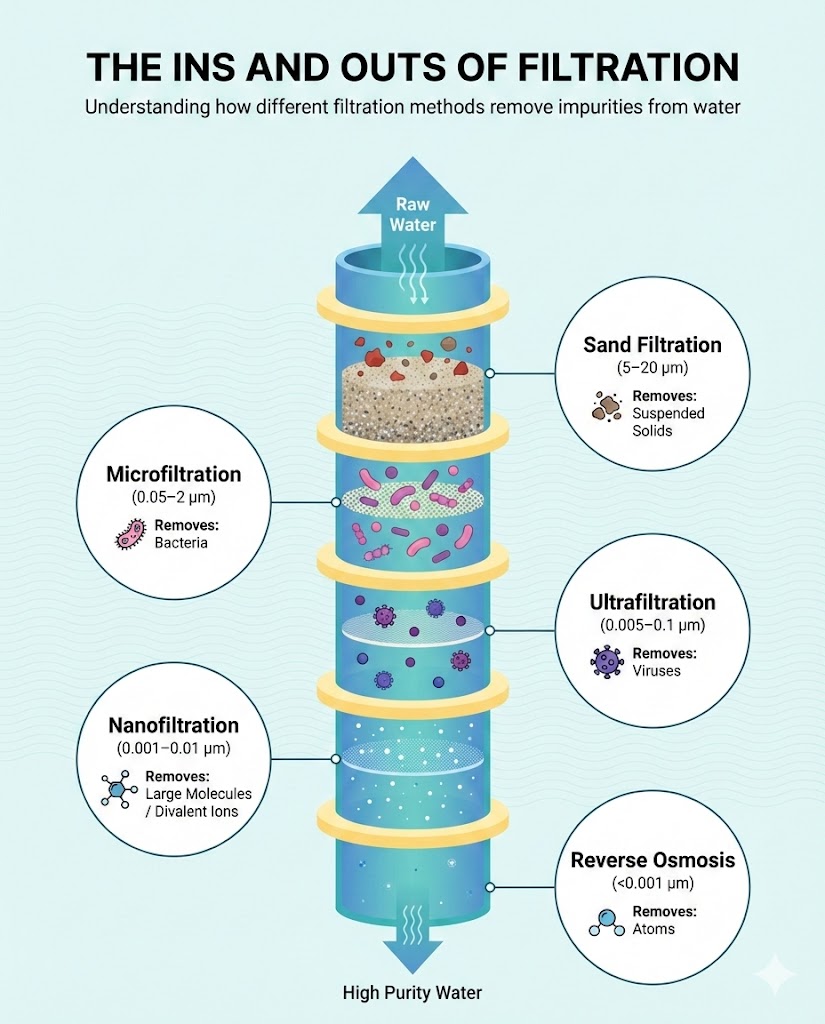
Membrane filtration uses semi-permeable membranes with precisely sized pores to separate particles based on size. This category includes several sub-types:
- Microfiltration: Removes particles larger than 0.1 microns, such as bacteria and sediment. Used in food and beverage processing.
- Ultrafiltration: Targets smaller particles, including viruses and large proteins. Common in water purification and dairy industries.
- Nanofiltration: Removes even smaller molecules, including some salts and organic compounds. Often used in softening water and recycling wastewater.
- Reverse Osmosis: The most advanced form, capable of removing dissolved salts, ions, and most contaminants. Widely used in desalination and producing drinking water.
Applications of Filtration
Filtration is not limited to water treatment. Its applications span multiple industries and everyday life.
Water Treatment
Municipal water treatment facilities use multi-stage filtration systems to remove sediments, pathogens, and chemicals from raw water sources. These systems often combine physical filtration with chemical treatment and disinfection to ensure safe drinking water.
Air Filtration
Indoor air quality is significantly improved through air filtration systems found in HVAC units, air purifiers, and industrial exhaust systems. High-efficiency particulate air (HEPA) filters, for example, can capture 99.97% of particles as small as 0.3 microns, including pollen, mold spores, and pet dander.
Food and Beverage Industry
Filtration ensures the clarity, safety, and shelf life of products like beer, wine, juice, and edible oils. It removes yeast, bacteria, and other impurities without altering the flavor or nutritional content.
Pharmaceuticals and Healthcare
In drug manufacturing, sterile filtration is essential to remove microorganisms from injectable solutions and other sensitive products. Medical devices, such as dialysis machines, also rely on precise filtration to function safely.
Automotive and Industrial Use
Engines depend on oil and fuel filters to remove contaminants that could cause wear or damage. Similarly, hydraulic systems in machinery use filtration to maintain fluid cleanliness and operational efficiency.
Factors Affecting Filtration Efficiency
Not all filtration systems perform equally. Several factors influence how effectively a filter works:
- Pore Size: Determines the smallest particle that can be trapped. Smaller pores capture finer particles but may slow flow rates.
- Filter Material: Different materials have varying chemical resistance, durability, and compatibility with specific fluids.
- Flow Rate: High flow rates can reduce contact time with the filter, potentially decreasing efficiency.
- Particle Characteristics: Size, shape, and charge of particles affect how easily they are captured.
- Maintenance and Replacement: Clogged or degraded filters lose effectiveness over time and must be cleaned or replaced regularly.
Key Takeaways
- Filtration is a process that separates solids from liquids or gases using a filter medium.
- Common types include gravity, vacuum, pressure, and membrane filtration, each suited to different needs.
- Applications range from drinking water purification and air cleaning to pharmaceuticals and industrial manufacturing.
- Efficiency depends on factors like pore size, filter material, flow rate, and proper maintenance.
- Advancements in membrane technology continue to improve the precision and sustainability of filtration systems.
FAQ
What is the difference between filtration and purification?
Filtration is a physical process that removes solid particles from a fluid. Purification, on the other hand, is a broader term that may include filtration as well as chemical, biological, or thermal methods to remove contaminants and make a substance safe or suitable for use.
How often should filters be replaced?
The replacement frequency depends on the type of filter, usage level, and manufacturer guidelines. For example, HVAC air filters may need changing every 1–3 months, while water filters in purifiers might last 6–12 months. Regular monitoring and maintenance ensure optimal performance.
Can filtration remove viruses and bacteria?
Yes, certain types of filtration, especially ultrafiltration, nanofiltration, and reverse osmosis, are capable of removing bacteria and viruses. HEPA filters can also trap many microorganisms when used in air filtration systems. However, effectiveness depends on the filter’s specifications and proper installation.