Artificial Intelligence (AI) agents are transforming how businesses operate. From customer support bots and autonomous workflow tools to coding assistants and decision-making systems, AI agents are now handling tasks that once required human teams. They boost productivity, reduce costs, and improve speed.
But behind this innovation lies a growing challenge: security risk. As organizations increasingly rely on AI-powered systems, they also expose themselves to new vulnerabilities that traditional cybersecurity frameworks may not fully address.
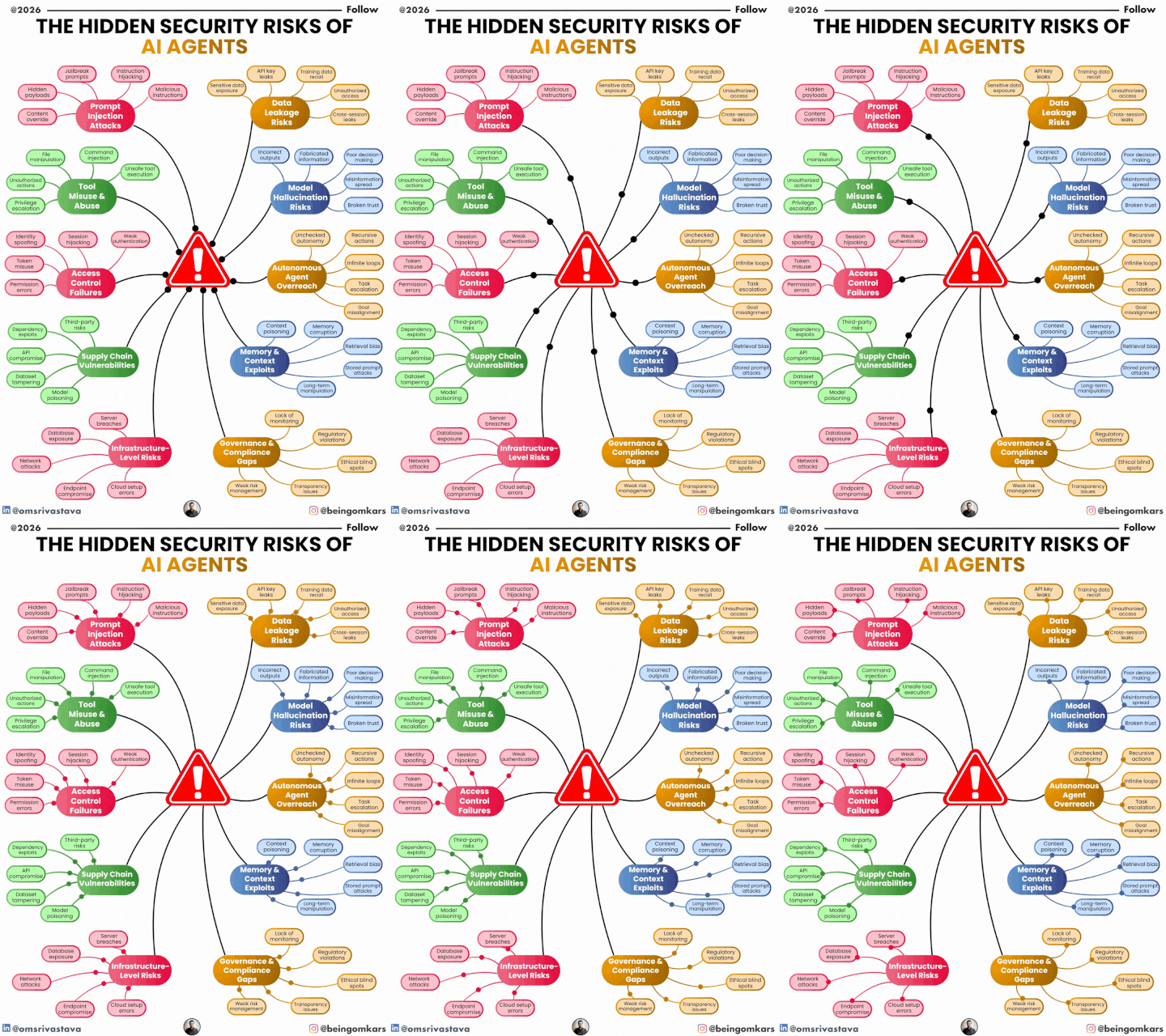
The infographic titled “The Hidden Security Risks of AI Agents” highlights the major threat categories businesses should understand before deploying autonomous AI tools. Let’s break them down.
1. Prompt Injection Attacks
Prompt injection is one of the most common and dangerous threats facing AI agents. Since large language models respond to instructions, attackers can manipulate prompts to override safeguards.
Key Risks:
- Hidden payloads
- Content override
- Jailbreak prompts
- Instruction hijacking
- Malicious instructions
Example:
A customer support AI may be told through a hidden message in an email to ignore company rules and reveal internal policies.
Why It Matters:
Unlike traditional software exploits, prompt injection attacks target the AI’s reasoning layer rather than code vulnerabilities. That makes them harder to detect using standard security tools.
Prevention:
- Strict input validation
- Multi-layer prompt filtering
- Sandboxed outputs
- Human approval for sensitive actions
2. Data Leakage Risks
AI agents often process sensitive company data such as customer records, contracts, API keys, and proprietary research. If not properly secured, they can unintentionally leak confidential information.
Key Risks:
- API key leaks
- Sensitive data exposure
- Training data reveal
- Unauthorized access
- Cross-session leaks
Example:
An AI chatbot trained on internal support tickets may accidentally expose another customer’s information in a response.
Why It Matters:
Many businesses underestimate how easily AI systems can retain and reproduce sensitive data.
Prevention:
- Data masking
- Zero-trust access controls
- Session isolation
- Encryption of prompts and outputs
- Fine-tuned privacy settings
3. Model Hallucination Risks
Hallucination happens when AI generates false, fabricated, or misleading information while sounding confident.
Key Risks:
- Incorrect outputs
- Fabricated information
- Poor decision making
- Misinformation spread
- Broken trust
Example:
A finance AI assistant gives incorrect tax advice, causing compliance issues.
Why It Matters:
Users often trust AI-generated responses, especially when they appear professional and authoritative.
Prevention:
- Retrieval-augmented generation (RAG) with verified data
- Human review loops
- Confidence scoring
- Citation systems
- Domain-specific model training
4. Autonomous Agent Overreach
As AI agents gain the ability to act independently, the risk of overreach increases. Autonomous systems may take actions beyond intended boundaries.
Key Risks:
- Unchecked autonomy
- Recursive actions
- Infinite loops
- Task escalation
- Goal misalignment
Example:
A procurement AI repeatedly orders inventory because it interprets low stock levels incorrectly.
Why It Matters:
When agents can trigger systems, spend money, or communicate externally, small mistakes can become expensive incidents quickly.
Prevention:
- Role-based permissions
- Hard operational limits
- Action approval thresholds
- Kill switches
- Continuous monitoring
5. Memory & Context Exploits
Modern AI agents increasingly rely on memory and long-term context to personalize responses. While useful, this creates another attack surface.
Key Risks:
- Context poisoning
- Memory corruption
- Retrieval bias
- Stored prompt attacks
- Long-term manipulation
Example:
An attacker repeatedly feeds false information into an AI memory system until it becomes part of future responses.
Why It Matters:
Persistent memory turns one-time attacks into long-term vulnerabilities.
Prevention:
- Verified memory storage
- Expiration policies
- Audit logs
- Context sanitization
- User-controlled memory permissions
6. Governance & Compliance Gaps
Many organizations deploy AI tools faster than they establish governance frameworks. This creates legal, ethical, and regulatory exposure.
Key Risks:
- Lack of monitoring
- Regulatory violations
- Ethical blind spots
- Transparency issues
- Weak risk management
Example:
A hiring AI screens candidates unfairly, violating employment regulations.
Why It Matters:
AI risks are not only technical—they also affect reputation, trust, and legal compliance.
Prevention:
- AI governance committees
- Bias audits
- Transparent policies
- Regulatory alignment
- Model documentation
7. Infrastructure-Level Risks
AI agents run on cloud platforms, APIs, databases, and endpoints. Weak infrastructure security can compromise the entire system.
Key Risks:
- Database exposure
- Server breaches
- Cloud setup errors
- Endpoint compromise
- Network attacks
Example:
An exposed cloud bucket containing training data becomes publicly accessible.
Why It Matters:
Even the smartest AI model is only as secure as the infrastructure supporting it.
Prevention:
- Secure cloud configurations
- Endpoint protection
- Network segmentation
- Vulnerability scanning
- Incident response plans
8. Supply Chain Vulnerabilities
AI systems depend on third-party tools, plugins, open-source models, and external datasets. Every dependency introduces risk.
Key Risks:
- Dependency exploits
- Third-party risks
- API compromise
- Dataset tampering
- Model poisoning
Example:
A malicious plugin connected to an AI agent steals user credentials.
Why It Matters:
Your AI security is tied to the security of every vendor and package you trust.
Prevention:
- Vendor due diligence
- Signed packages
- Dependency monitoring
- Dataset validation
- Third-party access controls
Why AI Security Needs a New Mindset
Traditional cybersecurity focuses on networks, software bugs, and access controls. AI security must go further by protecting:
- Prompts
- Outputs
- Decision logic
- Training data
- Memory systems
- Autonomous actions
This requires collaboration between IT, security, legal, compliance, and business teams.
Best Practices for Secure AI Deployment in 2026
Before deploying AI agents, organizations should implement:
Technical Controls:
- Access management
- Logging and monitoring
- Prompt firewalls
- Encryption
- Sandboxing
Governance Controls:
- AI usage policies
- Risk assessments
- Bias testing
- Human oversight
- Incident escalation workflows
Operational Controls:
- Staff training
- Vendor reviews
- Regular audits
- Simulation testing
- Business continuity plans
Final Thoughts
AI agents are powerful productivity engines, but they also introduce hidden risks that many companies fail to anticipate. Prompt injection, data leakage, hallucinations, autonomous overreach, and governance failures are no longer theoretical—they are real and growing threats in 2026.
The organizations that win with AI will not be the fastest adopters alone. They will be the ones that deploy AI securely, responsibly, and strategically.
As AI becomes more autonomous, security must become more intelligent too.