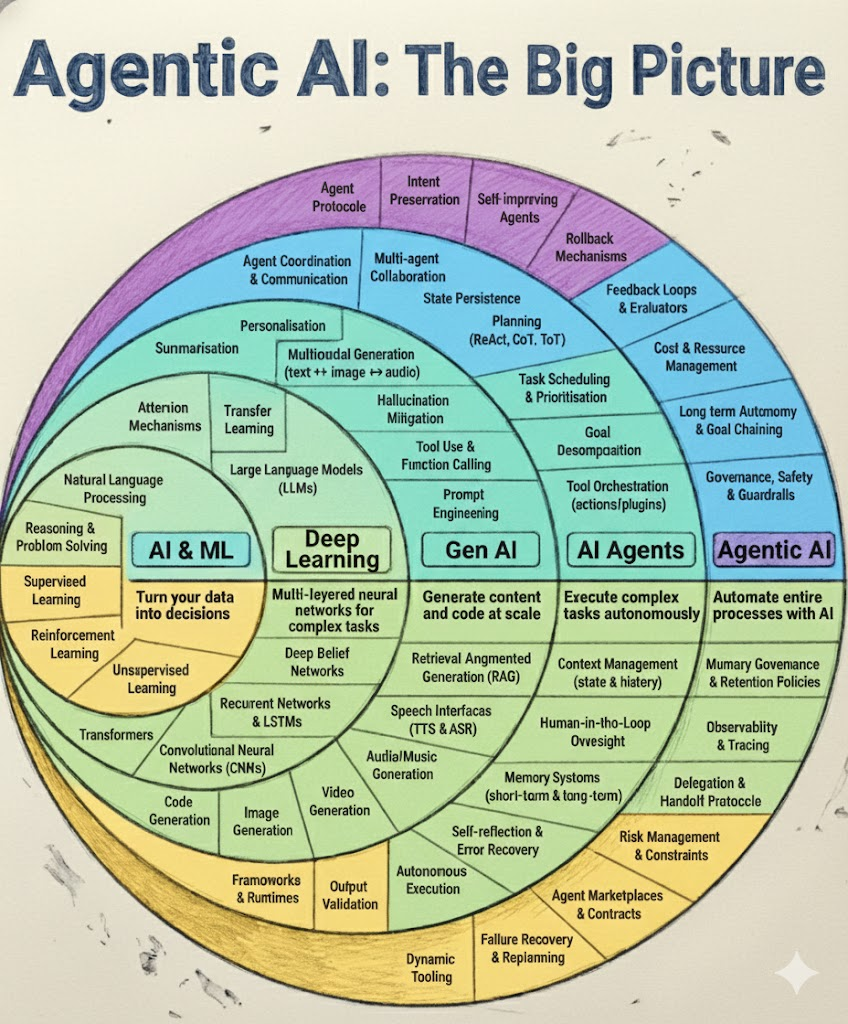
The transition from simple algorithms to fully autonomous systems is not a single leap, but a layered progression. Each stage of the “Big Picture” diagram represents a paradigm shift in how machines interact with information and the physical world. By peeling back these layers, we can understand the infrastructure required to move from a chatbot that answers questions to an agentic system that runs a business department.
Layer 1: AI & Machine Learning (The Foundation)
At the very center lies Artificial Intelligence and Machine Learning. This is the bedrock of the entire ecosystem. Its primary function is to turn data into decisions. Rather than being explicitly programmed with “if-then” statements for every scenario, these systems use statistical techniques to learn patterns.
-
Supervised Learning: Training on labeled data (e.g., “This is a picture of a cat”).
-
Reinforcement Learning: Learning through trial and error to maximize a reward, which is crucial for the later “Agentic” stages.
-
Natural Language Processing (NLP): The initial attempts to give machines a “voice” and the ability to parse human syntax.
Layer 2: Deep Learning (The Engine)
Moving outward, we find Deep Learning, characterized by multi-layered neural networks. If ML is the foundation, Deep Learning is the high-performance engine. It allows for “feature engineering” to happen automatically, meaning the AI decides which parts of the data are most important.
-
Transformers: The “T” in GPT. This architecture allows models to understand the context of a word based on the words that come before and after it.
-
CNNs & LSTMs: Specialized networks for vision and sequential data (like time-series or speech), enabling the AI to “see” and “remember” patterns over time.
-
Transfer Learning: The ability to take knowledge gained from one task and apply it to another, a prerequisite for the versatility of modern agents.
Layer 3: Generative AI (The Interface)
Gen AI represents the explosion of creativity. Here, the focus shifts from analyzing data to generating content and code at scale. This layer is what most people interact with today via tools like ChatGPT or Gemini.
-
RAG (Retrieval-Augmented Generation): This connects the AI to external, real-time data sources, solving the problem of “knowledge cutoffs.”
-
Prompt Engineering: The art of “talking” to the model to elicit the best possible output.
-
Hallucination Mitigation: The ongoing technical battle to ensure the AI stays grounded in facts rather than “dreaming” up false information.
Layer 4: AI Agents (The Actor)
This is the most significant pivot point in the diagram. AI Agents move beyond “talking” and begin executing complex tasks autonomously. An agent doesn’t just write an email; it logs into your email client, checks your calendar, and sends the invite.
-
Planning (ReAct, CoT, ToT): Techniques like “Chain of Thought” (CoT) allow the agent to break a big goal into smaller, logical steps.
-
Tool Use & Function Calling: The ability for the AI to “hand off” a task to a specialized tool, such as a calculator, a search engine, or a code execution sandbox.
-
Memory Systems: Distinguishing between short-term context (the current conversation) and long-term memory (user preferences and historical data).
Layer 5: Agentic AI (The Ecosystem)
The outermost layer, Agentic AI, represents the “Big Picture” in its most mature form. This isn’t just one agent; it is an orchestrated ecosystem where multiple agents work together to automate entire end-to-end processes.
-
Multi-Agent Collaboration: Imagine one agent acting as a Project Manager, another as a Coder, and a third as a Quality Assurance tester, all communicating through “Agent Protocols.”
-
Governance, Safety & Guardrails: As autonomy increases, so does the risk. This layer includes “Rollback Mechanisms” (the ability to undo an action) and “Intent Preservation” (ensuring the AI doesn’t deviate from the original goal).
-
Long-term Autonomy: Systems that can run for weeks or months, self-correcting and “re-planning” when they encounter failures, without needing a human to restart the process.
Conclusion: The Shift in Human Roles
As we move toward the edge of this diagram, the human role shifts from “Doer” to “Architect” and “Governor.” We are no longer just writing prompts; we are designing the systems that govern how these agents interact, ensuring they remain safe, ethical, and efficient.