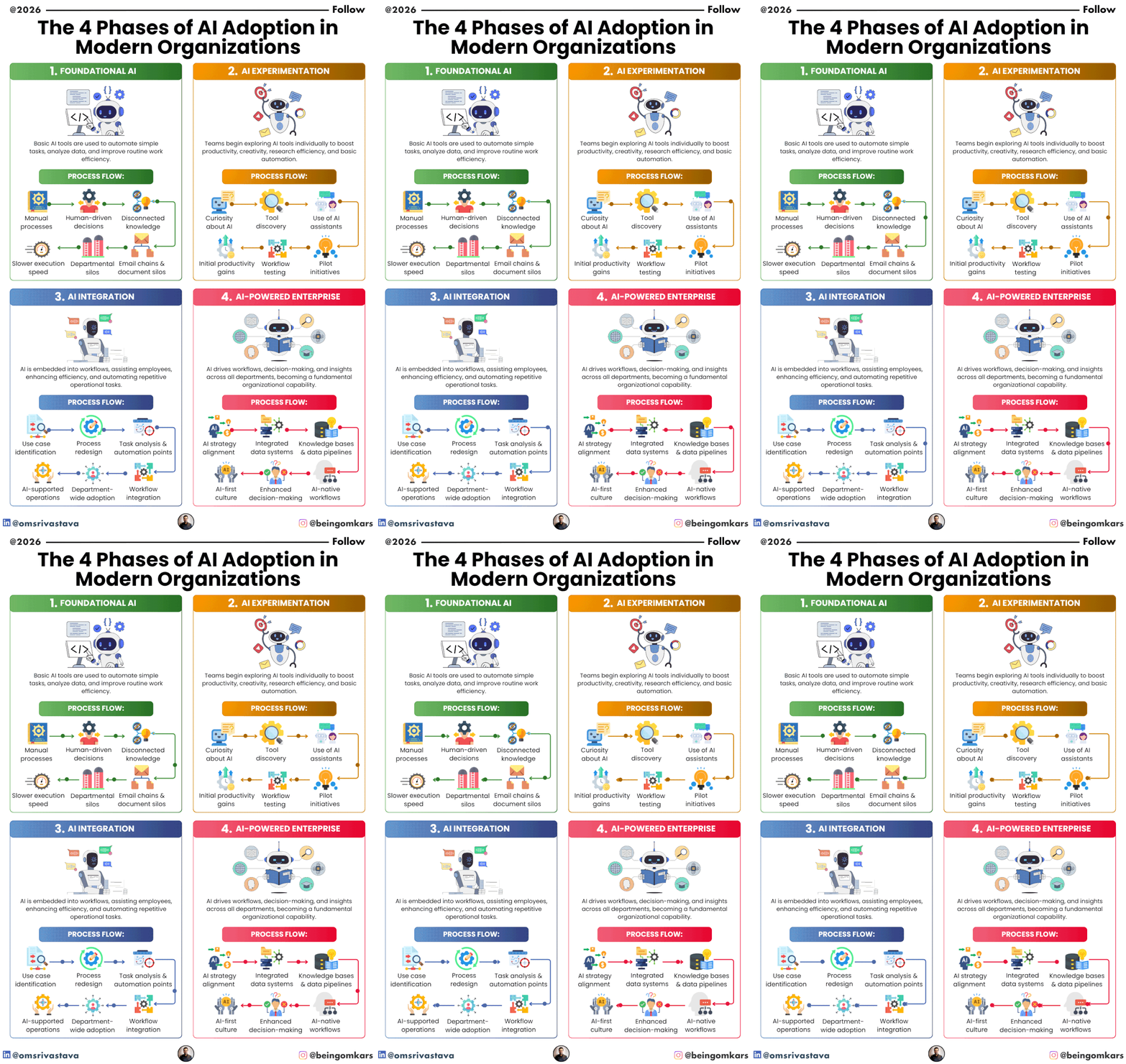
Artificial Intelligence (AI) adoption is no longer a one-time transformation—it’s a gradual evolution. Organizations typically move through four distinct phases as they mature from basic automation to fully AI-driven operations. Understanding these stages helps businesses assess where they stand and what steps are needed to unlock greater value.
1. Foundational AI: Laying the Groundwork
The journey begins with basic AI adoption, where organizations introduce simple tools to automate repetitive tasks and improve efficiency.
At this stage, operations are still largely manual and fragmented. Decision-making is human-driven, knowledge is scattered, and processes are slow. AI is used in limited ways—such as data analysis, basic automation, or rule-based systems—to reduce workload and enhance productivity.
However, challenges remain:
- Siloed departments restrict collaboration
- Email chains and disconnected systems slow workflows
- Knowledge is not centralized
This phase is less about transformation and more about building awareness and initial capability.
2. AI Experimentation: Exploring Possibilities
Once the foundation is set, organizations move into experimentation. Teams begin independently testing AI tools to improve productivity, creativity, and efficiency.
This phase is characterized by curiosity and exploration:
- Employees try AI assistants and automation tools
- Small pilot projects are launched
- Workflows are tested and refined
Early wins—such as faster research, content generation, or task automation—create momentum. However, adoption is still fragmented, with different teams using different tools without a unified strategy.
The key outcome here is learning what works and identifying high-impact use cases.
3. AI Integration: Embedding into Workflows
In this phase, AI transitions from isolated experiments to structured implementation. Organizations begin embedding AI into core workflows and business processes.
Key developments include:
- Identifying strategic use cases
- Redesigning processes to incorporate AI
- Automating repetitive operational tasks
- Integrating AI into existing systems
AI starts supporting employees at scale, improving efficiency across departments. Adoption becomes more consistent, and workflows become interconnected rather than siloed.
This stage marks a shift from “trying AI” to operationalizing AI.
4. AI-Powered Enterprise: Achieving Full Transformation
The final phase represents a fully mature organization where AI is central to how the business operates.
Here, AI is not just a tool—it’s a core capability driving:
- Decision-making
- Workflow automation
- Data-driven insights across departments
Organizations at this level have:
- Integrated data systems and pipelines
- Strong knowledge management frameworks
- AI-aligned business strategies
- An AI-first culture
Workflows become intelligent and adaptive, enabling faster, more accurate decisions. AI supports everything from strategic planning to day-to-day operations.
This phase delivers the highest value, turning AI into a competitive advantage.
Conclusion
AI adoption is a journey, not a switch. Organizations typically evolve from:
- Basic automation
- Experimentation and learning
- Process integration
- Enterprise-wide transformation
Each phase builds on the previous one, requiring not just technology investment but also cultural and strategic alignment.
Businesses that understand and actively navigate these stages are better positioned to scale AI effectively—and ultimately become truly AI-driven enterprises.