RNA Sequencing has become one of the most important technologies in modern molecular biology. By enabling precise measurement of gene expression across entire genomes, it provides insights into how cells function, respond to environmental changes, and develop disease. From academic research to clinical diagnostics and pharmaceutical development, RNA Sequencing is now a foundational tool for understanding biology at the molecular level.
This guide explains what RNA Sequencing is, how it works, its major applications, and what factors influence data quality and project success.
What Is RNA Sequencing?
RNA Sequencing, often referred to as RNA-Seq, is a technique used to analyze the complete set of RNA molecules in a biological sample. These molecules reflect which genes are active, how strongly they are expressed, and how transcripts are structured.
Unlike older hybridization-based methods, RNA Sequencing does not rely on predefined probes. Instead, it uses high-throughput sequencing to directly read complementary DNA derived from RNA, providing a comprehensive and unbiased view of the transcriptome.
Researchers use RNA Sequencing to:
-
Quantify gene expression levels
-
Identify novel transcripts and splice variants
-
Detect gene fusions and mutations
-
Compare expression profiles between conditions
-
Study regulatory mechanisms
How RNA Sequencing Works
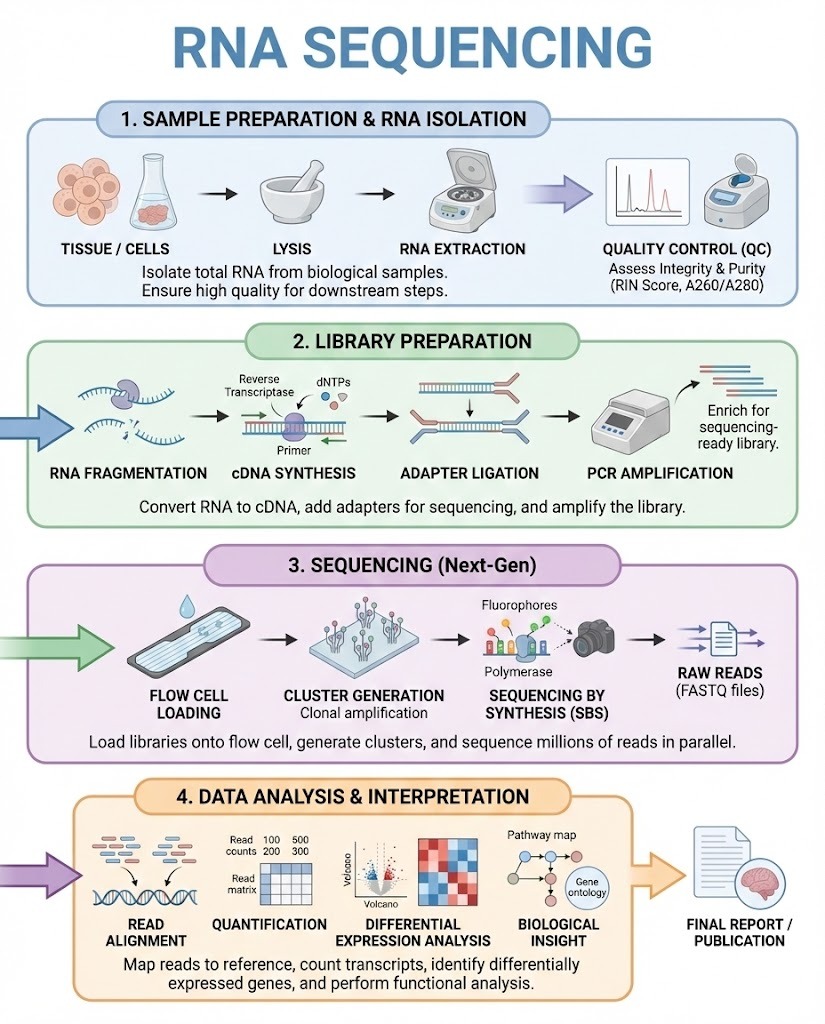
Although protocols vary, most RNA Sequencing projects follow a similar conceptual workflow.
Sample Collection and RNA Extraction
The process begins with biological material such as tissues, cells, or blood. RNA is extracted using chemical or column-based purification methods designed to preserve integrity and remove contaminants.
RNA quality is critical. Degraded RNA can distort expression profiles and reduce confidence in downstream analysis.
Library Preparation
Extracted RNA is converted into complementary DNA and prepared for sequencing. This stage typically includes:
-
RNA fragmentation or size selection
-
Reverse transcription into cDNA
-
Adapter ligation
-
Amplification and cleanup
Library preparation determines many performance characteristics of RNA Sequencing, including sensitivity and transcript coverage.
Sequencing
Prepared libraries are loaded onto a sequencing platform that generates millions of short reads. These reads represent fragments of the original RNA population and are stored in digital files for computational analysis.
Data Processing and Analysis
Bioinformatics tools are used to:
-
Filter low-quality reads
-
Align sequences to a reference genome or transcriptome
-
Quantify expression levels
-
Identify alternative splicing events
-
Perform statistical comparisons
The result is a detailed expression profile that can be interpreted biologically or clinically.
Types of RNA Sequencing
Different experimental goals require different approaches. Common RNA Sequencing strategies include:
-
mRNA sequencing focuses on protein-coding transcripts
-
Total RNA sequencing captures coding and noncoding RNA species
-
Small RNA sequencing targets microRNAs and other short RNAs
-
Single-cell RNA sequencing analyzes gene expression in individual cells
-
Strand-specific sequencing preserves transcript orientation
Each approach offers distinct advantages depending on the research question.
Key Applications of RNA Sequencing
RNA Sequencing is widely used across many fields.
Biomedical Research
Scientists use RNA Sequencing to explore:
-
Disease mechanisms
-
Immune system responses
-
Cancer progression
-
Developmental biology
It helps identify genes and pathways that are altered in specific conditions.
Clinical Diagnostics
In healthcare settings, RNA Sequencing can support:
-
Tumor profiling
-
Detection of rare genetic disorders
-
Monitoring treatment responses
-
Identifying biomarkers
While still subject to regulatory validation, clinical RNA Sequencing is rapidly expanding.
Drug Discovery and Development
Pharmaceutical researchers rely on transcriptomic data to:
-
Evaluate drug mechanisms of action
-
Detect off-target effects
-
Identify therapeutic targets
-
Stratify patient populations
Agriculture and Environmental Science
RNA Sequencing also contributes to:
-
Crop improvement
-
Stress tolerance studies
-
Microbial community analysis
-
Environmental monitoring
Advantages of RNA Sequencing
Compared to earlier technologies, RNA Sequencing offers several important benefits:
-
High sensitivity and wide dynamic range
-
Ability to detect novel transcripts
-
Single-base resolution
-
Compatibility with many sample types
-
Scalability for small or large projects
These strengths make it suitable for both exploratory studies and targeted investigations.
Challenges and Limitations
Despite its power, RNA Sequencing presents several challenges.
-
RNA is chemically unstable and easily degraded
-
Library preparation introduces potential biases
-
Data analysis requires specialized expertise
-
Large datasets demand significant storage and computing resources
-
Results depend heavily on experimental design
Understanding these limitations helps researchers plan realistic timelines and budgets.
Factors That Influence Data Quality
High-quality RNA Sequencing results depend on careful control of multiple variables.
Important factors include:
-
RNA integrity and purity
-
Consistency in sample handling
-
Library preparation method
-
Sequencing depth
-
Bioinformatics pipeline selection
Standard operating procedures and routine quality checks reduce technical variation.
Choosing Tools and Platforms
Successful RNA Sequencing projects require compatible tools at every stage.
Researchers typically evaluate:
-
RNA extraction kits
-
Library preparation systems
-
Sequencing instruments
-
Data analysis software
-
Data storage infrastructure
Integrated solutions from trusted suppliers often reduce compatibility risks and simplify workflow management.
Best Practices for Reliable Results
Experienced laboratories follow several widely accepted practices:
-
Validate protocols using pilot studies
-
Include biological and technical replicates
-
Document all experimental steps
-
Apply rigorous quality control metrics
-
Use appropriate statistical models
These measures improve reproducibility and scientific credibility.
The Future of RNA Sequencing
Ongoing advances are making RNA Sequencing faster, more affordable, and more precise. Emerging trends include:
-
Long-read transcript sequencing
-
Spatial transcriptomics
-
Improved single-cell technologies
-
Clinical-grade automation
-
Real-time data processing
As these innovations mature, RNA Sequencing will continue to expand its role in personalized medicine and systems biology.
Conclusion
RNA Sequencing has transformed how scientists study gene expression and cellular behavior. By providing a comprehensive view of the transcriptome, it enables discoveries that were previously unattainable with traditional methods.
Whether used in academic research, clinical diagnostics, or drug development, RNA Sequencing delivers powerful insights when supported by careful experimental design and robust data analysis. As technology continues to evolve, its importance in understanding health and disease will only grow.
Frequently Asked Questions
What is RNA Sequencing used for?
RNA Sequencing is used to measure gene expression, identify novel transcripts, analyze alternative splicing, and compare biological conditions at the molecular level.
How accurate is RNA Sequencing for gene expression analysis?
When properly designed and controlled, RNA Sequencing provides highly accurate and reproducible expression measurements across a wide range of transcript abundances.
What is the difference between RNA Sequencing and microarrays?
RNA Sequencing directly reads transcript sequences and does not rely on predefined probes, allowing detection of new genes and splice variants, whereas microarrays are limited to known targets.
How long does an RNA Sequencing experiment take?
Depending on sample number and complexity, the process can take from several days to a few weeks, including sample preparation, sequencing, and data analysis.
Download PDF
Enter your email address to unlock the full PDF download.
Generating PDF...