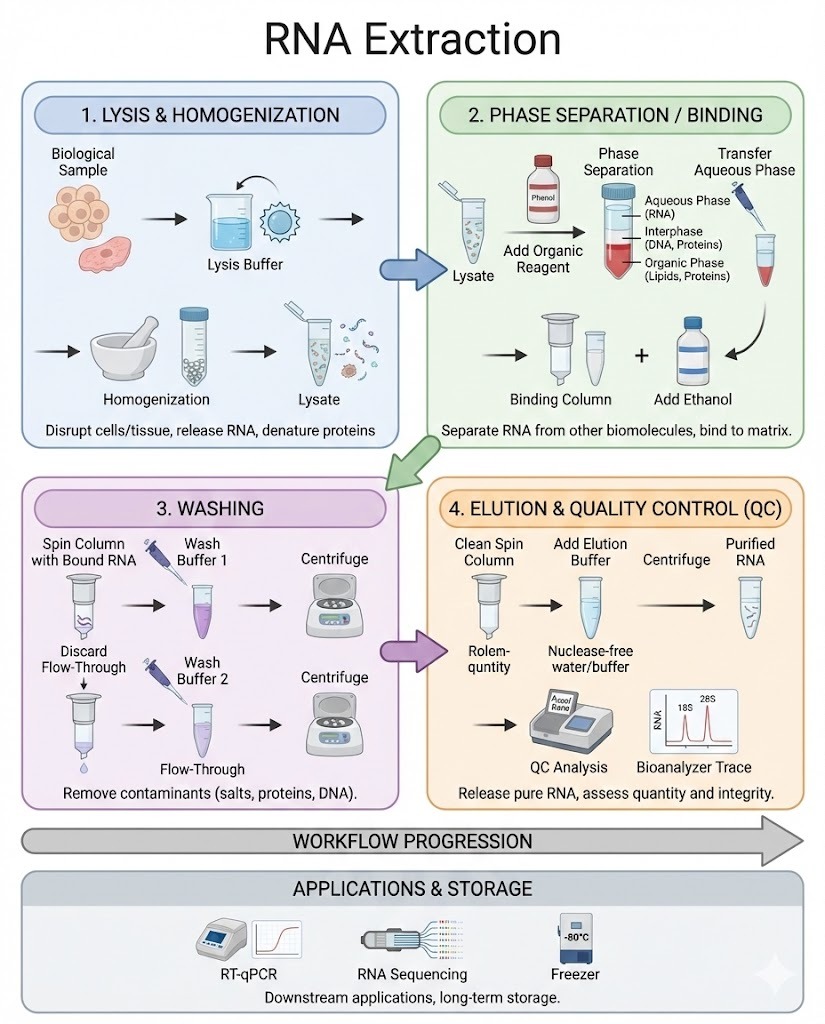
RNA extraction is a foundational technique in molecular biology, biotechnology, and clinical research. Nearly every transcriptomic or gene expression study depends on the ability to isolate intact, pure RNA from biological samples. Whether the goal is quantitative PCR, RNA sequencing, or viral detection, the quality of the extracted RNA directly determines the reliability of downstream results.
This guide provides a practical and comprehensive overview of RNA extraction, including its purpose, major methods, key variables, common challenges, and best practices for achieving consistent and reproducible outcomes.
What Is RNA Extraction?
RNA extraction is the process of isolating ribonucleic acid from cells, tissues, or other biological materials while removing proteins, lipids, DNA, and other contaminants. Because RNA is chemically unstable and highly susceptible to degradation by enzymes known as RNases, the procedure requires careful handling and optimized protocols.
Researchers rely on RNA extraction to:
-
Measure gene expression levels
-
Study alternative splicing and transcript variants
-
Detect viral or bacterial RNA
-
Perform transcriptome-wide analysis
-
Validate gene silencing or overexpression experiments
High-quality RNA serves as the starting material for many powerful molecular techniques.
Why RNA Extraction Quality Matters
Poor RNA quality can compromise an entire experiment. Degraded or contaminated RNA leads to:
-
Inaccurate gene expression measurements
-
Reduced sensitivity in detection assays
-
Failed library preparation for sequencing
-
Increased technical variability
-
Misleading biological conclusions
For this reason, RNA extraction is often considered one of the most critical steps in molecular workflows.
Common Sample Types for RNA Extraction
RNA can be isolated from a wide range of biological sources, including:
-
Cultured mammalian or microbial cells
-
Animal and plant tissues
-
Blood and plasma
-
Swabs and bodily fluids
-
Environmental samples
Each sample type presents unique challenges in terms of RNA stability, yield, and contamination risk.
Major Methods of RNA Extraction
Several well-established techniques are used in laboratories worldwide. The choice depends on sample type, throughput requirements, cost, and desired purity.
Phenol-Chloroform Extraction
This traditional method uses organic solvents to separate RNA from DNA and proteins.
Key characteristics:
-
High RNA yield
-
Effective for difficult samples
-
Cost-efficient
Limitations:
-
Toxic reagents
-
Time-consuming
-
Operator-dependent variability
Despite these drawbacks, phenol-based extraction remains widely used in research settings.
Silica Column-Based Extraction
This approach relies on RNA binding to silica membranes under specific salt conditions.
Advantages:
-
Fast and user-friendly
-
Consistent results
-
Minimal hazardous chemicals
Disadvantages:
-
Higher consumable cost
-
Slightly lower yield for some sample types
Column-based RNA extraction kits are common in academic and clinical laboratories.
Magnetic Bead-Based Extraction
Magnetic particles selectively bind RNA, allowing easy separation using magnets.
Benefits:
-
Automation compatibility
-
High reproducibility
-
Suitable for high-throughput workflows
Challenges:
-
Requires specialized equipment
-
Higher initial setup cost
This method is popular in diagnostic and industrial environments.
Direct Lysis Methods
Some applications use simplified protocols that skip purification steps.
Features:
-
Very fast
-
Minimal handling
Limitations:
-
Lower purity
-
Not suitable for sensitive downstream assays
These methods are mainly used in rapid screening or point-of-care testing.
Key Steps in a Typical RNA Extraction Workflow
Although protocols vary, most workflows include the following stages.
-
Sample disruption and lysis to release RNA
-
Inactivation of RNases
-
Separation of RNA from DNA and proteins
-
Washing to remove contaminants
-
Elution of purified RNA
-
Quality and quantity assessment
Each step must be optimized to prevent degradation and loss.
Assessing RNA Quality and Quantity
After RNA extraction, quality control is essential.
Common evaluation methods include:
-
Spectrophotometric measurement of concentration and purity
-
Fluorometric quantification for low-abundance samples
-
Electrophoretic analysis to assess RNA integrity
Key indicators of good quality RNA include:
-
High concentration relative to sample size
-
Appropriate purity ratios
-
Minimal fragmentation
Only high-quality RNA should be used for sensitive applications such as RNA sequencing or quantitative PCR.
Factors That Influence RNA Extraction Success
Several variables affect the outcome of RNA extraction.
Important factors include:
-
Sample freshness and storage conditions
-
Presence of RNases
-
Homogenization efficiency
-
Reagent quality
-
Temperature during processing
-
Operator technique
Standardizing these factors improves reproducibility and data reliability.
Common Challenges and How to Address Them
Even experienced laboratories encounter difficulties during RNA extraction.
RNA Degradation
Caused by:
-
RNase contamination
-
Prolonged processing time
-
Improper storage
Prevention strategies:
-
Use RNase-free consumables
-
Work quickly on ice
-
Add RNase inhibitors when appropriate
Low Yield
Possible reasons:
-
Incomplete lysis
-
Inefficient binding
-
Sample-specific issues
Solutions:
-
Optimize homogenization
-
Increase starting material
-
Adjust protocol parameters
DNA Contamination
DNA can interfere with downstream analysis.
Mitigation:
-
Include DNase treatment
-
Design assays that distinguish RNA from DNA
Applications That Depend on RNA Extraction
RNA extraction is essential for numerous scientific and clinical fields.
Major applications include:
-
Gene expression profiling
-
RNA sequencing
-
Viral diagnostics
-
Cancer biomarker discovery
-
Drug response studies
-
Functional genomics
The accuracy of these applications directly reflects the quality of the extracted RNA.
Choosing RNA Extraction Kits and Reagents
Selecting the right tools simplifies workflow design and improves consistency.
Key considerations:
-
Sample type compatibility
-
Yield and purity requirements
-
Throughput needs
-
Automation support
-
Regulatory compliance for clinical use
Many suppliers offer specialized kits tailored to specific tissues or organisms.
Best Practices for Reliable RNA Extraction
Laboratories with consistently high-quality results typically follow these principles:
-
Maintain RNase-free work environments
-
Validate protocols for each sample type
-
Use internal quality controls
-
Document reagent batches and conditions
-
Train staff thoroughly
-
Store RNA at appropriate temperatures
Implementing these practices reduces variability and experimental failure.
The Role of Automation in RNA Extraction
Automation is increasingly adopted to support:
-
Large sample volumes
-
Clinical testing pipelines
-
High reproducibility requirements
Automated platforms reduce human error, standardize processing, and shorten turnaround times, making them attractive for diagnostic and industrial settings.
Conclusion
RNA extraction is the cornerstone of modern transcriptomic and molecular analysis. It transforms complex biological samples into purified RNA suitable for precise measurement and interpretation.
By selecting appropriate extraction methods, maintaining strict quality control, and following best practices, researchers and clinicians can ensure reliable downstream results. As technologies continue to advance, efficient and reproducible RNA extraction will remain a critical requirement for understanding gene regulation, diagnosing disease, and developing new therapies.
Frequently Asked Questions
What is RNA extraction used for?
RNA extraction is used to isolate RNA from biological samples so it can be analyzed for gene expression, viral detection, transcriptome profiling, and other molecular applications.
How long does an RNA extraction procedure take?
Depending on the method and sample type, RNA extraction can take from 30 minutes to several hours, including quality assessment.
What is the best method for RNA extraction?
The best method depends on the application and sample type. Column-based and magnetic bead methods are popular for routine use, while phenol-based methods are often chosen for maximum yield.
How can RNA degradation be prevented during extraction?
Degradation can be minimized by using RNase-free materials, working quickly at low temperatures, and following validated protocols with proper reagent handling.
Download PDF
Enter your email address to unlock the full PDF download.
Generating PDF...