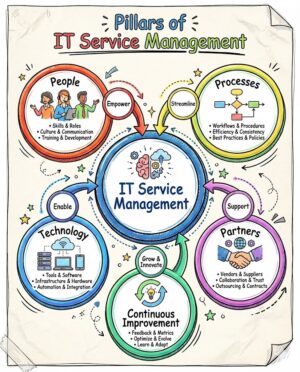
The concept of IT Service Management (ITSM) is far more than just maintaining computers and fixing broken equipment; it is a holistic approach to delivering value to customers in the form of services. For an organization to successfully implement and mature its ITSM capabilities, it must build its strategy upon a strong foundation. This foundation is often conceptualized as the ‘Pillars of IT Service Management.’ While frameworks like ITIL have evolved the terminology over time, the fundamental components remain constant, ensuring that service delivery is stable, scalable, and focused on business outcomes. These pillars provide a crucial structure, ensuring that all aspects of service provision—from strategic planning to tactical operation—are interconnected and optimized. Understanding these pillars is the prerequisite for any operational decision-maker seeking excellence in managing technology services in the modern enterprise.
Historically, and under the current ITIL 4 guidance, these foundational elements can be mapped directly to the Four Dimensions of Service Management, which ensures a balanced and integrated view of service delivery. Neglecting even one pillar leads to systemic imbalance and guaranteed failures in service performance, customer satisfaction, and overall value realization. The goal of defining these pillars is to move IT away from being a mere cost center and firmly position it as an essential strategic partner capable of driving business success and innovation.
The first crucial pillar is *Value Streams and Processes*. This dimension focuses on how the organization creates, delivers, and supports its services. A value stream is a series of steps an organization takes to create and deliver products and services to consumers. This includes everything from the initial demand or opportunity identification through to the realization of value by the end-user. Effective ITSM requires meticulously defined, repeatable, and optimized processes. These processes standardize how tasks are performed, reduce errors, and ensure consistency, which is vital for compliance and auditing. Key processes housed within this pillar include Incident Management, which ensures the quick restoration of normal service operation; Problem Management, which seeks to identify and eliminate the root causes of incidents; Change Enablement (formerly Change Management), which minimizes the risk associated with changes to the IT environment; and Service Level Management, which defines and monitors agreed-upon service quality metrics. Without streamlined value streams and mature processes, IT operations become chaotic, reactive, and incapable of scaling to meet growing business demands. Continuous process improvement, driven by metrics and feedback, is essential to keep this pillar strong and relevant as technology and business needs change.
The second pillar, *Organizations and People*, recognizes that technology services are delivered by human effort and supported by organizational structure and culture. This is arguably the most critical pillar, as even the best processes and tools fail if the people executing them lack the right skills, motivation, or structure. This pillar encompasses establishing a clear organizational structure with well-defined roles, responsibilities (often formalized using RACI matrices), and lines of authority. However, it extends far beyond the org chart. It crucially involves fostering a service culture—an environment where every team member understands their contribution to the overall value delivery and prioritizes the customer experience. This requires comprehensive training, skill development, and career pathways that keep staff engaged and competent in rapidly evolving technologies. Furthermore, communication and collaboration must be frictionless across internal IT teams and between IT and the business units it supports. A healthy organizational culture that values accountability, transparency, and continual learning directly supports the resilience and agility required for modern service management.
The third essential pillar is *Information and Technology*. This dimension relates to the tools, knowledge, and data required to manage services effectively. It covers the IT infrastructure itself—hardware, software, networks, data centers, and cloud environments—but also, and perhaps more importantly for ITSM formulation, the systems that enable IT management. The core of this is the Service Management Toolset, which typically includes platforms for Service Desk operations, Configuration Management Databases (CMDBs), knowledge bases, and automation capabilities. The correct selection and integration of these tools are paramount. For instance, a robust CMDB is the single source of truth for all IT assets and their relationships, which is crucial for efficient Change and Incident Management. Moreover, this pillar governs the management of information itself—ensuring data is accurate, secure, available, and utilized effectively to drive operational insights. Automation and AI/ML are increasingly becoming key components of this pillar, allowing routine tasks to be handled automatically, freeing up human resources for more complex, value-adding activities. The technology chosen must support the organization’s processes and enable the people, not constrain them.
The final pillar is *Partners and Suppliers*. No organization operates in isolation; services are increasingly dependent on external parties, including cloud providers, managed service providers (MSPs), software vendors, and outsourced functions. This pillar focuses on the relationships and agreements necessary to ensure that external parties deliver the required quality of service reliably and securely. Effective Supplier Management involves defining clear contract terms, monitoring performance against Service Level Agreements (SLAs), and establishing strong, collaborative relationships. It requires a strategic perspective to determine which services are core competencies that should be maintained internally and which can be effectively and safely sourced externally. Poor management of this pillar can introduce significant risks, including security vulnerabilities, compliance breaches, and service interruptions if external providers fail to meet their obligations. A successful strategy treats key partners as extensions of the internal team, fostering mutual trust and shared objectives rather than purely transactional relationships. This is especially vital in hybrid and multi-cloud environments where dependency on external infrastructure and software platforms is high.
While these four dimensions define the core building blocks, two overarching concepts underpin the stability and long-term success of all four pillars: Governance and Continual Improvement. Governance provides the direction and control, ensuring that the organization’s strategies and policies are followed across all four dimensions. It involves establishing decision-making frameworks, defining accountability, and monitoring performance against strategic goals. Governance ensures that all activities related to the four pillars are aligned with the overall business objectives and regulatory requirements.
Continual Improvement (CI), the second overarching concept, is the engine that prevents the pillars from becoming rigid and outdated. CI ensures that service management is not a one-time project but an ongoing cycle of measurement, review, and enhancement. The CI model typically involves steps like ‘What is the vision?’, ‘Where are we now?’, ‘Where do we want to be?’, ‘How do we get there?’, ‘Take action,’ ‘Did we get there?’, and finally, ‘How do we keep the momentum going?’ Applying CI principles across all four pillars—improving processes, training people, upgrading technology, and optimizing supplier relationships—guarantees that ITSM capabilities evolve in lockstep with the demands of the business and the rapidly changing technological landscape. This feedback loop is essential for maintaining competitive advantage and managing risk effectively.
In practice, the interconnected nature of these pillars means that optimizing one often requires consideration of the others. For example, implementing a new automation *Technology* (Pillar 3) necessitates new *Processes* (Pillar 1) and specialized skills in the *People* (Pillar 2) to manage the new system. Similarly, deciding to outsource the Service Desk function to a *Partner* (Pillar 4) fundamentally changes the *Processes* and resource allocation within the *Organization*. The guide to water treatment chemical formulation, much like ITSM, emphasizes a cyclical relationship where chemical input dictates physical output; in ITSM, strategic input dictates operational output.
For operational decision-makers who may lack a deep technical background, these pillars serve as a framework for strategic resource allocation. When troubleshooting service failures or planning strategic improvements, they must ask structured questions related to each pillar: Do our processes clearly define the steps? Do our people have the necessary training and capacity? Is the technology suitable and integrated correctly? Are our partners meeting their contractual obligations? This structured inquiry prevents siloed thinking and ensures that solutions address the root cause of the imbalance across the service ecosystem.
Furthermore, chemical safety and regulatory compliance are paramount in water treatment, mirroring the critical importance of security and compliance in ITSM. The Information and Technology pillar must incorporate robust security controls and adhere to national and international standards (like ISO 27001 or industry-specific regulations) to protect sensitive data and maintain public trust. Failure to adhere to these standards, much like a failure in chemical purity, can result in catastrophic operational and reputational damage. Therefore, integrating compliance requirements directly into the design of processes and technology is non-negotiable.
The successful management of IT services is defined by the strength and alignment of these foundational pillars. They are the scaffolding for the entire service value system, translating complex technology into reliable, valuable business capabilities. By maintaining focus on processes, people, technology, and partners, organizations can ensure resilience, efficiency, and a constant trajectory of value creation, transforming IT from a reactive function into a proactive driver of enterprise strategy.
Expanding on the *Value Streams and Processes* pillar, a critical distinction must be made between technical management, application management, and service management processes. Technical management focuses on the infrastructure components (servers, storage, network devices) and the operational efficiency of those assets. Application management focuses on the lifecycle of software applications used by the business. Service management processes integrate these two technical domains, ensuring that all underlying components—whether hardware or software—are managed to deliver a specified level of service quality to the customer. This requires careful alignment of process metrics. For example, while the technical team might measure network latency (a technical metric), the service management process uses this data to ensure the agreed-upon availability target (a service metric) is met for the end user.
Regarding the *Organizations and People* pillar, the structure must be flexible enough to support new operational models, such as DevOps or Agile development, which require greater cross-functional collaboration than traditional siloed IT departments. Adopting a service-oriented mindset means shifting from a focus on components (e.g., “I manage the server”) to a focus on outcomes (e.g., “I ensure the e-commerce platform is available”). This cultural shift is often the most difficult aspect of ITSM transformation. It necessitates leadership buy-in and continual reinforcement through performance management and reward systems that recognize collaborative success over individual heroism or silo efficiency. The roles must also account for increasing specialization in areas like cybersecurity, data science, and cloud architecture, which demands strategic workforce planning to address future skills gaps effectively.
The *Information and Technology* pillar is heavily influenced by rapid technological advancement, particularly the shift to cloud and hybrid IT environments. Modern ITSM tools must be capable of dynamic discovery and mapping of assets that live both on-premises and across multiple cloud platforms. Furthermore, the integration between ITSM tools (for workflow) and operational monitoring tools (for performance data) is paramount. Failure to integrate these systems results in manual data entry, increased error rates, and delayed response times. The concept of Service Integration and Management (SIAM) is especially relevant here, ensuring that when multiple technology platforms or external providers are utilized, the information flow and operational handoffs are seamlessly coordinated through integrated toolsets, treating the entire complex ecosystem as a unified service delivery fabric.
Finally, revisiting *Partners and Suppliers*, the strategic classification of suppliers is essential. Not all vendors require the same level of management rigor. Suppliers providing commodity services (like office supplies) require minimal oversight, whereas strategic partners providing mission-critical services (like core network connectivity or essential cloud services) require intensive, collaborative management. This often includes joint continual improvement efforts and shared risk management sessions. The contract structure must move beyond punitive clauses and focus instead on incentives for innovation and shared value creation, reflecting a mature partnership model rather than a simple buyer-seller arrangement. The guidance encourages not just managing the delivery, but also managing the associated risks—such as the risk of vendor lock-in or the security risks associated with data access provided to third parties, demanding careful due diligence throughout the lifecycle of the relationship.
The strength of the ITSM framework lies in the synergistic nature of these pillars. Just as the guide emphasizes that chemical choice affects physical process success (e.g., poor coagulation means poor filtration), deficiencies in any ITSM pillar lead directly to failure in others. For instance, weak processes (Pillar 1) make even the most highly skilled staff (Pillar 2) inefficient; unreliable technology (Pillar 3) undermines the best agreements with partners (Pillar 4). Therefore, successful ITSM implementation requires a balanced investment and development strategy across all four dimensions, ensuring that governance acts as the unifying structure and continual improvement drives necessary evolution.
The focus on efficiency and cost reduction in the modern trends of water treatment is echoed in ITSM’s contemporary goals, which prioritize cost-to-serve analysis, optimizing resource utilization, and minimizing waste through efficient process design. The comprehensive nature of the guide, covering main process streams and peripheral management (like sludge conditioning in water treatment), mirrors the ITSM requirement to manage the entire service lifecycle, including the often-overlooked aspects of managing legacy systems, decommissioning services, and handling configuration data cleanup. A truly effective ITSM strategy leaves no part of the service ecosystem unaddressed or unmanaged, maintaining operational excellence from demand inception through service retirement.
Ultimately, the Pillars of IT Service Management—Value Streams & Processes, Organizations & People, Information & Technology, and Partners & Suppliers—provide the blueprint for transforming technology assets into valuable, reliable services. By addressing each pillar with equal rigor, organizations ensure their IT function is robust, adaptive, and fully aligned with the overarching strategic goals of the business, consistently delivering high-quality, safe, and effective services to the end consumer.