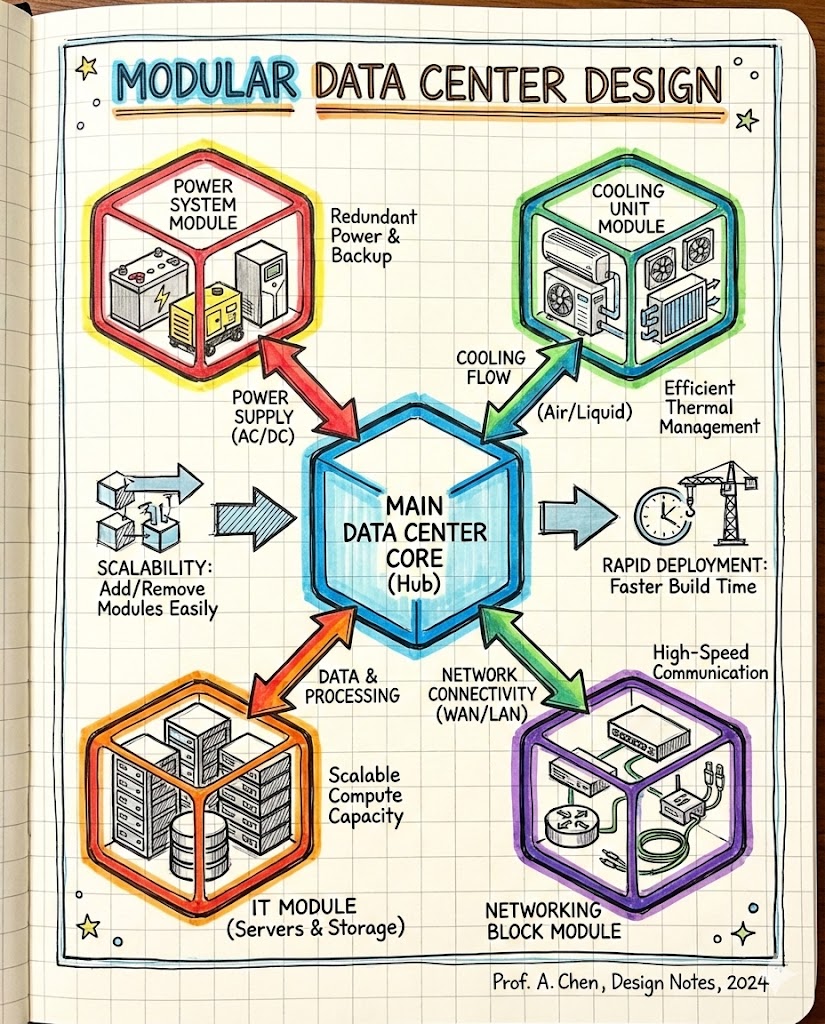
Modular data center design represents a transformative evolution in how critical IT infrastructure is planned, built, and deployed, moving away from the lengthy and complex processes associated with traditional “stick-built” facilities. At its core, a modular data center (MDC) is a facility composed of highly standardized, prefabricated modules that are engineered and manufactured off-site in a controlled factory environment. These modules arrive at the final location complete with everything necessary for operation, including IT racks, specialized cooling systems, and integrated power distribution units. This revolutionary approach, where systems are assembled, integrated, and rigorously tested before delivery, fundamentally changes the economics and timelines of data center development, making it indispensable for organizations that require rapid response to market demands, support for edge computing, or quick scalability to accommodate unforeseen growth in IT capacity.
The concept of modularity is rooted in standardization, allowing the entire data center to be broken down into various independent compartments or functional blocks. Each module is designed separately according to unified industry standards, managing its own scale, power load, and configuration. The essential subsystems—including power supply, thermal management, and monitoring—are compartmentalized to ensure they do not interfere with each other and can operate independently. This architecture provides numerous functional advantages, most notably the ability to deal dynamically with modern server changes such as cloud computing, extensive virtualization, centralization, and, critically, high-density computing loads driven by artificial intelligence and machine learning. The unified input/output interfaces of these modules allow them to be combined like “digital Lego blocks” to establish a fully functional, custom-configured data center tailored exactly to current IT needs.
One of the foundational elements of the modular design is the robust power management system, which must ensure reliable, continuous operation for sensitive computing equipment. This system typically includes the uninterruptible power supply (UPS) unit, providing power conditioning and backup during utility disruptions, along with associated power distribution centers (PDC). Furthermore, comprehensive battery systems, detailed grounding infrastructure, and multi-level distribution protection systems featuring lightning and surge protection are integrated within the modules. Because these components are pre-assembled and tested together in the factory, the risk of on-site integration failures is drastically reduced, ensuring a higher level of reliability from the moment the module is deployed. Both AC and DC distribution options are often available, providing customers with flexibility based on their specific equipment requirements and desired power efficiency metrics.
Thermal management is another defining characteristic of modular systems, where energy efficiency is often significantly enhanced compared to older, traditional facilities. Modular data centers frequently employ sophisticated airflow control strategies, such as hot aisle/cold aisle containment, which separates exhaust heat from cool supply air, dramatically improving cooling effectiveness. To manage the dense heat loads common in modern environments—which can exceed 20 kilowatts per rack—in-row cooling units are often utilized to deliver cool air directly to the racks, minimizing air loss and maximizing the efficiency of the refrigeration cycle. Depending on the environment and specific thermal requirements, these integrated cooling solutions may incorporate either direct expansion (DX) or chilled water systems, ensuring optimal operating temperatures are consistently maintained, thereby contributing to lower Power Usage Effectiveness (PUE) scores and reduced operational expenditure.
The speed of deployment afforded by modular data centers is perhaps their most compelling benefit, making them a true game-changer in today’s fast-paced business environment. While a traditional data center build can take anywhere from 12 to over 24 months to complete, a modular solution can be installed and become fully operational in a matter of weeks or a few months, depending on the complexity and scale. This dramatic reduction in timeline is possible because the complex construction, assembly, and system integration occur simultaneously with site preparation at the final location. The prefabricated parts are designed for quick installation and easy disassembly, minimizing site labor and delays often caused by unpredictable factors such as weather conditions, ensuring the facility can commence operations much faster than any traditional brick-and-mortar build.
Furthermore, modular data centers are designed with inherent scalability and flexibility, solving a major problem faced by traditional construction: predicting future IT capacity needs. Traditional facilities are often oversized initially to hedge against worst-case scenarios over the next 3 to 4 years, leading to unreasonable initial construction and high upfront costs for infrastructure that remains underutilized. MDCs, conversely, allow organizations to start with a smaller footprint and add standardized modules—for power, cooling, or IT capacity—incrementally as demand grows, providing a plug-and-play capability that minimizes disruption to ongoing operations. This flexibility allows IT leaders to precisely align infrastructure investments with current requirements and budget constraints, offering a clear, predictable path for phased expansion without committing massive capital upfront for systems that may not be needed immediately.
From a financial perspective, modular solutions offer improved cost predictability and favorable capital expenditure (CapEx) models. Since the manufacturing and integration of systems occur in a factory environment at a fixed cost, projects are less susceptible to the volatile cost overruns, material price fluctuations, and labor shortages common in traditional on-site construction. While the initial investment for manufacturing and transporting the modules can sometimes translate to higher upfront costs than the initial phases of a traditional build, the overall capital expenditure is more controlled and predictable, allowing for phased investments that track directly with business growth. Moreover, the superior energy efficiency (lower PUE) achieved through optimized cooling and air management systems contributes significantly to reduced operational expenditure (OpEx) over the life of the facility, ultimately providing substantial long-term savings.
Despite the numerous advantages, modular data centers do present specific trade-offs when compared to traditional construction. The primary advantage of a traditional build is the ability to fully customize the layout, design, and environmental systems to exact, unique business requirements. Modular systems, optimized for rapid deployment and standardization, inherently offer more limited customization options. Operators must also consider the physical space required to fit these large prefabricated modules, as not all site locations can accommodate the necessary footprint. Additionally, while the overall reliability is high due to factory testing, the ongoing maintenance can sometimes be more specialized and complex, as each independent module might require distinct maintenance protocols compared to a single, central data center infrastructure.
The application range of modular data centers is extensive, extending far beyond the traditional core facility. They are especially suited for meeting the burgeoning demands of edge computing deployments, where processing power is required closer to the end user to minimize latency. Their portability and rapid deployment capabilities make them ideal for remote or rural installations, temporary capacity needs (such as large events or emergencies), and disaster recovery sites. Furthermore, specific types of MDCs, such as containerized data centers housed within standard ISO shipping containers, offer true mobility, making them perfect for specialized operations in military, mining, or oil and gas industries where infrastructure must be quickly established and potentially relocated without significant investment or disruption.
The acceleration of AI and machine learning workloads is fundamentally reshaping data center requirements, pushing modular design to the forefront of industry solutions. Pre-AI data centers were simply not built to handle the extreme density and power consumption of modern GPU-intensive compute. Current requirements often specify power densities exceeding 200 kilowatts per rack, with future designs projected to reach over 1 megawatt per rack. Meeting these intense thermal loads necessitates sophisticated cooling solutions, often involving liquid cooling systems like direct-to-chip or closed-loop cooling, which must be carefully integrated into the modular architecture. The MDC’s distributed, standardized design provides the massive scalability—supporting hundreds of megawatts and thousands of racks across interconnected zones—required to handle these demanding, energy-intensive environments that are now essential for AI deployment.
As the complexity and power density of MDCs increase, ensuring safety and compliance becomes paramount. Higher power densities amplify the potential for hazards like arc flashes, and the reliance on complex cooling systems using flammable liquids introduces serious fire risks. To address these evolving safety challenges, industry standards are adapting. UL 2755, the Outline of Investigation for Prefabricated Modular Data Center Systems and Related Modular Units, has been established as a critical benchmark. This standard enables manufacturers to have the entire prefabricated modular data center evaluated as a single, integrated product, streamlining compliance with various code requirements, including reference in NFPA 70, the National Electrical Code. Compliance with UL 2755 helps ensure structural integrity (including seismic considerations and stacking loads), effective thermal management, and mitigation of fire and electrical hazards, providing critical assurance to local code authorities and enhancing overall occupational safety.
In conclusion, the effective formulation and deployment of data center capacity today requires a synthesized understanding of IT requirements, logistical constraints, and rapidly evolving technological standards. Modular data center design offers an adaptable, flexible, and reliable alternative to the fixed constraints of traditional facilities. By mastering the intricacies of factory prefabrication, standardized component integration, and advanced cooling techniques necessary for high-density loads, professionals can leverage MDCs to manage the constant challenges of fluctuating capacity demands. The modular approach, characterized by unmatched deployment speed, predictable costs, and high energy efficiency, serves as the essential backbone for achieving operational excellence in a rapidly expanding digital landscape, ensuring businesses can consistently deliver the computational power required by modern applications, from core enterprise functions to the furthest reaches of the network edge.