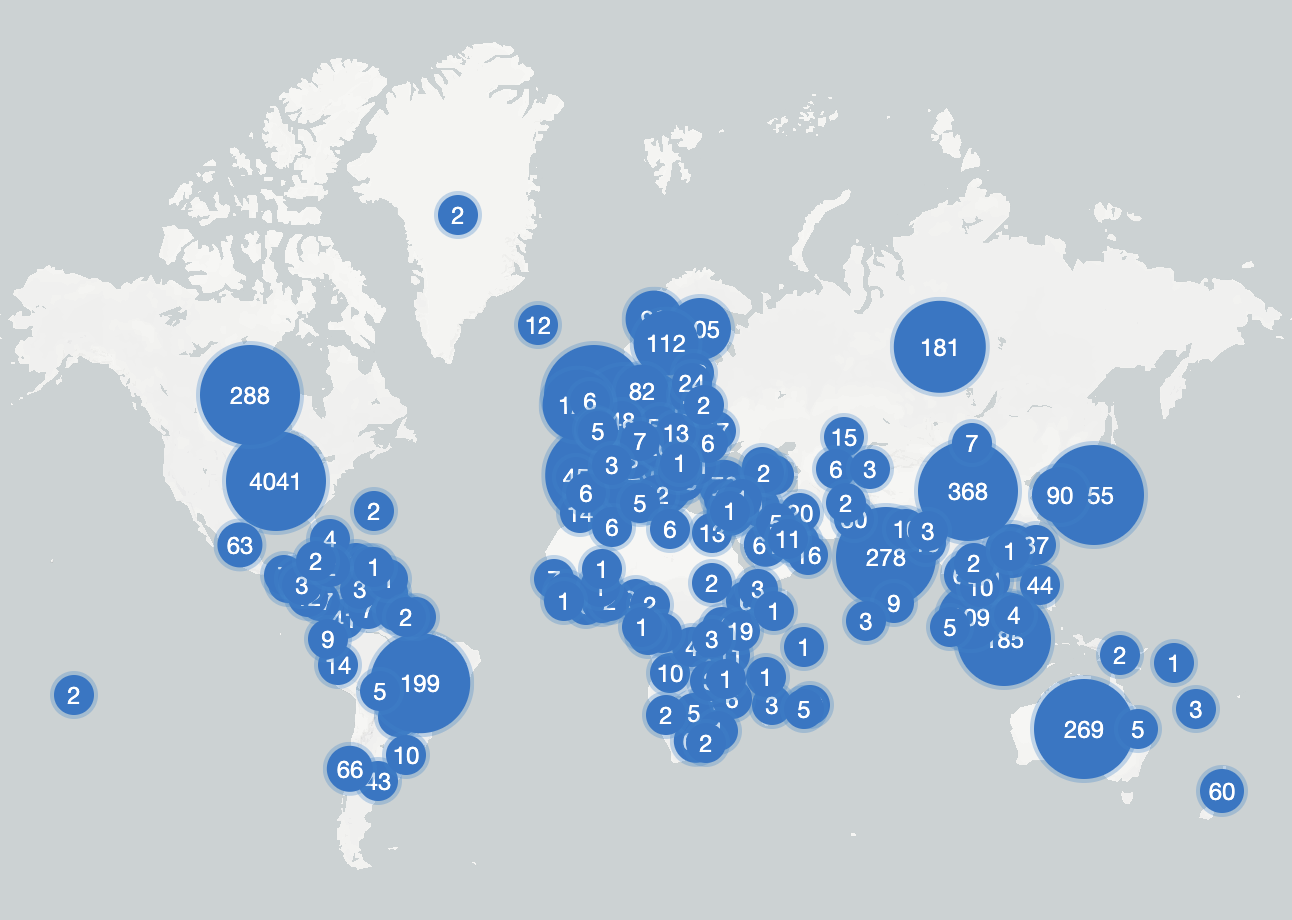
Rapid adoption of AI among enterprises and consumers is fueling the growth of data centers, the massive structures that provide the necessary computing power.
The data center boom impacts nearly everyone, from the tech and real estate sectors to policymakers and the environmentally conscious, who respectively view these data centers as a geopolitical asset and a drain on natural resources.
This report covers the most critical statistics and trends regarding data centers in 2026.
Editor’s Picks
- There are currently 11,038 data centers globally located in 174 countries.
- Demand for data centers is predicted to nearly triple by 2030.
- Between now and 2030, companies worldwide are expected to invest nearly $7 trillion in building and upgrading data centers.
- Global data center power usage is expected to increase to 219 GW over the next five years, enough to power roughly 180 million US homes.
- On average, data centers cover 100,000 square feet, but hyperscale data centers are as large as 10 million square feet.
- Data centers are present in more than 170 countries, and nearly 40% are located in the US.
- Large data centers use up to 5 million gallons of water per day for cooling purposes.
- US states with multiple data centers create more than $30 billion in additional economic output annually.
Current State & Future Growth of Data Centers
The scale, capacity, and market value of data centers are growing exponentially.
Much of this is due to the increasing demand for AI among enterprises and consumers. But countless other business operations, like processing data from IoT devices, depend on data centers too.
Increasing consumer demand is just as powerful. Streaming services, ecommerce apps, and social media are creating massive workloads to be processed in data centers.
There are over 11,000 live data centers around the world (Data Center Map)
As of March 2026, there are 11,038 active data centers around the globe.

Not all of these data centers are used for AI, but many are.
The US has almost 8x more data centers than any other country (Data Center Map)
With 4,011 data centers as of March 2026, the US has by far the most globally. The UK ranks #2 with 511, followed by Germany with 507, China with 368, and France with 344.

Demand for data centers is predicted to nearly triple by 2030 (McKinsey)

This year, non-AI workloads are predicted to total 38 GW, while AI workloads are expected to hit 44 GW.
By the end of next year, estimates show 18 additional GW will be added. Growth between 2027 and 2029 is expected to reach about 20 GW each year.
However, mega growth is projected between 2029 and 2030, with 31 GW of data center capacity expected to be added.
This estimate shows a total of 219 GW in data center capacity by 2030.
The data center sector is set to grow by 14% CAGR through to 2030 (JLL)
AI and cloud computing are expected to fuel a 14% CAGR in the data center industry through 2030. The sector is forecast to add around 97 GW of capacity between 2025 and 2030, nearly doubling its size within five years.
By the end of the decade, global data center capacity could hit approximately 200 GW, driven primarily by continued hyperscale cloud expansion and accelerating demand for AI infrastructure.
Over the next five years, nearly $7 trillion will be spent on building and upgrading data centers (McKinsey)
This investment is expected to be spread across three main groups. About 15% will go to land and building requirements, about 25% will be spent on power generation and cooling, and about 60% will be invested in the tech and hardware required to run the data centers.
Demand for AI-specific data center usage is predicted to be responsible for more than $5 trillion of this investment.
This estimate is based on the current momentum of the data center market. If momentum significantly accelerates, total data center investments could reach nearly $8 trillion over the next five years. Alternatively, if demand drops, spending could level off at about $3.7 trillion.
US companies are expected to account for more than 40% of data center spending over the next five years (McKinsey)
US spending on data centers was predicted to top $425B in 2025. The vast majority of data center spending, about 70%, is expected to come from hyperscalers.
Leading hyperscalers, including Amazon, Microsoft, Google, Meta, and others, are already building in the US and have plans to invest even more in the coming years.
The capital spending of each hyperscaler is already trending toward $100B annually.
Although other countries are seeing an uptick in data center investment, most face restrictive regulations, higher energy costs, and fewer financial incentives than the US.
Total spending of US companies on data center construction was estimated to surpass $52B in 2025 (ConstructConnect)
YTD spending through October showed that data center construction spending has more than doubled YoY and more than tripled since 2023.
In October 2025 alone, US companies spent nearly $11B across 23 data center construction sites (ConstructConnect)

That’s compared to just $2.9B in 2024.
The average cost per square foot in data centers is nearly $1,000, which is 50% higher than last year. However, the rising costs seem unlikely to slow new construction. There are more than 60 projects, with a combined value of more than $50 billion, expected to break ground in the next six months.
AI will be responsible for 50% to 70% of total data center computing by 2030 (Bain & Company, McKinsey)
Last year, AI training workloads used 5 GW of data center capacity, and AI inference (the process of generating outputs) used 2 GW.
By 2030, those numbers are expected to grow exponentially. AI training could require 23 GW, and AI inference could require 54 GW.
Several factors could lead to variations in these predictions, though. If businesses can unlock valuable AI solutions, demand could grow even more than current predictions.
On the other hand, increased efficiency in AI solutions could decrease the required capacity.
In North America, total data center capacity hit a record 8,155 MW in the first half of 2025 (CBRE)
North American data center capacity has increased more than 43% YoY.
In addition, nearly 75% of under-construction capacity is already leased.
Capacity increases would be even greater if not for two factors: land availability and power access. Since power grids are already stretched thin in existing locations, look for the bulk of future capacity gains to happen in new markets. And, look for new capacity to come from large sites. Owners and developers are prioritizing sites between 200 MW and 750 MW.
Prime Locations for Data Centers
There are almost 4,000 data centers in the US and more than 2,000 across Europe.
Every US state has at least one data center, with Vermont having the least (3) and Virginia having the most (570).
There are nearly 500 data centers in Northern Virginia (Data Center Map)

This area, often referred to as NoVA, covers 13 counties and about 4,400 square miles.
Ashburn, Virginia, alone is home to more than 150 data centers.
Why Virginia?
One reason is the location’s interconnectivity. There’s a superior fiber network that enables low latency, and many critical submarine cables land on the coast of Virginia. It’s also close to several major cities, like New York and Washington, D.C.
Currently, an additional 16.8 GW of capacity for Virginia data centers is either under construction or in the planning stage.
15 US States have at least 1 GW of existing or planned data center capacity (Deloitte)
Aside from Virginia, Texas has the most capacity (currently 2.9 GW, with another 3.1 GW planned). Dallas is a major hub with nearly 200 data centers.
Ohio ranks third (currently 1.6 GW, with 2.4 GW planned). More than 60% of the state’s data centers are in Columbus.
Aside from northern Virginia, the top data center markets are Atlanta, Dallas-Fort Worth, and Chicago (CBRE)
Atlanta is one of the largest data center markets in the U.S. The city has a total inventory of 1,280 MW with an additional 1,892 MW under construction. Overall, Atlanta accounts for 16% of data center inventory in the U.S.
In the Dallas-Fort Worth area, there’s a total capacity of 870 MW with 425 MW under construction. That accounts for about 11% of the total U.S. data center market.
Chicago has a total capacity of 692 MW, which accounts for 9% of the US market. There’s an additional 244 MW under construction.
Approved, upcoming data centers in Las Vegas and Reno will grow the area’s capacity by 950% (Stanford)
Upcoming projects in Nevada will add 3,800 MW to local data center capacity.
Google has announced a $400 million expansion to an existing data center, Microsoft recently acquired 300 acres of land, and Vantage Data Centers has a $3 billion project in the works.
That’s in addition to the 495 MW Switch data center that’s planned to run on 100% renewable energy.
About 15% of Europe’s data centers are in Germany (Tech Policy Press)

Germany has the highest concentration of data centers outside the US Nearly one-quarter of these data centers are located in Frankfurt.
The Frankfurt data center boom is so expansive that all existing energy capacity has already been claimed for years to come.
The main draw for data centers in Frankfurt is DE-CIX, the world’s largest internet exchange operator.
The largest data center in the world is in Hohhot, China (GBC Engineers)
China Telecom’s Inner Mongolia Information Park encompasses 10.7 million square feet. Despite its gigantic size, the data center’s capacity is just 150 MW. That’s because much of the campus is devoted to warehouses, offices, and even residential space.
The most powerful data center in the world is planned for Utah (KSL Utah)
Creekstone Energy is in the planning and permitting stages of building a 20-million-square-foot data center site called Delta Gigasite. Within the decade, the company says the data center will ramp up to 10 GW of capacity.
The Footprint of Data Centers
While a few data center campuses exceed 10 million square feet, the typical data center covers about 100,000 square feet. However, recent data shows that the average is trending upward as newer facilities come online.
Typically, hyperscale data centers house more than 5,000 servers (IBM)

Because of the sheer amount of IT equipment, these data centers are typically larger than 200,000 square feet, and several are well over 1M square feet.
Large sites offer several advantages to companies with a wealth of capital, like Meta, Microsoft, and AWS. All of the hardware and cooling infrastructure at one site is highly standardized. In addition, the infrastructure needed for connection to the power grid is massive, but it only needs to be set up once.
There are more than 1,000 hyperscale data centers worldwide, double the amount of five years ago (Synergy Research Group)
Between 2019 and 2024, the number of hyperscale data centers doubled. More than 135 came online in 2024 alone.
It’s only taken four years for the total capacity of these data centers to double, and estimates show that capacity could double again in less than four years.
54% of hyperscale data centers are based in the US. Other major locations include China (16%) and Europe (15%).
Amazon ranks as the leading hyperscaler in the world (Data Center Magazine)
Amazon operates 241 known data center locations across 22 countries. An additional 83 sites are under construction.
Like many other hyperscalers, the precise number and location of all of Amazon’s data centers are unknown. However, a recent Bloomberg report suggests that Amazon may be operating more than 900 data center locations.
No matter the precise number of sites, Amazon’s capital expenditures on data centers are massive. This year, it topped $100 billion.
Microsoft is building a 1.2 million square foot “AI factory” in Wisconsin (Microsoft)
Microsoft is investing about $3 billion to build this data center that covers 315 acres. It’s expected to open in early 2026.
In November, the company opened a very similar site, covering about 1 million square feet across 85 acres, outside of Atlanta.
In total, Microsoft operates 131 known data centers, and another 111 are under construction.
The first data center built by Google now covers 1.3 million square feet (IBM)

In 2006, Google opened its first data center site in The Dalles, Oregon.
Since then, the company has invested more than $1.8 billion to expand this single site. It now covers more than 1.3 million square feet.
Google recently announced a $600 million plan to expand the site even more. A fifth building, about 290,000 square feet, is expected to be added.
It takes less than 18 months for a hyperscale data center to come online (Tech Republic)
Construction of the first of OpenAI’s Stargate data center projects launched in June 2024.
The first two buildings, covering 980,000 square feet with 200 MW of capacity, went online in September.
Construction on six additional buildings began in March and is estimated to be wrapped up by mid-2026. Those buildings are projected to bring the site to a total of 4 million square feet and 1.2 GW of power.
The average size of a data center in the northeast US is 143,000 square feet (Regional Plan Association)
New York leads the Northeast with 149 data centers. There are ten in Lower Manhattan alone, and 35 are located within 10 miles of the New York City financial district.
One of the largest and most critical is the 60 Hudson Street data center, which is one of the most important hubs of data interconnectivity in the world. It hosts multiple data center operators across its 24 stories.
Another large data center is the SDC Manhattan data center. It covers 222,000 square feet and provides 18 MW of capacity.
Iowa data centers now occupy more than 15 million square feet across 6,600 acres (Business Record)
There are more than 25 data centers in Iowa. Operators have invested nearly $15 billion in the market since the mid-2000s.
There are several hyperscale data centers in the state. For example, Apple is currently expanding its 360 million-square-foot site in Waukee, Iowa, to encompass 1.9 million square feet.
Four additional hyperscalers are expected to come online soon.
The Economic Impact of Data Centers
Data centers drive tremendous revenue for enterprises, but they’re also impacting economics and opportunities in local communities.
Meta’s capital expenditures for 2025, most of which are spent on data centers, could total more than $70 billion (New York Times)
Meta’s capital expenditures totalled $28 billion in 2023 and $39 billion last year. In 2026, analysts predict company spending could reach as high as $100 billion in capital expenditures.
Prometheus, Meta’s first gigawatt data center, is currently under construction in New Albany, Ohio. The data center is predicted to come online next year. An on-site natural gas power generation project, totalling 200 MW, is predicted to be operational by November 2026.
Hyperion, a 5 GW data center from Meta, is set to come online by 2028. Meta officials say the site in Louisiana will be almost as large as the footprint of Manhattan. There will be three natural gas power plants on site, costing a total of $3 billion.
Vantage is investing $25 billion in a data center campus in Shackelford County, Texas (Construction Digital)
The site will consist of 10 data centers covering 1,200 acres. In total, it will provide 1.4 GW of compute capacity once it’s fully finished.
Vantage says the site will create 5,000 jobs across construction and long-term operation.
For every data center job, six indirect jobs are created (PwC)

In Virginia, the data center market creates about 74,000 jobs annually, worth a total of $5.5 billion in labor income for the state.
However, data centers themselves actually create very few jobs compared to the amount of land they occupy. It takes about 1,500 people to build a data center; once it’s operational, the site employs fewer than 200 people.
In Ohio, data centers could support more than 132,000 jobs by 2030 (Ohio Chamber of Commerce Research Foundation)
Last year, data centers in the state provided nearly $7 billion in labor income across about 95,000 jobs.
About 36,000 of these jobs were directly attributable to data center construction and operation. About 30,000 jobs were in supplier industries, and about 28,000 of the jobs were supported by household spending of people in the direct jobs and supplier jobs.
A 330 MW data center provides about $29 million in annual property tax revenue (Imperial Valley Press)
That estimate comes from a data center project in Imperial County, California, a rural area outside of San Diego. In addition to property tax revenue, the data center is predicted to create $72.5 million in sales tax revenue from purchasing IT equipment.
That’s a sizable increase in revenue for a county with just over 180,000 residents.
37 states have specific laws that grant sales tax exemptions for data centers (CNBC)

A CNBC analysis found that 21 states don’t publicly report the total value of their tax breaks. However, the remaining 16 states that do report totals showed that nearly $6 billion in sales tax exemptions have been given to data centers over the past five years.
For instance, a Microsoft data center built in Illinois resulted in more than $38 million in sales tax exemptions. The site created 20 permanent jobs.
In Virginia, data centers received more than $730 million in tax exemptions for the fiscal year 2024 (CNBC)
Every dollar the state did not collect in sales tax resulted in 48 cents in new state revenue.
Financial audits show that Virginia, as well as Texas and Illinois, has recorded a more than 1,000% increase in tax revenue loss in recent years.
The Environmental Impact of Data Centers
Data centers require an immense amount of power to run thousands of servers. They also require millions of gallons of water to cool all of those servers.
Environmental activists, as well as local community members, worry that data centers will drain already low water supplies, increase fossil fuel pollution, and drive up electricity costs. However, new cooling techniques and increased renewable energy options could negate these effects.
The average data center uses ~4 MW of continuous power (IEA)
Global data centres consumed approximately 415 TWh of electricity in 2024, equivalent to an average continuous power demand of ~47 GW, according to the International Energy Agency.
This equates to an estimated average of ~35 GWh of electricity per data centre annually, or ~4 MW of continuous power per site.
However, this global average masks a large variation in facility size and energy use.
Smaller data centres typically operate in the 1–5 MW range, while hyperscale facilities frequently require tens of megawatts, with many new developments targeting 50–100 MW or more.
The amount of electricity used by data centers is predicted to grow 16% each year through 2028 (Boston Consulting Group)
By 2028, data centers could demand up to 130 GW of power.
The increase in power needs from data centers will drive 60% of the overall electrical load increase in the US through 2030. That’s more than the load increase from any other sector, including electric cars.
To put that in perspective, that’s the amount of power generated by over 13,000 offshore wind turbines, 245 million solar panels, or 65 Hoover Dams.
By 2028, data centers could consume up to 12% of total electricity in the United States (Department of Energy)
In 2023, data centers consumed 4.4% of total US electricity, but that number could triple over the next three years. That’s equivalent to adding enough electricity to power the entire country of France.
The density of power use in data centers is expected to reach 176 kW per square foot in 2027 (Goldman Sachs)
This increased power density is due to the computing power needed to process AI workloads. For example, an AI server rack in 2027 is expected to require 50x more power than the server racks powering the internet today.
The chips that power AI workloads are also packed incredibly close together. The same amount of electricity used to power 1,000 American homes powers the AI chips that fit into a space that’s about the size of a filing cabinet.
The power needs of data centers could raise residential electricity bills by 25% in some parts of the US (Carnegie Mellon University)
In December 2024, the largest grid operator in the US, PJM, announced that capacity market prices, which ensure grid availability, would increase from $30 to $270 per megawatt-day. PJM’s capacity market rates continue to climb today, now sitting at $330 per megawatt-day.
Monthly electricity costs in areas surrounding data centers are up by as much as 267% over the past five years (Bloomberg)
Increased prices have already trickled down to homeowners. With the highest concentration of data centers, Virginia is predicted to see the highest increases in the coming years. Today’s average monthly electricity bill in the state is about $143, but could surge to $315 by 2039.
Data centers consume up to 5 million gallons of water per day (Environmental and Energy Study Institute)

In order for the equipment to function properly, data centers must maintain a temperature between 64 and 80 degrees F. Operators use water-based cooling methods to disperse heat.
In one cooling method, about 80% of the water evaporates. The remaining water cannot be reused and must be pumped out to a water treatment plant.
One Microsoft data center in Arizona uses 56 million gallons annually, equivalent to 670 households (APM Research Lab)
The water needs of data centers are particularly concerning to citizens in water-stressed areas. Research shows that by 2027, data centers will be using up to 1.74 trillion gallons annually. That’s about half of the annual water usage of the UK.
Nearly 65% of senior enterprise leaders are concerned that the environmental requirements of AI will have a negative impact on their sustainability goals (Ernst & Young)
Data center usage is reported under Scope 3 emissions. Enterprises that are adopting widespread use of AI could potentially see a large increase in emissions and negative progress in terms of other sustainability goals.
Potential factors include ecosystem disruption from data center construction, increasing carbon emissions from fossil fuel power generation, and increasing water consumption.
What’s next for data centers?
Data center revenue is predicted to grow to $624 billion by 2029, but that estimate could vary drastically depending on changes in data center locations, power generation opportunities, and financial investments.
Location
As companies look to build additional sites to drive revenue gains, location will be one of the most important factors.
Prime states like Virginia already have a saturated market that has created several challenges in terms of power generation and growing resistance among citizens. On the other hand, rural areas across the U.S. provide reliable grid connections and large areas of cheap land. These areas are often eager to welcome the tax revenue provided by large data center projects.
Look for the next generation of data centers to be built in places like rural Virginia, Washington, Michigan, and Iowa.
Power
The next generation of data centers will also need alternative solutions for power generation.
Right now, it takes about eight years to build enough infrastructure to power new data centers without adding strain to the grid. That’s why more than 70% of data center and power generation leaders say that powering data centers is either very or extremely challenging. Several data center projects have already been scaled back or delayed due to insufficient energy supply.
“Behind-the-meter” (BTM) power, an onsite power plant that operates specifically for the data center, is the most popular solution right now. Up to 25 GW of BTM is expected to be deployed over the next five years. Most BTM projects today are natural gas, but fuel cells and small modular reactors could gain traction in the coming years.
Economics
Both enterprise interest and private investment in data centers reached record highs last year. Adding to that demand, one in five Americans now uses AI regularly.
This demand is leading to unprecedented spending. Hyperscalers are predicted to spend $525 billion on capital expenditures by 2032.
Power grid updates and associated utility investments are predicted to cost $720 billion through 2030.
However, citizens and local governments are a critical part of the economic picture. Data center construction will likely continue to fuel thousands of local construction jobs, and forthcoming regulations could help bear the brunt of increased electricity rates among consumers.
Source_https://programs.com/resources/data-center-statistics/