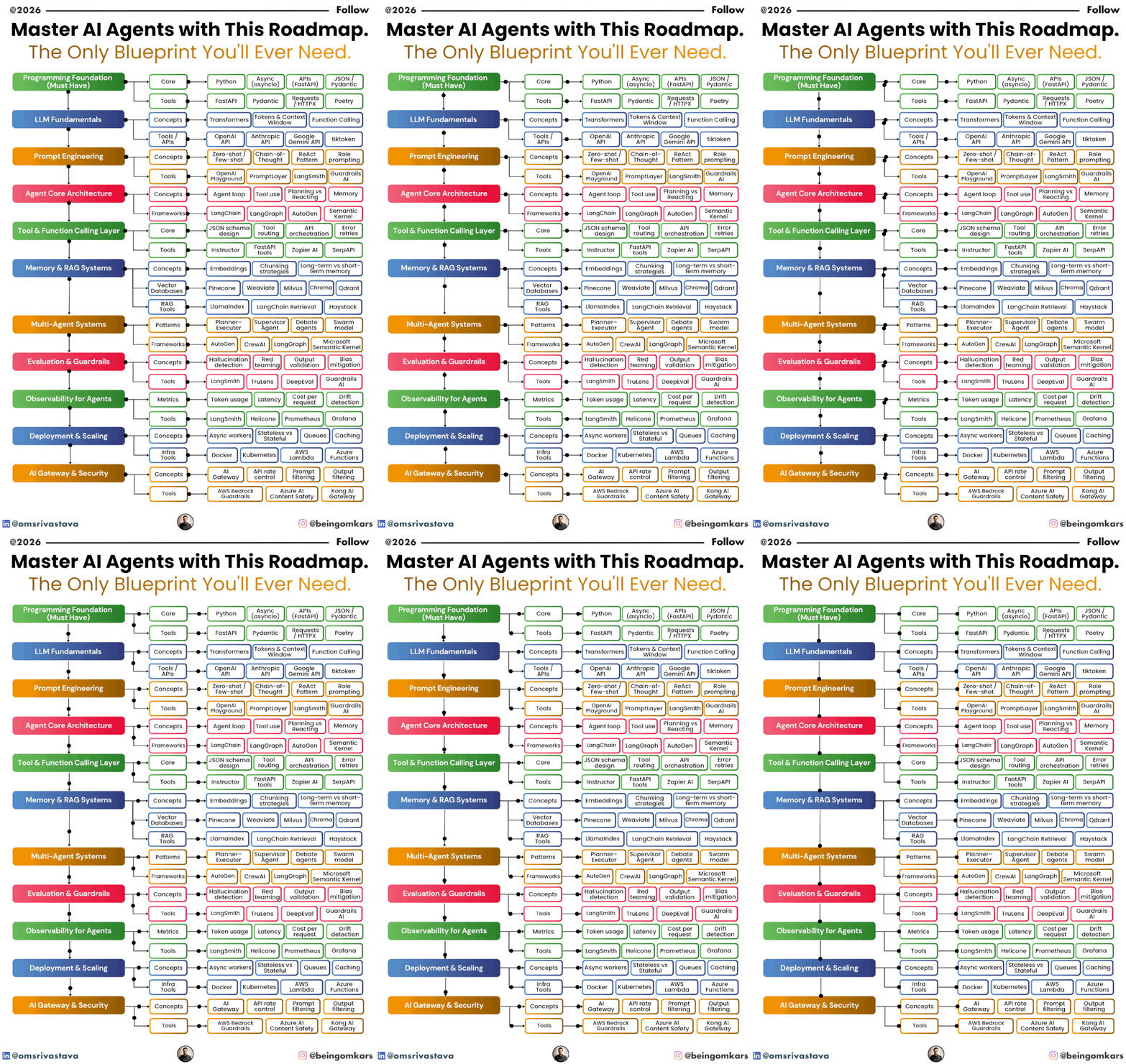
AI agents are no longer side projects or experimental demos—they are fast becoming the backbone of modern software systems. From autonomous customer support bots to research copilots and multi-agent workflows, AI agents in 2026 demand structured thinking, strong foundations, and production-ready architecture.
This roadmap lays out a step-by-step blueprint to master AI agents—from programming basics to deployment, observability, and security. Let’s break it down layer by layer.
1. Programming Foundation (Must-Have)
Every strong AI agent starts with solid programming fundamentals.
Core Skills
-
Python as the primary language
-
Asynchronous programming (async/await)
-
API development using FastAPI
-
JSON & Pydantic for data validation
Essential Tools
-
FastAPI
-
Pydantic
-
Requests / HTTPX
-
Poetry for dependency management
👉 This layer ensures your agents are fast, reliable, and API-ready.
2. LLM Fundamentals
Before building agents, you must understand how large language models actually work.
Key Concepts
-
Transformers architecture
-
Tokens & context window limitations
-
Function calling
-
Model behavior and constraints
LLM APIs & Tooling
-
OpenAI API
-
Anthropic API
-
Google Gemini API
-
Tokenizers like tiktoken
👉 This foundation helps you design agents that reason within limits instead of hallucinating blindly.
3. Prompt Engineering
Prompting is no longer about clever text—it’s about controlling behavior.
Core Techniques
-
Zero-shot & few-shot prompting
-
Chain-of-Thought reasoning
-
ReAct pattern (Reason + Act)
-
Role prompting
Practical Tools
-
OpenAI Playground
-
PromptLayer
-
LangSmith
-
Guardrails AI
👉 Great prompts turn LLMs into predictable, reusable components.
4. Agent Core Architecture
This is where an LLM becomes an agent.
Key Concepts
-
Agent loop (think → act → observe → repeat)
-
Tool usage
-
Planning vs reacting
-
Memory handling
Popular Frameworks
-
LangChain
-
LangGraph
-
AutoGen
-
Semantic Kernel
👉 This layer defines how your agent thinks, decides, and evolves.
5. Tool & Function Calling Layer
Agents become powerful when they can do things, not just talk.
Core Capabilities
-
JSON schema design
-
Tool routing
-
API orchestration
-
Error handling & retries
Tooling Ecosystem
-
Instructor
-
FastAPI tools
-
Zapier AI
-
SerpAPI
👉 This enables agents to search, calculate, call APIs, and automate workflows.
6. Memory & RAG Systems
Without memory, agents are stateless and forgetful.
Core Concepts
-
Embeddings
-
Chunking strategies
-
Short-term vs long-term memory
Vector Databases
-
Pinecone
-
Weaviate
-
Milvus
-
Chroma
-
Qdrant
RAG Frameworks
-
LlamaIndex
-
LangChain Retrieval
-
Haystack
👉 Memory turns agents into knowledge-aware assistants, not chatbots.
7. Multi-Agent Systems
Complex problems often need teams of agents, not just one.
Agent Patterns
-
Planner–Executor
-
Supervisor agent
-
Debate agents
-
Swarm models
Frameworks
-
AutoGen
-
CrewAI
-
LangGraph
-
Semantic Kernel
👉 Multi-agent systems unlock parallel thinking, self-review, and collaboration.
8. Evaluation & Guardrails
Production agents must be safe, accurate, and measurable.
Key Areas
-
Hallucination detection
-
Red teaming
-
Output validation
-
Bias mitigation
Evaluation Tools
-
LangSmith
-
TruLens
-
DeepEval
-
Guardrails AI
👉 This layer ensures trust, compliance, and quality at scale.
9. Observability for Agents
If you can’t measure it, you can’t improve it.
Metrics That Matter
-
Token usage
-
Latency
-
Cost per request
-
Drift detection
Observability Stack
-
LangSmith
-
Helicone
-
Prometheus
-
Grafana
👉 Observability keeps your agents efficient and cost-controlled.
10. Deployment & Scaling
Agents must survive real-world traffic.
Core Concepts
-
Async workers
-
Stateless vs stateful agents
-
Queues and caching
Infrastructure Tools
-
Docker
-
Kubernetes
-
AWS Lambda
-
Azure Functions
👉 This layer enables reliability, scalability, and performance.
11. AI Gateway & Security
As agents grow powerful, security becomes non-negotiable.
Security Concepts
-
AI gateways
-
API rate limiting
-
Prompt filtering
-
Output filtering
Security Tools
-
AWS Bedrock Guardrails
-
Azure AI Content Safety
-
Kong AI Gateway
👉 This protects your system from abuse, prompt injection, and unsafe outputs.
Final Thoughts
This roadmap isn’t about learning tools randomly—it’s about building AI agents like real software systems.
If you follow this blueprint:
-
You won’t just use AI agents
-
You’ll design, deploy, scale, and secure them
In 2026, that’s the difference between AI experiments and AI products.