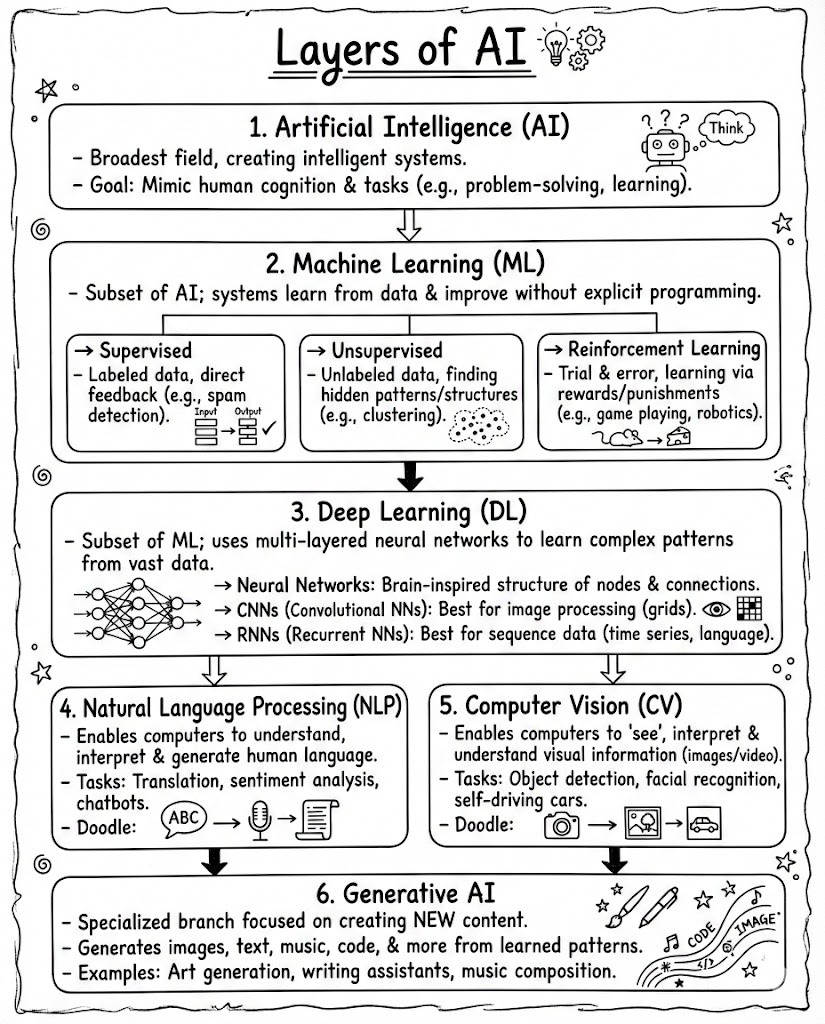
Introduction to the Layers of AI
Conceptual Framework
Artificial intelligence manifests not as a monolithic entity but as a stratified edifice, wherein each stratum interdepends upon the others to engender cognitive capabilities. This layered ontology demystifies AI’s complexity. Consider the basal infrastructure supporting algorithmic ingenuity, ascending to applicative interfaces that permeate quotidian existence. Such stratification elucidates how disparate components coalesce into sentient systems. It fosters analytical dissection. Without this framework, AI appears arcane; with it, innovation accelerates.
Historical Contextualization
The genesis of AI layers traces to mid-20th-century cybernetics, where pioneers like Norbert Wiener envisioned feedback loops as rudimentary strata. Progress ensued. The 1980s connectionism revival birthed neural networks, layering perceptrons into profound architectures. Subsequent epochs integrated hardware accelerations, such as GPUs, fortifying foundational tiers. This diachronic evolution underscores a perpetual refinement. Layers did not emerge sui generis but through iterative epistemological shifts, from symbolic AI’s rule-based laminations to contemporary data-driven hierarchies.
The Foundational Layer: Infrastructure and Hardware
Computational Substrates
At the nadir of AI’s architecture resides the computational substrate, comprising silicon-based processors and emergent neuromorphic chips that emulate synaptic efficacies. These underpin all superior operations. GPUs, with their parallel processing prowess, transmute raw arithmetic into cognitive simulations, while TPUs optimize tensor flows for expeditious training. Innovation surges. Quantum bits, or qubits, promise exponential leaps, yet thermal decoherence persists as a vexation. This layer’s robustness dictates the feasibility of overlying complexities; frail substrates yield ephemeral intelligences.
Data Repositories and Management
Data repositories form the lifeblood, vast silos harboring petabytes of heterogeneous information, curated through ontological schemas to avert informational entropy. Management entails not mere storage but sophisticated curation. Techniques like sharding distribute loads across distributed ledgers, ensuring scalability amid burgeoning datasets. Privacy-preserving federated learning mitigates centralization risks. Anomalies lurk. Without meticulous stewardship, data silos devolve into cacophonous noise, impeding the ascent to algorithmic acuity.
The Algorithmic Layer: Models and Architectures
Neural Topologies
Neural topologies constitute the crux, intricate webs of interconnected nodes mimicking cerebral cortices, where convolutional layers discern spatial hierarchies in visual data. Depth amplifies abstraction. Transformers, with self-attention mechanisms, revolutionize sequential processing, enabling contextual embeddings that surpass recurrent antecedents. Pruning extraneous synapses enhances efficiency. Yet, overparameterization invites brittleness; adversarial perturbations can unravel these topologies, exposing vulnerabilities in their interwoven fabric.
Learning Paradigms Beyond Supervision
Beyond supervised regimes, unsupervised paradigms unearth latent structures in unlabeled corpora, employing autoencoders to compress and reconstruct manifolds. Reinforcement learning introduces Markovian decision processes. Agents navigate state-action spaces, optimizing reward functions through temporal difference learning. Curiosity-driven exploration augments this. Hybrid paradigms, fusing generative adversarial networks with variational inference, engender novel syntheses. Such paradigms transcend rote memorization, fostering adaptive intelligences resilient to distributional shifts.
The Integration Layer: Applications and Interfaces
Sectoral Deployments
Sectoral deployments embed AI strata into industrial tapestries, from autonomous vehicular systems leveraging sensor fusion to predictive analytics in pharmacogenomics. Precision reigns. In agronomy, layered AI optimizes crop yields via hyperspectral imaging and prognostic modeling. Financial arbitrage exploits algorithmic foresight. Challenges abound; interoperability between legacy infrastructures and nascent layers demands seamless orchestration, lest dissonances precipitate systemic failures.
Symbiotic Human-AI Interactions
Symbiotic interactions forge human-AI amalgams, where natural language interfaces demystify underlying strata, enabling intuitive queries that elicit contextual responses. Augmentation flourishes. Cobots in manufacturing synchronize with human kinematics, anticipating gestures through kinematic modeling. Ethical symbiosis necessitates transparency; explainable AI peels back layers, revealing decision rationales. This interplay elevates cognition, yet overreliance risks atrophying innate faculties, necessitating judicious calibration.
Emergent Horizons: Future Stratifications in AI
Quantum Augmentations
Quantum augmentations herald a paradigm shift, entangling qubits to solve intractable optimizations that classical layers falter upon, such as molecular simulations in quantum chemistry. Superposition amplifies. Hybrid quantum-classical algorithms, like variational quantum eigensolvers, bridge extant strata with nascent ones. Decoherence mitigation advances apace. This augmentation portends exponential accelerations, yet scalability hurdles—cryogenic exigencies and error correction—temper unbridled optimism.
Ethical and Societal Laminations
Ethical laminations overlay technical strata, embedding deontological principles to avert algorithmic biases that perpetuate societal schisms. Auditing becomes imperative. Societal impacts necessitate regulatory scaffolds, harmonizing innovation with equitable distribution. Anticipatory governance forestalls dystopian trajectories. As layers evolve, these laminations ensure AI’s stratification serves humanity’s telos, mitigating existential perils while amplifying collective sapience.