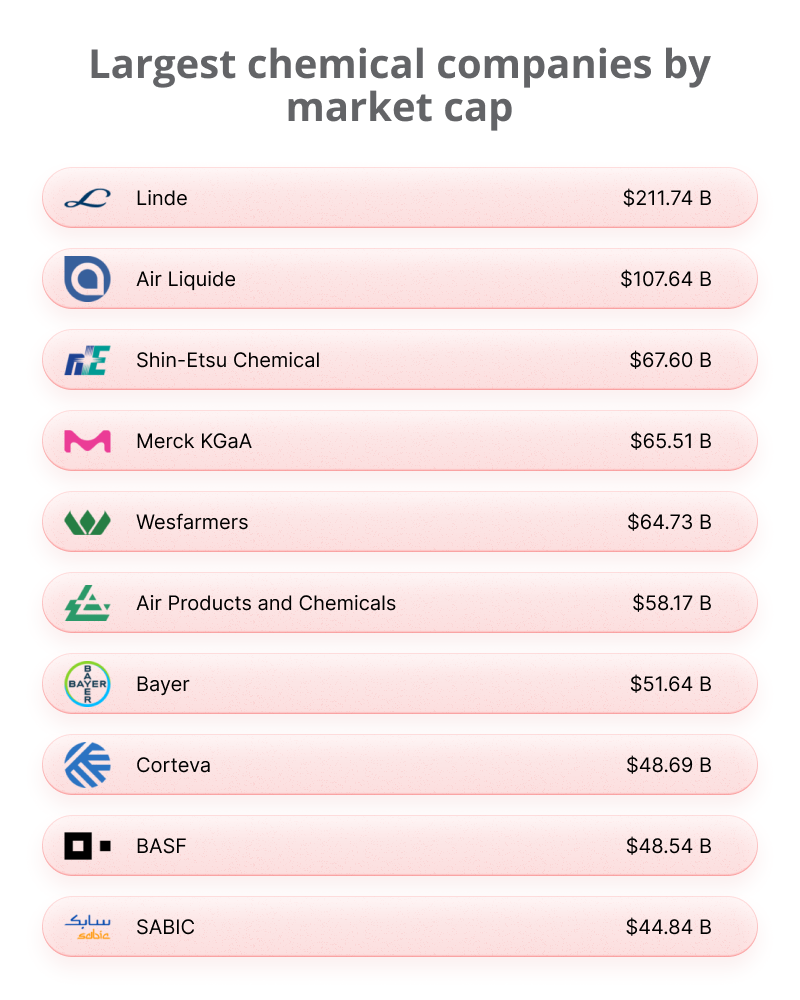
The global chemical industry sits at the heart of modern economies—powering manufacturing, healthcare, agriculture, energy, and advanced materials. Market capitalization offers a clear lens into which chemical companies command the greatest investor confidence, scale, and strategic influence worldwide. Below is an in-depth look at the largest chemical companies by market cap, highlighting what drives their valuation and why they matter to global industry.
1. Linde — $211.74 Billion
Linde leads the global chemical sector by a wide margin, reflecting its dominance in industrial and medical gases. The company plays a critical role in healthcare oxygen supply, clean hydrogen infrastructure, and decarbonization projects. Its strong long-term contracts, stable cash flows, and exposure to energy transition trends make it the most valuable chemical company in the world.
Why it matters: Linde is central to hydrogen economies, semiconductor manufacturing, and healthcare resilience.
2. Air Liquide — $107.64 Billion
France-based Air Liquide is another industrial gas giant, serving industries ranging from electronics to chemicals and healthcare. Its investments in green hydrogen, carbon capture, and digitalized gas supply systems underpin its strong valuation.
Why it matters: Air Liquide is a cornerstone supplier for advanced manufacturing and clean energy ecosystems.
3. Shin-Etsu Chemical — $67.60 Billion
Shin-Etsu Chemical is a global leader in semiconductor-grade silicon wafers and PVC. Its market cap reflects the strategic importance of electronics materials in an era of AI, data centers, and chip shortages.
Why it matters: Semiconductor supply chains depend heavily on Shin-Etsu’s high-purity materials.
4. Merck KGaA — $65.51 Billion
Merck KGaA operates at the intersection of chemicals, life sciences, and healthcare. Its strong presence in specialty chemicals and bioprocessing materials supports pharmaceutical innovation worldwide.
Why it matters: Merck enables drug discovery, biotech manufacturing, and advanced research infrastructure.
5. Wesfarmers — $64.73 Billion
While diversified across retail and resources, Wesfarmers’ chemicals, energy, and fertilizers segment contributes significantly to its valuation. The company benefits from stable domestic demand and infrastructure-linked chemical operations.
Why it matters: Wesfarmers illustrates how chemicals integrate into diversified industrial portfolios.
6. Air Products and Chemicals — $58.17 Billion
Air Products is known for large-scale hydrogen and gasification projects, particularly in energy and refining. Its long-term megaproject strategy supports predictable earnings and investor confidence.
Why it matters: The company is shaping the future of low-carbon hydrogen supply.
7. Bayer — $51.64 Billion
Bayer combines chemicals with life sciences and crop science, making it a major force in agriculture and healthcare. Despite restructuring challenges, its scale and innovation pipeline sustain a strong market presence.
Why it matters: Bayer influences global food security and pharmaceutical development.
8. Corteva — $48.69 Billion
Corteva specializes in agricultural chemicals and seeds, benefiting from rising global food demand and precision farming technologies.
Why it matters: The company supports sustainable agriculture and productivity growth worldwide.
9. BASF — $48.54 Billion
BASF is the world’s largest chemical producer by revenue, with operations spanning petrochemicals, materials, and specialty chemicals. Its market cap reflects cyclical exposure but unmatched industrial integration.
Why it matters: BASF underpins countless manufacturing value chains globally.
10. SABIC — $44.84 Billion
Saudi Arabia’s SABIC is a major petrochemicals and plastics producer, closely linked to energy markets and global infrastructure development.
Why it matters: SABIC is a key supplier for construction, packaging, and industrial plastics.
Key Takeaways for Industry Leaders
-
Industrial gases dominate market capitalization due to stable contracts and energy-transition relevance.
-
Semiconductor and life science chemicals command premium valuations amid technology and healthcare growth.
-
Sustainability, hydrogen, and advanced materials are the strongest long-term value drivers.
-
Market cap leadership increasingly reflects strategic positioning, not just production volume.