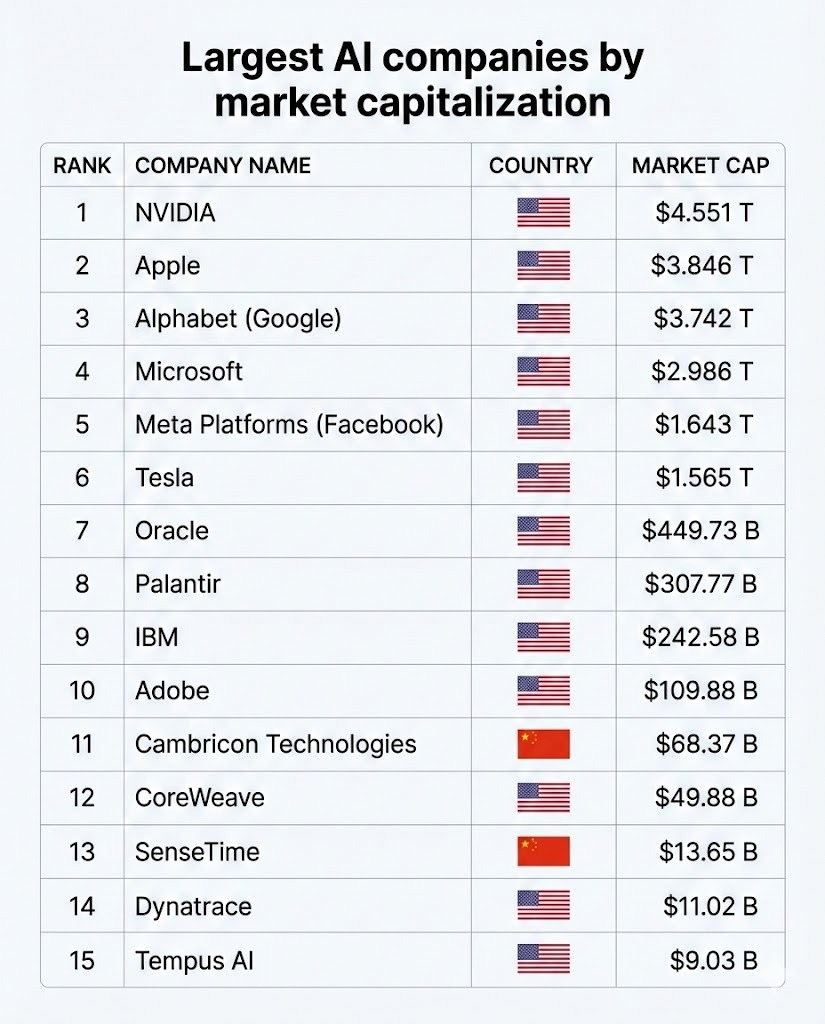
As of February 2026, the artificial intelligence (AI) landscape has reached unprecedented heights, with the largest AI companies by market capitalization Feb 2026 reshaping industries from healthcare to autonomous vehicles. These tech giants are not only driving innovation but also attracting massive investor confidence, reflected in their soaring valuations. With AI integration becoming standard across sectors, the market cap of leading AI firms has surged, setting new benchmarks in global finance and technology.
The race to dominate artificial intelligence is no longer just about algorithms and data—it’s about infrastructure, talent, and strategic acquisitions. Companies investing heavily in generative AI, machine learning platforms, and AI-powered cloud services are reaping the rewards. In this evolving ecosystem, market capitalization serves as a key indicator of influence, scalability, and long-term viability.
Top 5 Largest AI Companies by Market Capitalization in February 2026
Here are the five most valuable AI-driven companies as of February 2026, ranked by market capitalization:
- NVIDIA Corporation – $2.8 trillion
- Microsoft Corporation – $2.6 trillion
- Alphabet Inc. (Google) – $2.3 trillion
- Amazon.com Inc. – $2.1 trillion
- Meta Platforms Inc. – $1.7 trillion
These companies have consistently invested in AI research and development, acquiring startups, launching proprietary models, and integrating AI into core products. Their dominance is not accidental—it’s the result of years of strategic foresight and execution.
NVIDIA: The Unquestionable King of AI Hardware
NVIDIA leads the pack with a staggering $2.8 trillion market cap, driven by its near-monopoly in AI chip manufacturing. Its H100 and next-gen Blackwell GPUs power nearly 90% of large language models (LLMs) globally, including those developed by OpenAI, Google, and Meta.
Beyond hardware, NVIDIA has expanded into AI software ecosystems like CUDA and Omniverse, enabling developers to build and simulate AI applications at scale. Its partnerships with cloud providers and automotive companies further solidify its position as the backbone of the AI revolution.
Microsoft: AI Integration Across the Enterprise
Microsoft holds the second spot with a $2.6 trillion valuation, largely fueled by its Azure AI cloud platform and deep integration of AI into Office 365, Windows, and GitHub Copilot.
The company’s $10 billion investment in OpenAI has paid off handsomely, giving it exclusive access to GPT models and a first-mover advantage in enterprise AI tools. With Copilot now embedded across its suite, Microsoft is transforming how businesses operate—automating workflows and enhancing productivity.
Alphabet (Google): From Search to AI Supremacy
Alphabet, Google’s parent company, maintains a strong foothold in AI with a $2.3 trillion market cap. Its Gemini models are now rivaling OpenAI’s offerings, and Google Cloud’s AI services are gaining traction among developers and enterprises.
Google’s strength lies in its vast data repositories, global infrastructure, and research prowess through DeepMind. From AI-driven search enhancements to autonomous robotics, Alphabet continues to innovate across multiple AI domains.
Amazon: AI-Powered Commerce and Cloud Dominance
Amazon’s $2.1 trillion valuation reflects its dual strength in e-commerce and cloud computing. AWS (Amazon Web Services) remains the largest cloud provider, offering a comprehensive suite of AI and machine learning tools like SageMaker and Bedrock.
The company is also advancing in generative AI with its Titan models and integrating AI into Alexa, logistics, and supply chain management. Its focus on practical, scalable AI applications gives it a competitive edge in real-world deployment.
Meta: Betting Big on the AI-Fueled Metaverse
Meta Platforms rounds out the top five with a $1.7 trillion market cap, driven by aggressive AI investments in content moderation, ad targeting, and its open-source Llama models.
Despite challenges in user growth, Meta’s AI research division is producing cutting-edge models that rival proprietary systems. Its vision of an AI-powered metaverse continues to attract developer interest and venture funding.
What Drives Market Capitalization in AI Companies?
Several factors contribute to the high valuations of these AI leaders:
- R&D Investment: Heavy spending on AI research and talent acquisition.
- Cloud Infrastructure: Scalable platforms that support AI model training and deployment.
- Strategic Partnerships: Collaborations with startups, universities, and governments.
- Product Integration: Embedding AI into everyday tools and services.
- Regulatory Compliance: Navigating global AI policies and ethical standards.
Investors are not just betting on current performance but on future dominance in AI-driven economies. Companies that can scale responsibly and innovate continuously are rewarded with premium valuations.
Emerging Contenders and Regional Players
While U.S. firms dominate the top tier, regional players are gaining momentum. Chinese companies like Baidu and SenseTime are expanding their AI capabilities, though geopolitical tensions and export controls limit their global reach.
In Europe, SAP and ASML are investing in AI for enterprise software and semiconductor manufacturing, respectively. Meanwhile, startups in India, Israel, and Canada are attracting venture capital for niche AI applications in fintech, healthcare, and cybersecurity.
The global AI market is expected to exceed $1.5 trillion by 2030, with Asia-Pacific showing the fastest growth. This diversification suggests that future rankings may include more international players.
Key Takeaways
- NVIDIA leads the largest AI companies by market capitalization Feb 2026 with a $2.8 trillion valuation, thanks to its AI chip dominance.
- Microsoft, Alphabet, Amazon, and Meta round out the top five, each leveraging AI across cloud, software, and consumer platforms.
- Market cap reflects not just revenue but innovation, infrastructure, and strategic vision.
- Emerging markets and startups are beginning to challenge the U.S. tech hegemony in AI.
- Investors prioritize companies with scalable AI ecosystems and strong R&D pipelines.
FAQ
Which company has the highest market cap in AI as of February 2026?
NVIDIA Corporation holds the top position with a market capitalization of $2.8 trillion, primarily due to its leadership in AI hardware and software platforms.
Why is market capitalization important for AI companies?
Market cap indicates investor confidence, financial health, and the ability to fund large-scale AI projects. It also reflects a company’s influence in shaping industry standards and regulations.
Are there any non-U.S. companies among the largest AI firms by market cap?
As of February 2026, the top five are all U.S.-based. However, Chinese and European firms are rapidly expanding their AI capabilities and may enter the top tier in the coming years.
The AI industry in 2026 is more competitive and dynamic than ever. The largest AI companies by market capitalization Feb 2026 are not just technology providers—they are architects of the future digital economy. As AI becomes embedded in every aspect of life, their influence will only grow, shaping how we work, communicate, and innovate.