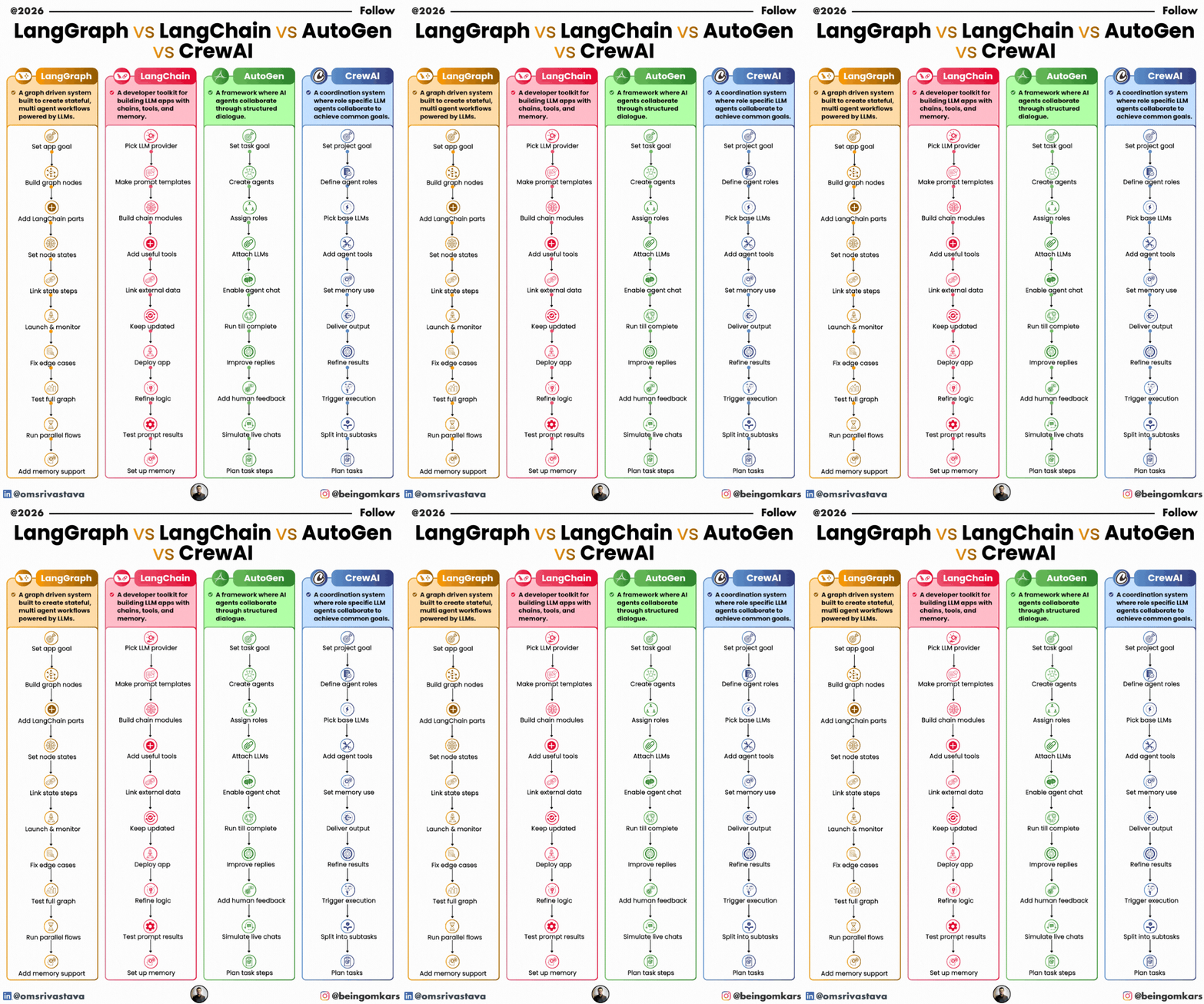
As artificial intelligence continues to evolve, developers and organizations are increasingly turning to specialized frameworks to build complex, multi-agent, and workflow-driven AI applications. Among the most prominent tools in this space are LangGraph, LangChain, AutoGen, and CrewAI. While these frameworks share some overlapping goals—such as enabling the use of large language models (LLMs) in structured applications—they differ significantly in architecture, design philosophy, and use cases. This article provides a clear, factual comparison of these four frameworks to help developers and decision-makers understand their core features and ideal applications.
What Is LangChain?
LangChain is one of the earliest and most widely adopted open-source frameworks for building applications powered by large language models. Launched in 2022, it provides a modular architecture that allows developers to chain together components such as prompts, models, memory, and tools to create sophisticated AI workflows.
At its core, LangChain supports a wide range of LLMs—including OpenAI, Anthropic, and open-source models—and integrates with external data sources, APIs, and vector databases. It emphasizes flexibility and ease of use, making it a popular choice for prototyping and deploying chatbots, document question-answering systems, and retrieval-augmented generation (RAG) pipelines.
LangChain’s strength lies in its extensive library of pre-built components and integrations. However, as applications grow in complexity—especially those involving multiple agents or stateful interactions—developers often find that LangChain’s linear chaining model becomes limiting.
Introducing LangGraph: Stateful Workflows for Complex AI
LangGraph is an extension of LangChain designed specifically to address the limitations of linear workflows. It introduces a graph-based architecture where nodes represent computational steps (such as LLM calls or tool invocations), and edges define the flow of data and control between them.
This stateful, graph-oriented approach allows for more dynamic and interactive AI systems. For example, LangGraph enables conditional branching, loops, and memory persistence across interactions—features that are essential for multi-turn conversations or agent collaboration. Unlike traditional LangChain chains, LangGraph supports cyclic graphs, making it suitable for applications like autonomous agents that need to plan, act, and reflect iteratively.
LangGraph is particularly useful when building systems that require long-term memory, decision-making loops, or coordination between multiple specialized agents. It retains compatibility with LangChain’s ecosystem, allowing developers to reuse existing components while gaining greater control over workflow logic.
AutoGen: Microsoft’s Framework for Multi-Agent Collaboration
Developed by Microsoft Research, AutoGen is a framework focused on enabling autonomous, multi-agent conversations. It allows developers to define multiple AI agents—each with distinct roles, goals, and capabilities—that can communicate, negotiate, and collaborate to solve complex tasks.
AutoGen agents can be configured to use different LLMs, tools, and reasoning strategies. For instance, one agent might act as a coder, another as a reviewer, and a third as a planner. These agents can interact in structured dialogues, pass messages, and even critique each other’s outputs to improve results.
One of AutoGen’s standout features is its support for human-in-the-loop interactions, where users can intervene in agent conversations to provide feedback or redirect tasks. This makes it well-suited for applications in software development, research assistance, and automated troubleshooting.
Unlike LangChain and LangGraph, which are more general-purpose, AutoGen is explicitly designed for agentic systems. It abstracts much of the complexity of agent communication and coordination, allowing developers to focus on defining roles and objectives rather than low-level message passing.
CrewAI: Task-Oriented Agent Teams
CrewAI is a newer framework that builds on the concept of multi-agent systems but emphasizes task delegation and team-based workflows. In CrewAI, a “crew” consists of multiple agents, each assigned a specific role (e.g., researcher, writer, analyst), who work together to complete a shared goal.
The framework introduces the concept of “tasks”—discrete units of work that are assigned to agents based on their expertise. Tasks can be sequential, parallel, or conditional, and agents can collaborate by sharing information or requesting assistance from one another.
CrewAI is designed to be intuitive and developer-friendly, with a focus on clarity and structure. It includes built-in support for memory, tool usage, and role-based access, making it easier to manage complex workflows without writing extensive boilerplate code.
While still evolving, CrewAI is gaining traction for use cases such as content creation, market research, and project management, where coordinated effort among specialized agents is essential.
Comparing the Frameworks
To better understand the differences, consider the following comparison:
- Architecture: LangChain uses linear chains; LangGraph uses stateful graphs; AutoGen and CrewAI use multi-agent systems with message passing.
- Primary Use Case: LangChain is ideal for simple RAG and chatbot applications; LangGraph excels in stateful, interactive workflows; AutoGen is best for autonomous agent collaboration; CrewAI focuses on task-oriented team execution.
- Complexity: LangChain is the easiest to start with; LangGraph adds complexity for greater control; AutoGen and CrewAI introduce higher abstraction for agent coordination.
- Integration: All four frameworks support major LLMs and tools, but LangChain and LangGraph have the broadest ecosystem support due to their maturity.
Key Takeaways
- LangChain is a foundational framework for LLM applications but lacks support for complex, stateful workflows.
- LangGraph extends LangChain with graph-based, stateful execution, enabling more dynamic and interactive AI systems.
- AutoGen specializes in autonomous multi-agent conversations, with strong support for human-in-the-loop interactions.
- CrewAI simplifies the creation of task-oriented agent teams, emphasizing role-based collaboration and workflow clarity.
- The choice of framework depends on the application’s complexity, need for agent coordination, and desired level of control.
FAQ
Can I use LangGraph without LangChain?
While LangGraph is built on top of LangChain and leverages many of its components, it is possible to use LangGraph independently for graph-based workflows. However, most developers use them together to benefit from LangChain’s extensive integrations.
Is AutoGen suitable for single-agent applications?
AutoGen can be used for single-agent tasks, but it is optimized for multi-agent scenarios. For simpler applications, frameworks like LangChain or LangGraph may be more efficient and easier to manage.
How does CrewAI differ from AutoGen?
Both frameworks support multi-agent systems, but CrewAI emphasizes structured task delegation and team roles, while AutoGen focuses on flexible, conversational agent interactions. CrewAI is more opinionated in its design, whereas AutoGen offers greater customization.