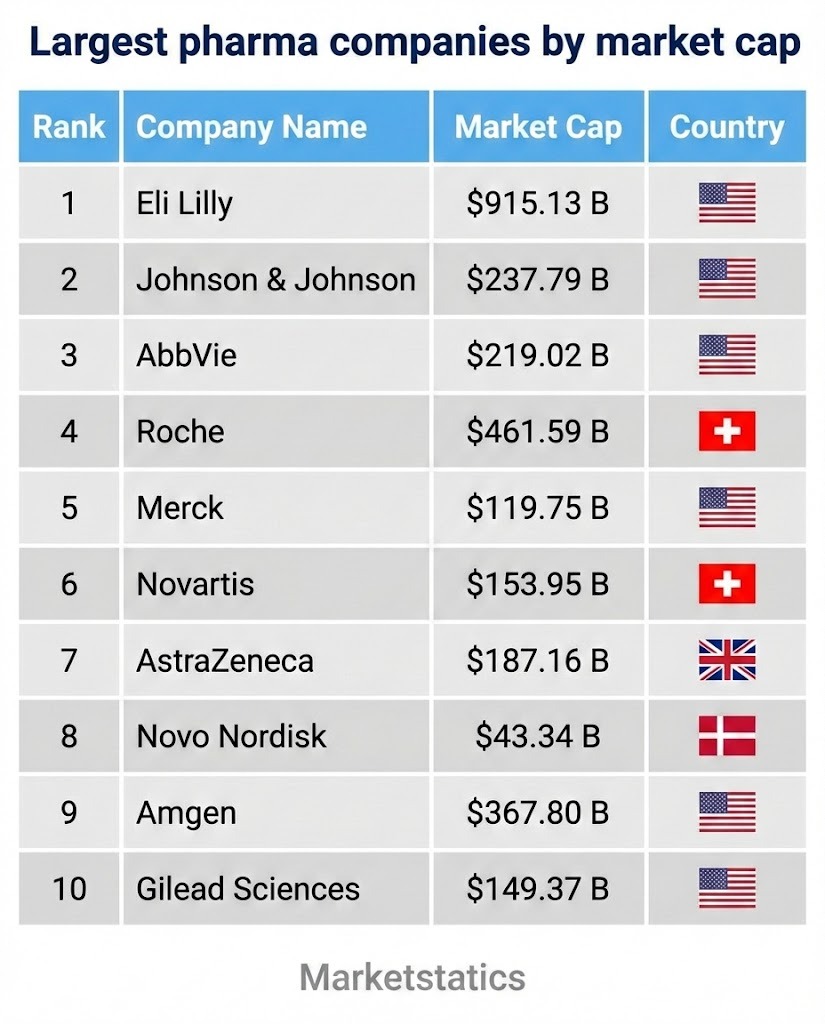
The global pharmaceutical landscape is now dominated by names once familiar mostly within industry circles — but increasingly cast into the spotlight as investors chase growth in obesity, cancer, and immunology treatments. At the summit of this sprawling sector sits Eli Lilly, whose valuation eclipses most rivals and serves as a barometer of where Wall Street believes future profits will come from. (Companies Market Cap)
Eli Lilly currently tops the list of the world’s largest pharmaceutical companies by market capitalization, with a valuation approaching nearly $1 trillion — a milestone reached thanks to blockbuster drugs targeting diabetes and obesity, such as Mounjaro and Zepbound. These treatments have transformed both Lilly’s earnings prospects and investor sentiment, making its stock one of the most watched outside big-tech. (Companies Market Cap)
Second only to Lilly is Johnson & Johnson, a sprawling health care conglomerate whose pharma arm underpins a market cap roughly half that of Lilly’s. The company’s diversified portfolio — spanning immunology to vaccines — has provided a steady anchor in an otherwise turbulent sector. (Companies Market Cap)
Following these giants in the rankings are AbbVie and Roche, entrenched players with deep pipelines in oncology and immunology, and Merck, known for its cancer blockbuster Keytruda. Swiss and American firms alike pepper the upper echelons, including Novartis and AstraZeneca, both of which mix traditional drug portfolios with growing investments in biotechnology. (Companies Market Cap)
A notable story unfolding in the mid-tier is Novo Nordisk, once among Europe’s most valuable firms thanks to its dominance in GLP-1 based therapies. Recent trading volatility tied to pricing pressures suggests that even market leaders are vulnerable as competition intensifies and public policy reshapes pricing dynamics. (Reuters)
Beyond the top 10, the mix begins to reflect a broader and increasingly global industry: Amgen and Gilead Sciences maintain strong market caps in the U.S.; Pfizer remains a household name; and companies such as GSK plc and Sanofi hold their ground in Europe. (Companies Market Cap)
Not all growth is confined to the Western giants. Emerging players from Asia and India — while smaller by market capitalization — reflect the shifting demographics of drug demand and manufacturing capacity. Firms like India’s Divis Laboratories and Torrent Pharmaceuticals appear deeper on the list, emblematic of the sector’s broadening geographic footprint. (Companies Market Cap)
What unites these disparate companies is a shared pivot toward innovation-driven portfolios and a race to commercialize the next generation of high-margin therapies — from obesity and metabolic diseases to oncology and gene therapies. Yet with valuations swayed by regulatory shifts, pricing pressures, and scientific risk, the sector’s hierarchy is as dynamic as the science it seeks to conquer.