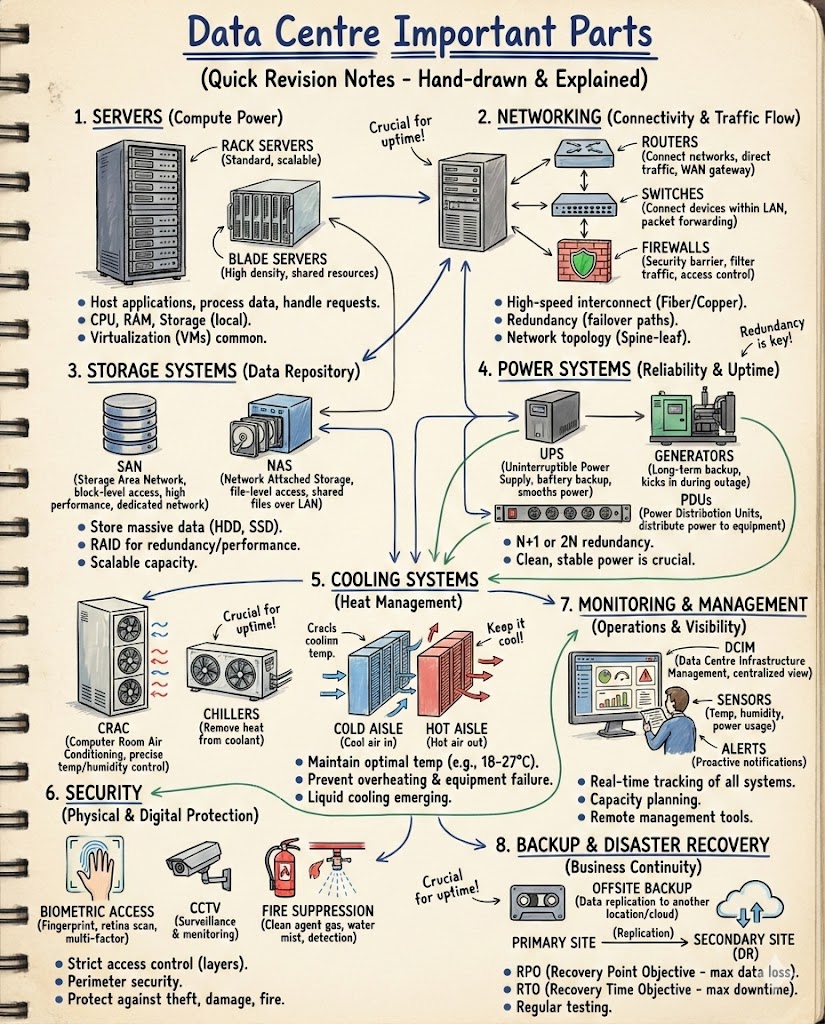
Important Parts of a Data Centre
A data centre is a specialized facility that houses computing systems and related components such as servers, storage, and networking equipment. It is the backbone of modern digital services, supporting cloud computing, banking systems, e‑commerce, social media, research, and enterprise operations. To function reliably, securely, and efficiently, a data centre is built from several critical parts. Each plays a unique role in ensuring continuous operation, performance, and protection of data.
1. Servers
Servers are the core of any data centre. They perform the actual computing tasks such as processing requests, running applications, hosting websites, and managing databases.
Key features:
- High‑performance CPUs and memory
- Redundant components (power supplies, fans, disks)
- Rack‑mounted or blade form factors
- Virtualization support
Without servers, a data centre would have no computing capability.
2. Storage Systems
Storage systems hold the data that organizations depend on, including files, databases, backups, and application data.
Types of storage:
- Direct Attached Storage (DAS)
- Network Attached Storage (NAS)
- Storage Area Networks (SAN)
- Solid State Drives (SSD) and Hard Disk Drives (HDD)
Modern data centres often combine high‑speed storage for active data and large‑capacity storage for archives and backups.
3. Networking Equipment
Networking equipment connects servers to each other and to the outside world.
Main components:
- Switches
- Routers
- Firewalls
- Load balancers
- Network cables and fiber optics
A fast and reliable network ensures low latency, high availability, and smooth data transfer between systems and users.
4. Power Supply Systems
A continuous and stable power supply is essential. Even a short outage can cause data loss and service disruption.
Important power components:
- Utility power connection
- Uninterruptible Power Supply (UPS)
- Backup generators
- Power Distribution Units (PDUs)
These systems provide redundancy and protect equipment from voltage fluctuations and outages.
5. Cooling and Environmental Control
Servers generate large amounts of heat. Cooling systems prevent overheating and hardware failure.
Cooling solutions include:
- Computer Room Air Conditioning (CRAC)
- Computer Room Air Handling (CRAH)
- Liquid cooling systems
- Hot aisle / cold aisle layout
Environmental monitoring also controls humidity, air quality, and temperature to maintain optimal operating conditions.
6. Racks and Physical Infrastructure
Racks organize and support equipment in a structured and space‑efficient manner.
Infrastructure elements:
- Server racks and cabinets
- Raised flooring or cable trays
- Cable management systems
- Mounting rails and shelves
Good physical organization improves airflow, simplifies maintenance, and enhances safety.
7. Security Systems
Data centres store sensitive and valuable information, making security a top priority.
Physical security:
- Biometric access control
- ID cards and key systems
- CCTV surveillance
- Security guards
Cybersecurity:
- Firewalls
- Intrusion detection and prevention systems
- Encryption
- Access control policies
Together, these measures protect against unauthorized access and cyber threats.
8. Monitoring and Management Systems
Monitoring tools track the health and performance of equipment and infrastructure.
They monitor:
- Server usage and errors
- Network traffic
- Temperature and humidity
- Power consumption
Data Centre Infrastructure Management (DCIM) software helps administrators detect problems early and optimize operations.
9. Backup and Disaster Recovery Systems
To protect against data loss and system failure, data centres use backup and disaster recovery solutions.
Common methods:
- Regular data backups
- Replication to secondary data centres
- Cloud‑based disaster recovery
These systems ensure business continuity during hardware failures, cyberattacks, or natural disasters.
Conclusion
A data centre is far more than a room full of computers. It is a carefully engineered environment made up of servers, storage, networking, power systems, cooling, security, and management tools. Each component plays a vital role in delivering reliable, secure, and high‑performance digital services. Understanding these important parts helps organizations design better infrastructure and ensures that modern technology continues to run smoothly.