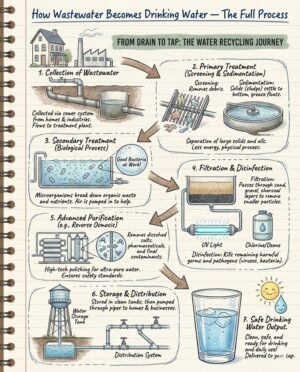
The transformation of wastewater into safe, high-quality drinking water is one of the most critical feats of modern environmental engineering, representing a vital strategy in managing global water scarcity. This process, often referred to as water reclamation or potable reuse, is a complex, multi-barrier approach that essentially mimics and accelerates the natural hydrological cycle, often resulting in water purity levels that surpass those of conventional sources.
The fundamental goal is to take municipal effluent—water that has already been used in homes, businesses, and industries and subsequently treated in a standard wastewater facility—and subject it to highly advanced purification stages. The journey from sewage to potable water requires rigorous steps designed not merely to remove solid waste and biological matter, but specifically to eliminate dissolved contaminants, trace organic chemicals, pharmaceuticals, viruses, and pathogens to levels undetectable by current standards.
Before advanced purification begins, the water undergoes conventional primary and secondary wastewater treatment. Primary treatment physically screens out large solids and allows remaining grit and heavier organic matter to settle in sedimentation tanks. Following this, secondary treatment, typically involving biological processes like the activated sludge method, introduces beneficial microorganisms that consume and break down the majority of dissolved and suspended organic material.
The effluent emerging from the secondary treatment stage, while safe for discharge into certain natural waterways, is not yet suitable for human consumption. This is where the third and most crucial phase—Advanced Water Treatment (AWT)—begins, utilizing cutting-edge membrane and chemical technologies to achieve the stringent purification levels required for potable reuse.
The first step in the Advanced Water Treatment sequence often involves microfiltration (MF) or ultrafiltration (UF). These are physical barriers utilizing incredibly fine, porous membranes. Microfiltration membranes typically have pores ranging from 0.1 to 10 micrometers, effectively removing residual suspended solids, protozoa, and larger bacteria. Ultrafiltration takes this a step further, with pore sizes down to approximately 0.01 micrometers, capable of eliminating viruses and nearly all pathogens, providing a critical safety barrier against biological contaminants.
Following membrane filtration, the water is prepared for the most intensive purification stage: Reverse Osmosis (RO). Reverse osmosis is the cornerstone of advanced water purification, forcing water molecules through a semi-permeable membrane under high pressure, leaving behind almost all dissolved salts, inorganic molecules, heavy metals, and nearly every type of chemical contaminant, including emerging contaminants of concern such as endocrine disruptors and trace pharmaceutical compounds. The RO process effectively acts as a molecular sieve, ensuring that only pure water passes through, generating two streams: the highly purified permeate and a concentrated brine residual that must be managed carefully.
Although reverse osmosis removes the vast majority of contaminants, a tiny fraction of highly persistent, low molecular weight organic compounds may occasionally pass through. To address this, the water undergoes an Advanced Oxidation Process (AOP). AOP typically involves the application of strong ultraviolet (UV) light in conjunction with an oxidant, such as hydrogen peroxide. This synergistic combination generates highly reactive hydroxyl radicals, which are powerful, non-selective chemical species. These radicals effectively mineralize, or break down, the remaining trace organic contaminants into harmless inorganic byproducts, ensuring complete chemical purity.
The combination of membrane filtration, reverse osmosis, and advanced oxidation is known as the ‘three-barrier approach,’ and it guarantees that the recycled water meets or exceeds all current federal and state drinking water quality standards. It is this multi-step, redundant system that provides the necessary confidence and safety margin for engineers and regulators.
Once the water is chemically and biologically pure, it must be prepared for integration into the drinking water distribution system, a step known as post-treatment. Because the rigorous RO process removes beneficial minerals along with contaminants, the purified water is highly corrosive and lacks the characteristic taste people expect. Therefore, a process of stabilization or remineralization is necessary.
Stabilization typically involves adding calcium carbonate or lime to increase alkalinity and hardness, making the water less corrosive to pipes and improving its palatability. This critical step ensures that the water is chemically balanced, protecting the expensive infrastructure of the distribution network and confirming consumer acceptance.
The final, non-negotiable step before distribution is disinfection. This process ensures that a persistent disinfectant residual is maintained throughout the pipe network, preventing any potential microbial regrowth. Commonly, chlorination or the formation of chloramines is employed, providing continuous protection up to the consumer’s tap, just as is done with water sourced from conventional reservoirs or aquifers.
The path the purified water takes to the consumer defines whether the project utilizes Indirect Potable Reuse (IPR) or Direct Potable Reuse (DPR). Indirect Potable Reuse involves introducing the reclaimed water into an environmental buffer, such as recharging a groundwater aquifer or discharging it into a surface reservoir. The retention time within this buffer, which can range from months to years, provides an additional, natural purification step and helps alleviate public concerns about the source.
IPR systems are common globally and have been successfully operating for decades in places like Orange County, California, where highly treated wastewater is used to replenish groundwater basins, serving as a protective barrier against seawater intrusion and a source for later potable reuse extraction. This environmental blending offers social acceptance benefits and ensures the system handles natural fluctuations in demand and supply.
Direct Potable Reuse (DPR), in contrast, involves introducing the highly purified water directly into the potable water distribution system, either upstream of a conventional drinking water treatment plant or directly into the network. DPR eliminates the need for an environmental buffer and is thus more water-efficient and cost-effective, particularly in arid urban environments where land for reservoirs or groundwater recharge facilities is scarce.
While DPR technology is mature and proven safe, regulatory frameworks and public acceptance are often the primary hurdles. Strict, continuous monitoring and redundant safety systems are fundamental to DPR, requiring advanced real-time sensors that can detect minute fluctuations in water quality and automatically divert flow if any parameter falls outside of specification, ensuring the highest level of consumer protection.
The entire operation is governed by stringent regulatory frameworks, such as those established by the Environmental Protection Agency (EPA) and state-level health departments. These regulations mandate not only the removal of known contaminants but also establish protocols for testing and monitoring emerging contaminants, which drives innovation in the required treatment barriers. Plant operators must adhere to these standards using continuous monitoring equipment, ensuring every liter meets safety criteria 24/7.
Beyond the technical processes, the success of wastewater becoming drinking water hinges on transparency and public education. Overcoming the “yuck factor” associated with drinking recycled water requires communicating clearly that the advanced treatment processes effectively erase the water’s history, producing a product that is chemically indistinguishable from and often purer than traditional sources.
The continuous drive for efficiency and sustainability is leading to new developments, including improved energy recovery within treatment facilities and the refinement of membrane technology to reduce energy consumption. As population centers grow and climate change stresses natural water supplies, potable reuse transitions from an option to a necessity for ensuring long-term water security.
In essence, the transformation of wastewater into drinking water is a testament to human ingenuity. It is a controlled, engineered, and constantly monitored process that relies on multiple layers of highly effective physical and chemical purification to deliver a safe, reliable, and sustainable water supply, guaranteeing the health of communities while protecting limited environmental resources for future generations.
The infrastructure investments required for advanced water treatment are substantial, but the return on investment is measured in resilience. By establishing a closed-loop system, urban centers reduce reliance on increasingly stressed external sources, securing independence from drought and unpredictable weather patterns, making recycled water an indispensable component of modern urban water portfolios.
The regulatory and monitoring requirements placed upon potable reuse facilities are typically far more rigorous than those applied to conventional surface water treatment plants. This elevated level of scrutiny includes comprehensive monitoring plans for regulated contaminants and frequent checks for unregulated substances, often surpassing the standard surveillance required for reservoir sources, providing an additional layer of public health confidence.
The process is not static; it constantly evolves. Research is ongoing into even more advanced technologies, such as capacitive deionization or specialized resins, designed to handle highly specific or extremely low concentrations of complex contaminants, further pushing the boundaries of water purification science.
In summary, wastewater reclamation is a meticulously controlled sequence of physical and chemical processes: initial screening and settling, biological degradation of organics, physical removal of particles and pathogens via microfiltration and ultrafiltration, removal of dissolved salts and chemicals via reverse osmosis, destruction of residual trace organics via advanced oxidation, and final stabilization and disinfection. This integrated approach ensures that the output is not just clean, but ultra-pure, ready to meet the highest demands of public health and safety.
Ultimately, the water molecules that exit a potable reuse plant are the same molecules that fall as rain and fill our rivers; they have simply been subjected to the best purification technology available on the planet, demonstrating that the future of drinking water supply lies, in part, in responsibly reusing the water we have already utilized.