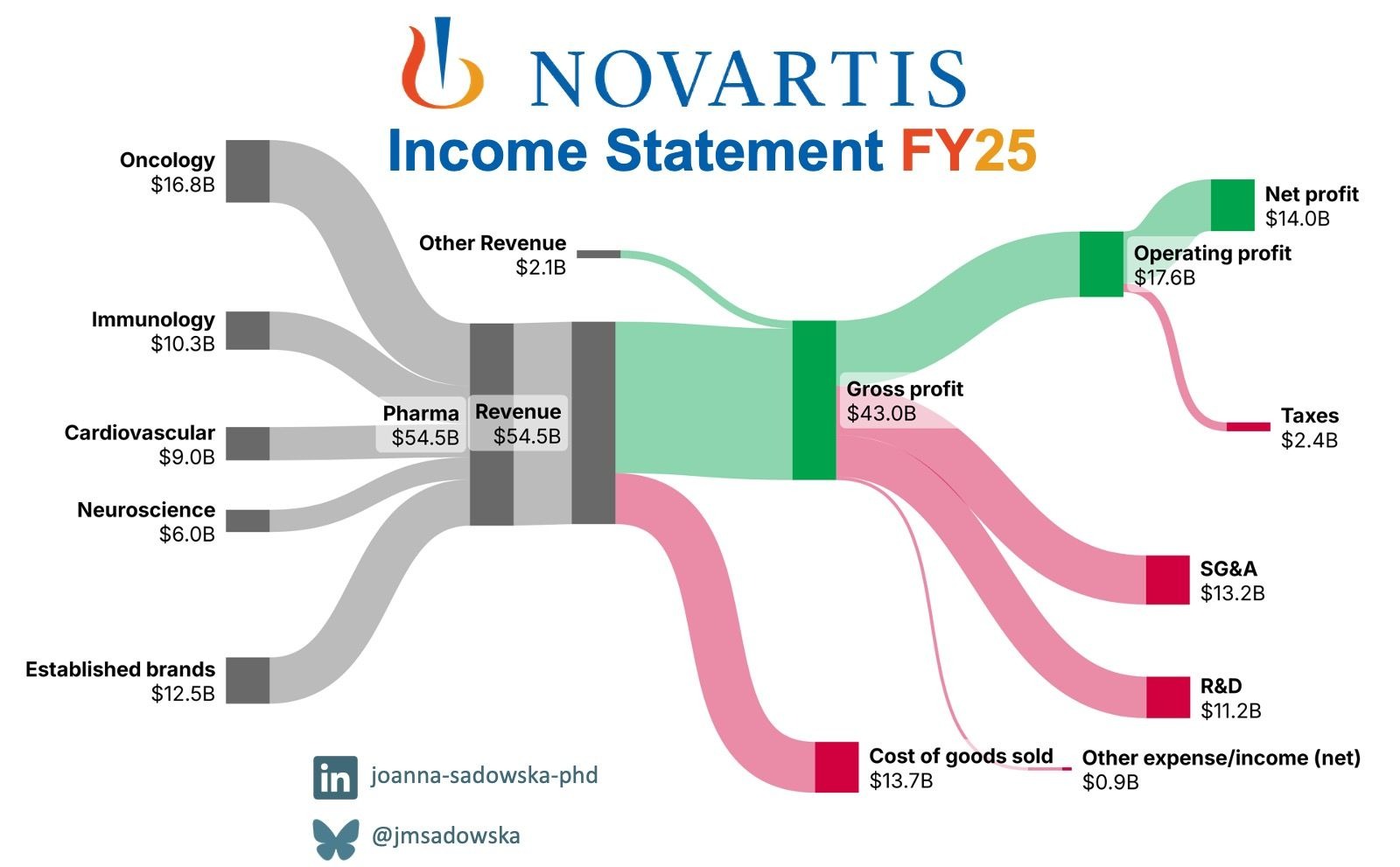
In fiscal year 2025, Novartis, one of the world’s leading pharmaceutical companies, reported a strong financial performance, driven by strategic portfolio optimization, innovation in key therapeutic areas, and disciplined cost management. Understanding how the Swiss multinational generated profit requires a close look at its income statement—the financial document that details revenues, expenses, and ultimately, net income over a specific period. This article breaks down the key components of Novartis’s FY2025 income statement to explain the sources of its profitability.
Overview of Novartis’s FY2025 Financial Performance
For the fiscal year ending December 31, 2025, Novartis reported total net sales of approximately $52.8 billion, marking a 6% increase compared to the previous year. Net income attributable to shareholders reached $11.4 billion, reflecting a healthy net profit margin of around 21.6%. This performance was supported by growth in both its Innovative Medicines and Sandoz (generic and biosimilar) divisions, despite ongoing challenges such as patent expirations and pricing pressures in certain markets.
The company’s ability to maintain profitability stemmed from a combination of revenue growth, operational efficiency, and strategic divestitures. By focusing on high-margin therapies and streamlining its cost base, Novartis strengthened its financial position and delivered value to stakeholders.
Revenue Streams: Where the Money Came From
Novartis generates revenue primarily through two business segments: Innovative Medicines and Sandoz.
- Innovative Medicines: This segment accounted for about 78% of total net sales in FY2025, contributing $41.2 billion. Growth was led by strong performance in key therapeutic areas such as oncology, immunology, and neuroscience. Drugs like Cosentyx (for psoriasis and arthritis), Entresto (for heart failure), and Kesimpta (for multiple sclerosis) continued to gain market share globally.
- Sandoz: The generics and biosimilars division generated $11.6 billion, representing 22% of total sales. While growth in this segment was more modest at 3%, it benefited from successful launches of biosimilars in Europe and North America, particularly in the areas of oncology and immunology.
Geographically, North America remained the largest market, contributing 45% of total sales, followed by Europe (30%) and International markets (25%). Emerging markets showed accelerated growth, particularly in China and Brazil, driven by expanded access to key therapies and favorable reimbursement policies.
Cost of Goods Sold (COGS) and Gross Profit
The cost of goods sold (COGS) for FY2025 was $14.3 billion, representing 27% of net sales. This figure includes the direct costs associated with manufacturing and distributing pharmaceutical products, such as raw materials, labor, and logistics.
Subtracting COGS from net sales yields gross profit, which stood at $38.5 billion. The gross profit margin of approximately 73% reflects Novartis’s ability to maintain pricing power for its patented drugs and manage production costs efficiently. This high margin is typical for innovative pharmaceutical companies, where R&D investments are recouped through premium pricing during patent protection periods.
Operating Expenses: R&D, Marketing, and Administration
After gross profit, the next major deductions are operating expenses, which include research and development (R&D), marketing and sales, and general administrative costs.
- Research and Development (R&D): Novartis invested $9.8 billion in R&D during FY2025, accounting for 18.6% of net sales. This level of investment underscores the company’s commitment to innovation, with a robust pipeline focused on areas such as gene therapy, oncology, and cardiovascular diseases. Notable advancements included Phase III trials for a new Alzheimer’s treatment and expansion of its CAR-T cell therapy portfolio.
- Marketing and Sales: These expenses totaled $10.2 billion, or 19.3% of sales. The company maintained a strong commercial presence, particularly in the U.S. and Europe, to support the launch and uptake of new products. Digital marketing and patient support programs played an increasing role in engagement strategies.
- General and Administrative (G&A): G&A expenses were $3.1 billion, representing 5.9% of sales. This category includes executive salaries, legal fees, IT infrastructure, and other overhead costs. Novartis has been actively reducing G&A through digital transformation and shared service centers.
Total operating expenses amounted to $23.1 billion. Subtracting this from gross profit results in operating income of $15.4 billion, yielding an operating margin of 29.2%.
Other Income, Taxes, and Net Profit
Beyond core operations, Novartis recorded other income of $1.2 billion, primarily from gains on the sale of non-core assets and licensing agreements. In 2025, the company completed the divestiture of its ophthalmology portfolio to Bausch + Lomb, which contributed a one-time gain of $800 million.
Interest expenses were relatively low at $400 million, reflecting prudent debt management. The company maintained a strong balance sheet with a debt-to-equity ratio of 0.45.
Income before taxes stood at $16.2 billion. After accounting for income taxes of $4.8 billion—an effective tax rate of 29.6%—Novartis reported net income of $11.4 billion. This represents a 9% increase from FY2024, driven by higher sales, cost control, and strategic asset sales.
Key Takeaways
- Novartis achieved strong profitability in FY2025 through a combination of revenue growth, high gross margins, and disciplined expense management.
- The Innovative Medicines segment was the primary driver of sales, with blockbuster drugs like Cosentyx and Entresto leading the way.
- R&D investment remained substantial at nearly 19% of sales, ensuring long-term innovation and pipeline strength.
- Strategic divestitures and operational efficiencies helped boost net income, even as the company navigated patent cliffs and market competition.
- The effective tax rate of 29.6% reflects a balanced approach to global tax planning while maintaining compliance with international regulations.
FAQ
What were the main factors behind Novartis’s profit growth in FY2025?
Profit growth was driven by increased sales of key innovative drugs, successful biosimilar launches in Sandoz, cost control measures, and gains from strategic asset sales. Strong performance in North America and emerging markets also contributed.
How much did Novartis spend on research and development in FY2025?
Novartis invested $9.8 billion in R&D, representing 18.6% of its total net sales. This investment supports a diverse pipeline across oncology, neuroscience, and rare diseases.
Did Novartis face any major challenges in FY2025?
Yes, the company continued to face patent expirations for older drugs, pricing pressures in the U.S. and Europe, and competition from generics and biosimilars. However, these were offset by new product launches and portfolio optimization.