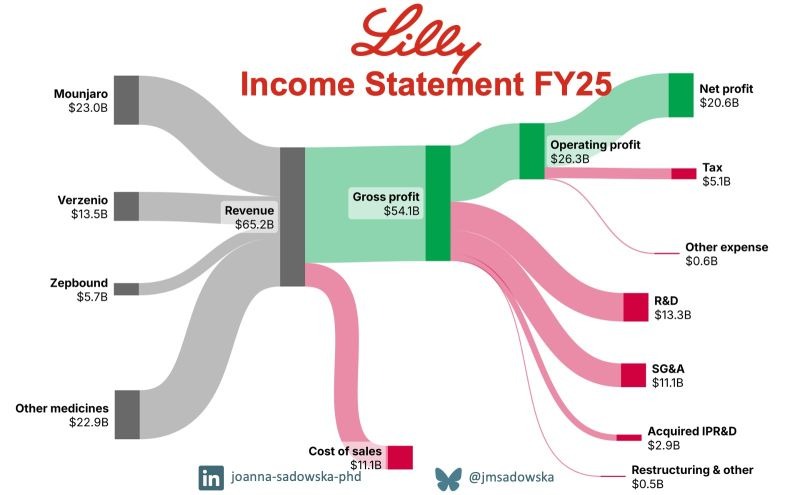
Eli Lilly and Company’s FY2025 results offer a textbook example of how a pharmaceutical major can scale blockbuster innovation while maintaining exceptional profitability. The company is currently riding one of the strongest product cycles in modern pharma history—driven primarily by its obesity and diabetes portfolio.
Revenue Engine: GLP-1 Takes Center Stage
In FY2025, Eli Lilly reported $65.2 billion in revenue, with the majority coming from its GLP-1 franchise. Treatments for obesity and diabetes are no longer just growth drivers—they are fundamentally reshaping Lilly’s revenue mix, pricing power, and long-term margin profile.
Demand strength, premium pricing, and expanding global access have turned the GLP-1 portfolio into the company’s primary earnings engine, allowing Lilly to scale revenue at a pace rarely seen in large-cap pharma.
Strategic Spending: Investing While Scaling
Despite its revenue surge, Lilly continues to invest aggressively for the future.
-
R&D spending reached $13.3 billion, reflecting a deep commitment to pipeline expansion across cardiometabolic diseases, immunology, oncology, and next-generation modalities.
-
SG&A expenses totaled $11.1 billion, supporting global commercialization, manufacturing scale-up, and market expansion for high-demand therapies.
These investments underline a key point: Lilly’s profitability is not coming from cost-cutting, but from operating leverage on rapidly growing revenues.
Partnerships Strengthen the Long-Term Pipeline
Alongside internal R&D, Lilly has doubled down on external innovation. In early 2026, the company announced multiple strategic partnerships, including collaborations with Repertoire Immune Medicines, Seamless Therapeutics, and Orna Therapeutics, among others.
These deals expand Lilly’s reach into immune medicine, RNA-based therapies, and novel drug platforms—positioning the company for sustained growth well beyond its current GLP-1 dominance.
Bottom Line: Exceptional Net Profitability
After accounting for $5.1 billion in taxes and $0.6 billion in other expenses, Eli Lilly closed FY2025 with a net profit of $20.6 billion.
This translates into an impressive ~32% net margin, a level few global pharmaceutical companies achieve—especially while simultaneously increasing R&D intensity and manufacturing investments.
The Bigger Picture
FY2025 shows how Eli Lilly has successfully aligned:
-
A once-in-a-generation product cycle
-
Disciplined cost management
-
Aggressive reinvestment in future innovation
The result is a company generating extraordinary profits today while actively building the foundation for its next decade of growth. In an industry where scale often slows innovation, Lilly has managed to do both—at the same time.