In October 2020, something unprecedented happened in Indian pharma.
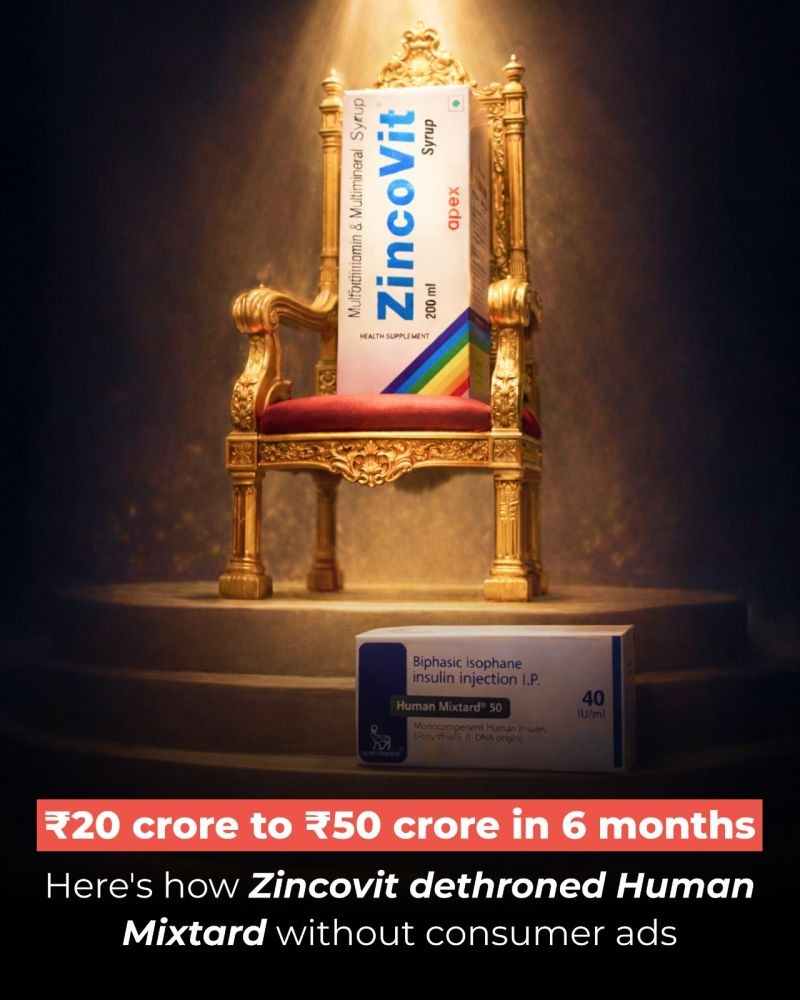
A multivitamin—not a life-saving insulin, not a chronic therapy drug—became the largest-selling pharmaceutical brand in the country.
That brand was Zincovit, manufactured by Apex Laboratories Pvt. Ltd..
For the first time in Indian pharma history:
-
A supplement outsold chronic lifestyle drugs
-
A ₹50+ crore brand emerged in a single month
-
A product jumped from rank #53 (Jan 2020) to #1 (Oct 2020)
It even overtook Human Mixtard, the insulin brand that had dominated Indian sales charts for years.
And here’s the most counterintuitive part:
👉 Apex never ran consumer advertising.
No TV spots. No influencer campaigns. No celebrity endorsements.
Yet Zincovit won.
This wasn’t luck. It was 30 years of compounding strategy.
Phase 1: Owning a Category Before It Was Valuable (1990–2010)
In 1990, when India’s pharma industry was focused on antibiotics and painkillers, Apex made a contrarian bet.
They introduced zinc-based formulations—at a time when micronutrients were barely discussed outside academic circles.
Instead of chasing multiple therapy areas, Apex did something rare:
-
They committed to zinc
-
They built a singular identity:
“The Zinc People”
For three decades, that positioning never wavered.
While other companies treated zinc as a line extension, Apex treated it as a core philosophy.
Result:
-
Zincovit wasn’t just another multivitamin
-
It became the reference brand for zinc supplementation
Phase 2: Trust Over Transactions – The Doctor-First Strategy
Zincovit didn’t grow through hype.
It grew through clinical logic.
Apex invested heavily in:
-
Medical literature
-
CME programs
-
Scientific detailing
Doctors began prescribing Zincovit:
-
Alongside antibiotics
-
During post-infection recovery
-
For nutritional replenishment
Why?
Because physicians understood the rationale, not the marketing pitch.
Zincovit became part of routine clinical practice, not a retail add-on.
This mattered later—much later.
Phase 3: Distribution as a Competitive Moat
While many pharma companies concentrated on metros, Apex quietly built distribution depth.
-
~1,400 medical representatives
-
~2,200 channel partners
-
Strong penetration in semi-urban and rural India
This meant:
-
Local practitioners trusted the brand
-
Chemists stocked it by default
-
Availability was never a bottleneck
Zincovit wasn’t just known—it was everywhere that prescriptions were written.
Phase 4: The Pandemic Inflection Point (2020)
When COVID-19 hit, India saw a sudden surge in demand for:
-
Immunity boosters
-
Nutritional supplements
-
Zinc-based products
Hundreds of brands rushed in.
But Zincovit didn’t need to explain itself.
It already had:
-
30 years of doctor trust
-
Clinical credibility
-
Ubiquitous availability
Doctors prescribed it instinctively.
Consumers followed prescriptions.
That’s how Zincovit:
-
Jumped from rank #53 to #1 in 9 months
-
Clocked ₹50 crore in October 2020 alone
-
Became India’s largest-selling pharma brand, across categories
This wasn’t viral marketing.
This was institutional trust paying dividends.
Phase 5: When Brand Equity Became Legal Armor (2025)
In 2025, Knoll Healthcare launched ZINOLVITA—
with similar naming, packaging, and visual cues.
Apex sued.
The case went to the Madras High Court.
The judgment was decisive.
The court ruled that ZINCOVIT had “acquired distinctiveness” through:
-
Decades of consistent use
-
Strong physician association
-
Market leadership
Knoll was permanently restrained from using the infringing brand.
👉 This is rare in Indian pharma.
👉 And it only happens when a brand’s identity is deeply entrenched.
In simple terms:
Marketing consistency turned into legal protection.
The Bigger Lesson: Ethical Pharma Marketing Compounds
Zincovit proves something many marketers underestimate:
🔹 Physician trust compounds over decades
🔹 Category ownership beats short-term launches
🔹 Distribution depth creates resilience
🔹 Brand equity can become a legal moat
Apex didn’t chase trends.
They stayed boring, consistent, and science-led.
And when the world changed overnight, they were already positioned to win.
Final Thought
Zincovit isn’t just a success story.
It’s a reminder that in pharma:
Credibility scales faster than advertising when it’s allowed to compound.
Now I’m curious 👀
Which other pharma brand have you seen build this kind of long-term, defensible positioning?