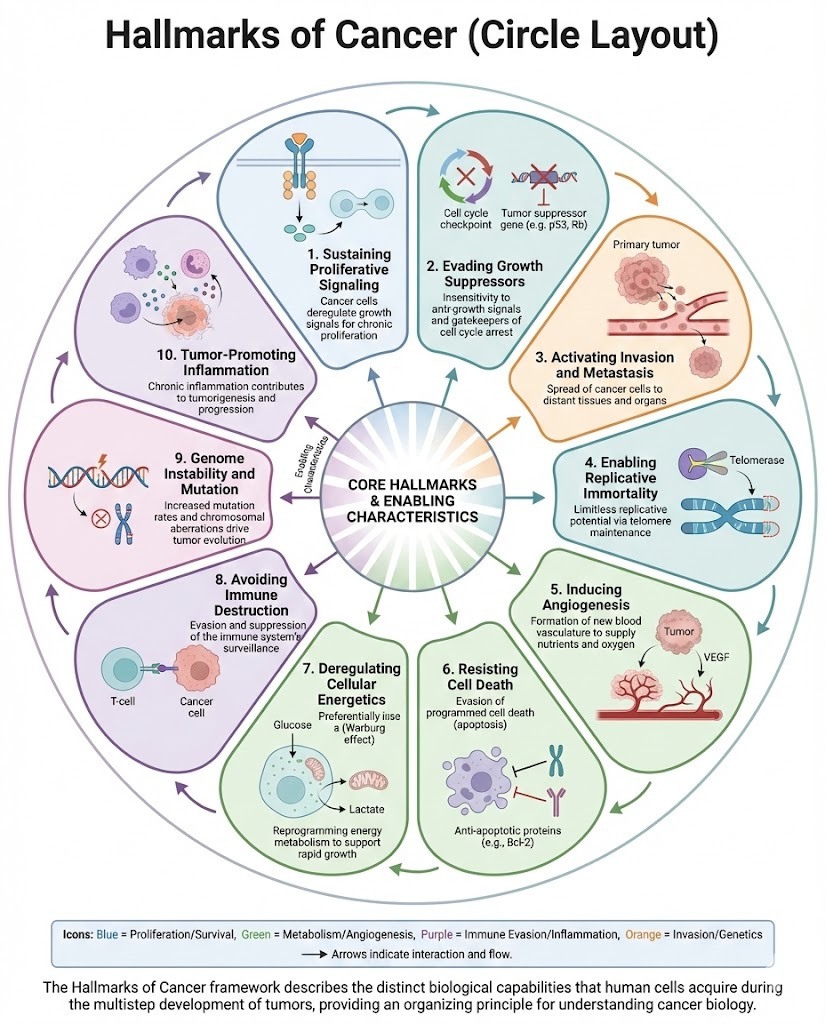
The concept of the hallmarks of cancer has reshaped how researchers, clinicians, and biotechnology companies understand tumor development and progression. Instead of viewing cancer as a single disease, this model explains it as a collection of biological capabilities acquired by cells over time. The Hallmarks of Cancer (Circle Layout) is a widely used visual framework that organizes these capabilities into a circular diagram, making complex interactions easier to understand and communicate.
This approach is especially valuable in education, drug development, and clinical research because it connects molecular mechanisms to observable disease behavior. By mapping cancer traits into a circle layout, scientists can illustrate how each hallmark supports the others and how therapies may interrupt these processes.
This article provides a detailed explanation of the Hallmarks of Cancer (Circle Layout), its components, why it matters, and how it is applied in modern oncology.
What Are the Hallmarks of Cancer?
The hallmarks of cancer are a set of biological characteristics that distinguish cancer cells from normal cells. They were originally proposed by researchers Douglas Hanahan and Robert Weinberg and later expanded as scientific knowledge grew.
These hallmarks describe how cancer cells:
-
Sustain uncontrolled growth
-
Avoid growth suppressors
-
Resist cell death
-
Enable unlimited replication
-
Promote blood vessel formation
-
Invade tissues and spread to distant organs
Additional enabling traits and emerging hallmarks have also been recognized, reflecting advances in genetics, immunology, and metabolism.
Why Use a Circle Layout?
The Hallmarks of Cancer (Circle Layout) is a visual representation that places each hallmark around a circular diagram. This design emphasizes that cancer is not driven by a single pathway but by interconnected biological systems working together.
Key advantages of the circle layout include:
-
Clear visualization of complex relationships
-
Equal emphasis on each hallmark
-
Easy comparison across cancer types
-
Practical use in presentations, textbooks, and research proposals
-
Support for systems biology and multi-target drug design
By arranging the hallmarks in a circular structure, researchers highlight the continuous and reinforcing nature of tumor development.
Core Hallmarks in the Circle Layout
While variations exist, most versions of the Hallmarks of Cancer (Circle Layout) include the following core traits.
Sustaining proliferative signaling
Cancer cells generate their own growth signals or amplify existing ones, allowing continuous division even when normal cells would stop.
Evading growth suppressors
Tumor cells disable regulatory pathways that normally prevent uncontrolled proliferation, including those governed by tumor suppressor genes.
Resisting cell death
Healthy cells undergo programmed death when damaged. Cancer cells bypass this mechanism, allowing them to survive despite genetic instability.
Enabling replicative immortality
Normal cells have a limited number of divisions. Cancer cells activate mechanisms such as telomerase to divide indefinitely.
Inducing angiogenesis
Tumors stimulate the formation of new blood vessels to supply oxygen and nutrients, supporting further growth.
Activating invasion and metastasis
Cancer cells acquire the ability to break away from the original tumor, invade surrounding tissues, and colonize distant organs.
These six classical hallmarks often form the foundation of the circle layout.
Enabling Characteristics and Emerging Hallmarks
Modern versions of the Hallmarks of Cancer (Circle Layout) often include additional layers.
Genome instability and mutation
High mutation rates allow cancer cells to evolve rapidly and adapt to hostile environments, including drug treatments.
Tumor-promoting inflammation
Inflammatory cells release growth factors and enzymes that enhance tumor survival and invasion.
Reprogramming energy metabolism
Cancer cells alter how they generate energy, favoring pathways that support rapid growth even in low-oxygen conditions.
Evading immune destruction
Tumors develop strategies to avoid detection or elimination by the immune system, which has led to the development of immunotherapies.
These features are often displayed in an outer ring or inner layer of the circle layout, showing how they support the core hallmarks.
How the Circle Layout Is Used in Practice
The Hallmarks of Cancer (Circle Layout) is more than a teaching tool. It plays a functional role in research and development.
Drug discovery and development
Pharmaceutical companies use the framework to:
-
Identify biological targets
-
Design combination therapies
-
Predict resistance mechanisms
-
Prioritize research investments
Targeting multiple hallmarks simultaneously is often more effective than focusing on a single pathway.
Clinical oncology
Oncologists use the model to:
-
Understand tumor behavior
-
Interpret molecular diagnostic results
-
Select targeted therapies
-
Explain disease mechanisms to patients
Academic research
Researchers apply the circle layout to:
-
Organize experimental findings
-
Compare cancer types
-
Develop computational models
-
Communicate complex biological interactions
Biotechnology and diagnostics
Diagnostic platforms increasingly map biomarkers to specific hallmarks, helping clinicians tailor treatments based on tumor biology.
Benefits of the Hallmarks of Cancer (Circle Layout)
This framework offers several important advantages.
-
Simplifies complex biological data
-
Encourages multi-disciplinary collaboration
-
Supports personalized medicine strategies
-
Guides rational therapy design
-
Enhances education and communication
It also provides a common language for researchers across genetics, immunology, pharmacology, and clinical medicine.
Limitations to Consider
While powerful, the model is not without limitations.
-
Not all cancers express every hallmark equally
-
Tumor behavior changes over time
-
Microenvironment factors can vary widely
-
Some biological mechanisms remain poorly understood
Therefore, the circle layout should be viewed as a flexible guide rather than a rigid classification system.
The Future of the Circle Layout Model
As cancer research advances, the Hallmarks of Cancer (Circle Layout) continues to evolve.
Future updates are likely to include:
-
More detailed immune interactions
-
Microbiome influences
-
Epigenetic regulation
-
Spatial tumor architecture
-
Integration with artificial intelligence analysis tools
These additions will further refine how scientists conceptualize cancer and develop new treatment strategies.
Conclusion
The Hallmarks of Cancer (Circle Layout) provides a structured, visually intuitive framework for understanding the biological foundations of cancer. By organizing key tumor traits into a circular model, it highlights the interconnected nature of cancer progression and treatment resistance.
From research laboratories to clinical settings and pharmaceutical development, this approach has become a cornerstone of modern oncology. While it does not capture every aspect of tumor complexity, it remains one of the most effective tools for organizing knowledge and guiding innovation in cancer science.
As technology and biological understanding continue to advance, the circle layout will likely expand and adapt, maintaining its role as a central reference point in the fight against cancer.
Frequently Asked Questions About Hallmarks of Cancer (Circle Layout)
What is the Hallmarks of Cancer (Circle Layout)?
The Hallmarks of Cancer (Circle Layout) is a visual model that organizes the key biological traits of cancer into a circular diagram. It shows how different capabilities such as uncontrolled growth and immune evasion interact to drive tumor development.
How many hallmarks are typically shown in the circle layout?
Most versions display six core hallmarks along with several enabling characteristics and emerging hallmarks. The exact number may vary depending on the scientific source or educational purpose.
Why is a circle layout used instead of a list?
A circular design emphasizes that cancer traits are interconnected and reinforce one another. It helps researchers and clinicians understand that tumors rely on multiple biological systems working together rather than a single defect.
How is the Hallmarks of Cancer (Circle Layout) used in treatment development?
Drug developers use the model to identify which biological processes to target and to design combination therapies that disrupt multiple hallmarks at the same time. This approach improves the chances of long-term treatment success and reduces resistance.
Download PDF
Enter your email address to unlock the full PDF download.
Generating PDF...