Imagine a world where artificial intelligence doesn’t just respond to commands—but anticipates needs, makes decisions, and acts autonomously. That future is already unfolding, driven by three transformative forces: Generative AI, Agentic AI, and AI Agents. These technologies are reshaping industries, redefining productivity, and challenging our understanding of machine intelligence. While Generative AI creates content, Agentic AI enables goal-driven behavior, and AI Agents bring both together in autonomous, task-performing systems. Together, they represent a leap from passive tools to proactive collaborators in business, healthcare, education, and beyond.
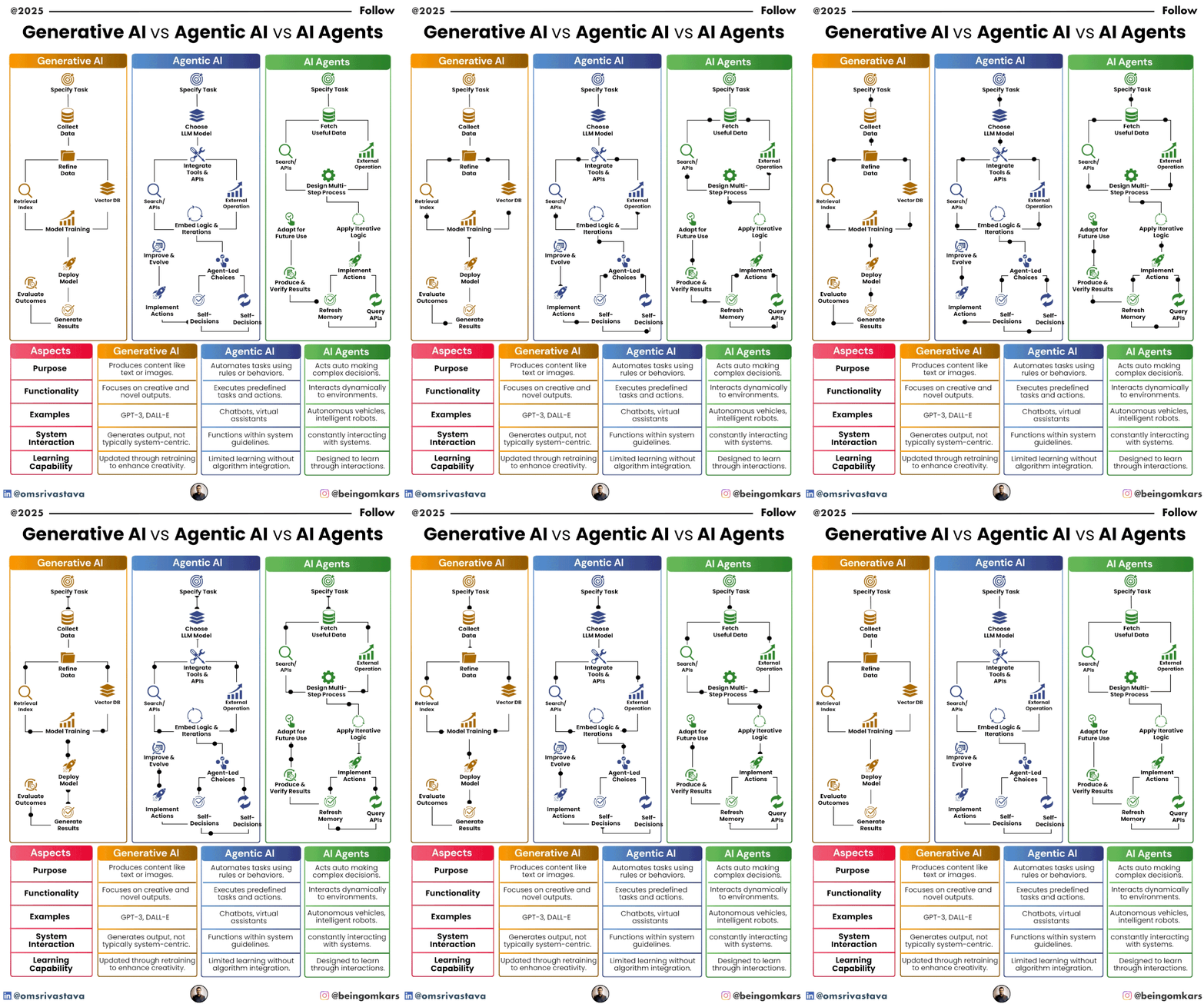
This article explores how these three pillars of modern AI differ, intersect, and converge to form the backbone of next-generation intelligent systems. Whether you’re a tech leader, entrepreneur, or curious observer, understanding the distinctions and synergies between Generative AI, Agentic AI, and AI Agents is essential to navigating the rapidly evolving AI landscape.
What Is Generative AI? The Creative Engine of Modern AI
Generative AI refers to artificial intelligence systems capable of creating new content—text, images, audio, video, code, and even synthetic data—based on patterns learned from vast datasets. Unlike traditional AI that classifies or predicts, Generative AI produces original outputs that mimic human creativity. Tools like ChatGPT, DALL·E, and MidJourney are prime examples, generating everything from marketing copy to photorealistic art in seconds.
At its core, Generative AI relies on deep learning models such as Generative Adversarial Networks (GANs) and Transformer architectures. These models are trained on massive datasets, learning the underlying structure of language, visuals, or music. Once trained, they can generate coherent and contextually relevant content by predicting the next word, pixel, or sound in a sequence.
The applications of Generative AI span across industries. In marketing, it automates content creation for social media and ads. In software development, it assists in code generation and debugging. In entertainment, it powers virtual characters and scriptwriting. Its ability to scale creativity makes it a game-changer for businesses seeking efficiency and innovation.
Key Features of Generative AI
- Content Creation: Generates text, images, audio, and video from prompts.
- Pattern Recognition: Learns from large datasets to mimic human-like output.
- Scalability: Produces high volumes of content quickly and consistently.
- Customization: Can be fine-tuned for specific domains or brand voices.
Despite its power, Generative AI has limitations. It lacks true understanding, often producing plausible but incorrect or biased outputs. It also requires significant computational resources and ethical oversight to prevent misuse, such as deepfakes or misinformation.
Agentic AI: The Rise of Autonomous Decision-Making
While Generative AI excels at creation, Agentic AI focuses on action. Agentic AI refers to systems that can set goals, plan steps, make decisions, and execute tasks with minimal human intervention. The term “agentic” comes from “agency”—the capacity to act independently and make free choices. In this context, AI gains a form of autonomy, moving beyond reactive responses to proactive behavior.
Agentic AI systems are built on reinforcement learning, planning algorithms, and multi-step reasoning. They don’t just answer questions—they solve problems. For example, an Agentic AI might analyze market trends, identify investment opportunities, execute trades, and adjust strategies based on real-time feedback—all without human input.
This level of autonomy is particularly valuable in complex, dynamic environments. In logistics, Agentic AI can optimize delivery routes in real time. In healthcare, it can monitor patient vitals and recommend treatment adjustments. In customer service, it can handle multi-turn conversations, escalate issues, and resolve complaints independently.
Core Capabilities of Agentic AI
- Goal Setting: Defines objectives based on user intent or environmental cues.
- Planning: Breaks down goals into actionable steps.
- Decision-Making: Evaluates options and selects optimal paths.
- Adaptation: Learns from outcomes and adjusts behavior over time.
Agentic AI is not about replacing humans but augmenting human capabilities. It handles routine, data-intensive tasks, freeing people to focus on strategic, creative, or interpersonal work. However, its autonomy raises ethical concerns, including accountability, transparency, and the risk of unintended consequences.
AI Agents: The Convergence of Generative and Agentic Intelligence
AI Agents represent the fusion of Generative AI and Agentic AI—intelligent systems that can both create and act. These agents are not just tools; they are digital entities with perception, reasoning, and action capabilities. They perceive their environment, process information, generate responses, and take steps to achieve goals—often interacting with other systems or users along the way.
Think of an AI Agent as a virtual assistant on steroids. While a basic chatbot answers questions, an AI Agent can research a topic, draft a report, schedule meetings, send emails, and follow up—all in pursuit of a user-defined objective. It combines the creativity of Generative AI with the autonomy of Agentic AI to deliver end-to-end task completion.
Modern AI Agents are often built using large language models (LLMs) as their cognitive core, enhanced with memory, tools, and decision-making frameworks. They can access APIs, browse the web, use software applications, and even collaborate with other agents. This makes them highly versatile and context-aware.
Examples of AI Agents in Action
- Personal Productivity Agents: Manage calendars, draft emails, and track tasks.
- Customer Support Agents: Handle inquiries, process returns, and escalate complex issues.
- Research Agents: Gather data, summarize findings, and generate insights.
- Autonomous Trading Agents: Analyze markets, execute trades, and manage portfolios.
AI Agents are already being deployed in enterprises, startups, and consumer applications. Companies like Microsoft, Google, and OpenAI are integrating agentic capabilities into their platforms, enabling users to delegate complex workflows to AI.
How Generative AI, Agentic AI, and AI Agents Work Together
The relationship between Generative AI, Agentic AI, and AI Agents is synergistic. Generative AI provides the creative and communicative foundation—generating language, visuals, and ideas. Agentic AI supplies the strategic layer—planning, deciding, and acting. When combined, they form AI Agents: intelligent, autonomous systems capable of end-to-end task execution.
For instance, consider a marketing campaign. A Generative AI model drafts ad copy and designs visuals. An Agentic AI system analyzes campaign performance, identifies underperforming channels, and reallocates the budget. An AI Agent orchestrates the entire process—creating content, launching campaigns, monitoring results, and optimizing in real time—without human intervention.
This integration enables a new paradigm of automation: not just task automation, but workflow automation. Instead of automating individual steps, AI Agents automate entire processes, adapting to changes and learning from experience.
The Technology Stack Behind AI Agents
- Large Language Models (LLMs): Provide natural language understanding and generation.
- Memory Systems: Store context, preferences, and past interactions.
- Tool Use: Enable access to external data, APIs, and software.
- Planning Engines: Break goals into sub-tasks and sequence actions.
- Feedback Loops: Allow learning from outcomes and improving over time.
As these components mature, AI Agents will become more reliable, scalable, and trustworthy. The challenge lies in ensuring they act ethically, align with human values, and remain under meaningful human control.
Real-World Applications of AI Agents
AI Agents are already transforming industries by automating complex, multi-step workflows. Their ability to combine creativity, reasoning, and action makes them ideal for roles that require both intelligence and initiative.
In healthcare, AI Agents can assist doctors by summarizing patient records, suggesting diagnoses, and scheduling follow-ups. They can monitor chronic conditions and alert clinicians to anomalies, improving patient outcomes and reducing workload.
In finance, AI Agents manage personal finances, track expenses, and recommend savings strategies. Institutional agents analyze market data, execute trades, and manage risk, operating 24/7 with precision and speed.
In education, AI Agents act as personalized tutors, adapting lessons to student needs, generating practice problems, and providing feedback. They can also assist teachers with grading, lesson planning, and administrative tasks.
In software development, AI Agents can write code, test applications, and deploy updates. They can even debug issues by analyzing logs and suggesting fixes, accelerating the development cycle.
Emerging Use Cases
- Autonomous research assistants that gather and synthesize information.
- AI-powered legal advisors that draft contracts and review compliance.
- Smart home agents that manage energy, security, and appliances.
- Supply chain agents that predict disruptions and reroute shipments.
As AI Agents become more sophisticated, their applications will expand into areas we can’t yet imagine. The key is to design them with clear goals, robust safeguards, and human oversight.
Challenges and Ethical Considerations
Despite their potential, Generative AI, Agentic AI, and AI Agents pose significant challenges. One major concern is bias. These systems learn from historical data, which may reflect societal inequalities. If not carefully managed, they can perpetuate or amplify discrimination in hiring, lending, or law enforcement.
Transparency is another issue. AI Agents often operate as “black boxes,” making decisions that are difficult to explain or audit. This lack of interpretability undermines trust, especially in high-stakes domains like healthcare or criminal justice.
Accountability is equally critical. When an AI Agent makes a mistake—such as approving a fraudulent loan or misdiagnosing a patient—who is responsible? The developer, the user, or the AI itself? Clear legal and ethical frameworks are needed to address these questions.
There’s also the risk of over-reliance. As AI Agents become more capable, humans may delegate too much authority, reducing critical thinking and oversight. This could lead to systemic failures if the AI behaves unpredictably.
Key Ethical Principles for AI Development
- Fairness: Ensure systems do not discriminate based on race, gender, or other protected attributes.
- Transparency: Make AI decision-making processes understandable and auditable.
- Accountability: Establish clear lines of responsibility for AI actions.
- Privacy: Protect user data and ensure consent in data usage.
- Safety: Design systems to operate reliably and avoid harmful outcomes.
Addressing these challenges requires collaboration between technologists, policymakers, and ethicists. It also demands ongoing monitoring, testing, and public dialogue.
The Future of Generative AI, Agentic AI, and AI Agents
The future of AI lies in the convergence of Generative AI, Agentic AI, and AI Agents. As models grow more powerful and architectures more sophisticated, we can expect AI Agents to become ubiquitous—handling everything from personal tasks to global challenges.
Advances in multimodal AI will enable agents to process and generate text, images, audio, and video seamlessly. This will allow for richer interactions and more natural collaboration between humans and machines.
Swarm intelligence—where multiple AI Agents work together—could revolutionize fields like disaster response, scientific research, and urban planning. Teams of agents could coordinate in real time, sharing data and adapting strategies dynamically.
We may also see the rise of personal AI companions—agents that learn individual preferences, values, and goals over time. These companions could assist with life decisions, mental health, and lifelong learning, acting as trusted advisors.
Predictions for the Next Decade
- AI Agents will become standard in enterprise software, automating 50%+ of routine workflows.
- Regulatory frameworks will emerge to govern AI autonomy and accountability.
- Human-AI collaboration will redefine job roles, emphasizing creativity, empathy, and strategy.
- AI Agents will play a key role in solving global challenges, from climate change to disease outbreaks.
The journey ahead is both exciting and uncertain. With thoughtful development and responsible deployment, Generative AI, Agentic AI, and AI Agents can unlock unprecedented opportunities for innovation and human progress.
Key Takeaways
- Generative AI creates content using patterns learned from data, enabling scalable creativity.
- Agentic AI enables autonomous decision-making and goal-driven behavior in dynamic environments.
- AI Agents combine both capabilities to perform end-to-end tasks with minimal human input.
- These technologies are converging to form intelligent, adaptive systems that transform industries.
- Ethical considerations—bias, transparency, accountability—must guide development and deployment.
- The future will see AI Agents as proactive collaborators, enhancing human potential across domains.
FAQ
What is the difference between Generative AI and Agentic AI?
Generative AI focuses on creating new content—such as text, images, or music—based on learned patterns. Agentic AI, on the other hand, emphasizes autonomous decision-making and goal-directed behavior. While Generative AI answers “what,” Agentic AI addresses “how” and “why.”
Can an AI Agent function without Generative AI?
Technically, yes—but it would lack the ability to communicate naturally or generate creative outputs. Most modern AI Agents rely on Generative AI (like LLMs) for language understanding and response generation, making the combination highly effective for real-world tasks.
Are AI Agents safe to use in critical applications like healthcare or finance?
AI Agents can be safe if designed with robust safeguards, transparency, and human oversight. However, they should not operate fully autonomously in high-risk scenarios. Continuous monitoring, explainability, and regulatory compliance are essential to ensure safety and trust.