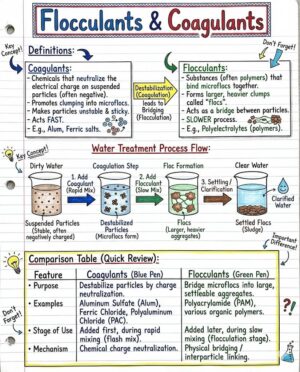
Coagulation and flocculation represent two of the most critical preliminary steps in nearly all modern water and wastewater treatment processes. They are essential chemical conditioning stages designed to remove turbidity, color, organic matter, and pathogenic microorganisms by transforming small, non-settleable particles into larger, heavier aggregates, known as flocs, that can be easily removed through subsequent physical processes like sedimentation, clarification, and filtration. A comprehensive guide on flocculants and coagulants is therefore foundational knowledge for engineers, operators, and environmental scientists dedicated to maintaining water quality and regulatory compliance.
The particles present in raw water—whether sourced from surface water or groundwater—are typically fine colloidal solids. Colloidal particles are characterized by their small size, usually ranging from 0.001 to 1 micrometer, which makes them impervious to simple gravity settling. Crucially, these particles often carry a net negative surface electrical charge. Because like charges repel, these negative charges create a stable suspension, preventing the individual particles from colliding and adhering to one another. The primary goal of coagulation is to overcome this electrostatic repulsion barrier.
Coagulation is the rapid chemical process where the stabilizing negative charge of colloidal particles is neutralized. This destabilization is primarily achieved through the addition of chemicals known as coagulants. Traditional coagulants are typically inorganic metal salts, most commonly based on aluminum or iron. When these coagulants are introduced into the water, they hydrolyze rapidly, releasing highly charged positive ions (cations). These positive ions interact with the negatively charged colloidal surfaces, effectively neutralizing the zeta potential of the particles. Once the repulsive forces are minimized, Van der Waals forces—the weak, short-range attractive forces—can take over, allowing the particles to approach one another and initiate the aggregation process, forming micro-flocs.
Aluminum-based coagulants are among the most globally utilized agents. Aluminium sulphate, often inexactly referred to as ‘alum,’ is a cornerstone coagulant. When dissolved, alum forms a variety of positively charged hydrolysis products, including polynuclear aluminum hydroxides, which are highly effective charge neutralizers. The performance of alum is highly dependent on the raw water pH and alkalinity, typically requiring an optimal pH range for effective precipitation of aluminum hydroxide solids, which act as sweep flocs to entrap impurities. If the water lacks sufficient natural alkalinity, an alkali agent such as lime or soda ash must be co-dosed to ensure the pH remains within the narrow operational window.
A more sophisticated class of aluminum coagulants includes Polyaluminium Chloride (PAC) and Polyaluminium Chlorosulphate (PACS). These compounds are often pre-hydrolyzed, meaning they contain stable, pre-formed polynuclear aluminum species before they are added to the water. This pre-polymerized state offers several advantages over traditional alum, including higher efficiency across a broader pH range, reduced sensitivity to low temperatures, and the formation of denser, faster-settling floc structures. Furthermore, PAC generally consumes less natural alkalinity than alum, reducing or eliminating the need for extensive pH adjustment and minimizing sludge volume, which simplifies residual waste management.
Iron-based coagulants, principally ferric chloride (FeCl3) and ferric sulphate (Fe2(SO4)3), are equally important and versatile. Like aluminum salts, iron salts hydrolyze in water to yield highly charged positive iron species that destabilize colloids. Ferric salts are particularly noted for their effectiveness in removing color and targeting specific contaminants, such as arsenic and phosphorus, often exhibiting optimal performance at a slightly different pH range than aluminum salts. A critical operational consideration for ferric salts is their strong acid-producing nature upon hydrolysis, which can significantly depress the water’s pH. Consequently, the concurrent addition of an alkali, such as hydrated lime or caustic soda, is frequently mandatory to maintain the optimal reaction pH and prevent the finished water from becoming corrosive.
Following coagulation, the newly destabilized particles are still only micro-flocs. These nascent aggregates are too small and too light to settle effectively on their own. This is where the second stage, flocculation, becomes crucial. Flocculation is the physical process of aggregating these micro-flocs into larger, robust, and readily settleable macro-flocs. This process relies on gentle mixing—usually achieved through mechanical stirring paddles in dedicated flocculation basins—which increases the probability of particle collisions without introducing shear forces strong enough to break apart the forming flocs.
While gentle mixing facilitates particle contact, the process is often significantly accelerated and enhanced by the addition of flocculant aids, commonly known as polymers or polyelectrolytes. These are high-molecular-weight, synthetic organic compounds characterized by long, chain-like structures. Polymers function through a mechanism called bridging. The long polymer chains adsorb onto the surfaces of multiple micro-flocs simultaneously, chemically binding them together and creating massive, three-dimensional macro-flocs. The selection of the correct polymer—in terms of type, molecular weight, and charge density—is paramount to success.
Polymers are classified primarily by their ionic charge into three categories. Cationic polymers possess a positive charge and are often used as primary coagulants themselves, offering excellent charge neutralization capabilities, particularly in raw waters with high organic content. Anionic polymers carry a negative charge and are predominantly used as flocculant aids, enhancing the bridging effect after the initial destabilization by metal salts or cationic polymers. Nonionic polymers carry little to no net charge and are used in specialized applications where physical bridging, rather than charge interaction, is the dominant requirement, such as sludge dewatering. The selection process for flocculant aids typically involves rigorous jar testing and assessment of raw water characteristics, including turbidity levels, temperature, and pH, to achieve optimal performance and minimize chemical consumption.
The synergistic relationship between coagulation and flocculation is the cornerstone of solids separation. Failure in the coagulation stage—perhaps due to inadequate dosing, incorrect pH, or insufficient rapid mixing—will inevitably compromise flocculation, leading to poor quality floc that is weak, too small, or settles too slowly. Conversely, aggressive mixing during flocculation can shear delicate flocs, causing them to disintegrate and pass through subsequent sedimentation and filtration barriers, leading to high effluent turbidity. Therefore, the successful operation of a treatment plant depends entirely on balancing the chemical input (coagulation) with the physical energy input (mixing during flocculation).
Operational control is a key theme within any guide to these chemicals. The effectiveness of coagulants is acutely sensitive to pH. For instance, alum performs optimally in a relatively narrow pH range, typically between 5.5 and 7.5. Outside this range, the aluminum species may remain soluble or precipitate inefficiently, resulting in chemical wastage and insufficient particle removal. Therefore, continuous, precise monitoring of pH and alkalinity is non-negotiable. Similarly, temperature plays a crucial role; colder water slows down the rate of chemical reaction and particle collision, often necessitating adjustments in coagulant type (like switching to PAC) or dosage, as well as extending mixing times to compensate for the reduced reaction kinetics.
The physical application of coagulants demands rapid, high-energy mixing, termed ‘flash mixing,’ to ensure instantaneous and uniform dispersal throughout the raw water stream. This must occur within seconds to prevent localized precipitation before particle destabilization is complete. Flocculation, conversely, requires low-energy, tapered mixing to encourage the gentle growth of flocs without inducing shear. A formulation guide must integrate the chemical science with the mechanical design and operation of the treatment plant, emphasizing the kinetic requirements of the chemical reactions and ensuring that the plant design supports the necessary hydraulic profiles for effective solids contact.
Beyond traditional drinking water purification, coagulants and flocculants are vital in wastewater treatment and industrial applications. In municipal wastewater, their primary role is often tertiary treatment to remove residual suspended solids, phosphorus compounds (essential for meeting nutrient discharge limits), and heavy metals from secondary effluent or primary sludge. High-rate clarification processes, like Dissolved Air Flotation (DAF), also rely heavily on precise chemical conditioning using coagulants and polymers to form highly floatable flocs that adhere to injected air bubbles, demonstrating the broad applicability of these formulation principles across different matrices and separation technologies.
An essential aspect of handling these chemicals is safety and regulatory compliance. All chemicals used in drinking water treatment, including coagulants and flocculants, must meet stringent national standards, such as NSF/ANSI Standard 60 in the United States, which certifies that the products do not introduce harmful contaminants (like lead, mercury, or antimony) into the finished water at unacceptable levels. Operators must rigorously adhere to safety protocols for handling concentrated chemicals, including acids and bases, wearing appropriate personal protective equipment (PPE), and ensuring adequate storage and containment facilities are maintained, as outlined in detailed formulation safety appendices. Failure to comply poses both environmental and occupational hazards.
Furthermore, the use of these chemicals profoundly affects the overall economic performance and environmental footprint of the treatment plant. Optimization through tools like Jar Testing—a simple laboratory procedure that mimics the coagulation/flocculation process at bench scale—allows operators to determine the minimum effective dose (MED) for a given set of raw water conditions. Minimizing chemical consumption not only reduces operational costs but also lowers the volume and mass of sludge produced, simplifying downstream residual management and lowering disposal expenses. Poor dosing, conversely, leads to chemical wastage, excessive sludge production, inefficient filter runs, and potential regulatory violations, resulting in higher operational expenditure and energy usage.
The innovation trajectory in this field continues to focus on developing more sustainable and high-performance alternatives. Research trends are moving towards plant-derived, bio-based flocculants, such as those extracted from naturally occurring starches or chitosans, which are often biodegradable and reduce reliance on petrochemical derivatives. Additionally, the development of enhanced coagulants, such as composite metal-polymer hybrids, aims to combine the robust charge neutralization of mineral salts with the powerful bridging capabilities of synthetic polymers, offering superior performance across difficult-to-treat raw water sources characterized by low temperature, high dissolved organic carbon, or extreme turbidity spikes.
For specialized applications, agents like activated carbon are sometimes classified alongside or used synergistically with coagulants. While activated carbon’s primary function is adsorption (removing dissolved contaminants like taste and odor compounds or specific synthetic organic chemicals), its powdered form (PAC) requires efficient removal, often achieved by relying on the sweep coagulation effect facilitated by aluminum or iron salts and enhanced by appropriate flocculant polymers. This demonstrates the integrated nature of chemical formulation, where multiple agents must work in concert to achieve finished water quality targets that extend beyond basic particle removal and address aesthetic parameters.
In conclusion, the formulation guide to flocculants and coagulants is more than just a catalog of chemicals; it is an integrated text covering applied chemistry, fluid dynamics, and operational physics. Mastering coagulation involves understanding charge destabilization and hydrolysis kinetics, while mastering flocculation demands controlling mixing energy and optimizing polymer bridging. The success of water treatment hinges entirely on the careful selection, precise dosing, and meticulous control of these chemical processes, ensuring that the critical step of solids removal is executed efficiently to safeguard public health and preserve infrastructure integrity.
This systematic approach, detailed within comprehensive guides, ensures operational professionals are equipped to handle fluctuating raw water quality, adhere to strict regulatory limits, and continually optimize the chemical budget against performance metrics. The continual advancement in polymer science, the refinement of inorganic coagulant mixtures, and the integration of these processes with emerging technologies like membrane filtration reaffirm the dynamic and indispensable role of coagulation and flocculation in securing clean water resources globally. The ability to correctly calculate dose rates, understand pH dependencies, and select the optimal polymer based on raw water chemistry remains the fundamental skillset imparted by effective guides on these essential water treatment chemicals, serving as a pillar of reliable water supply.