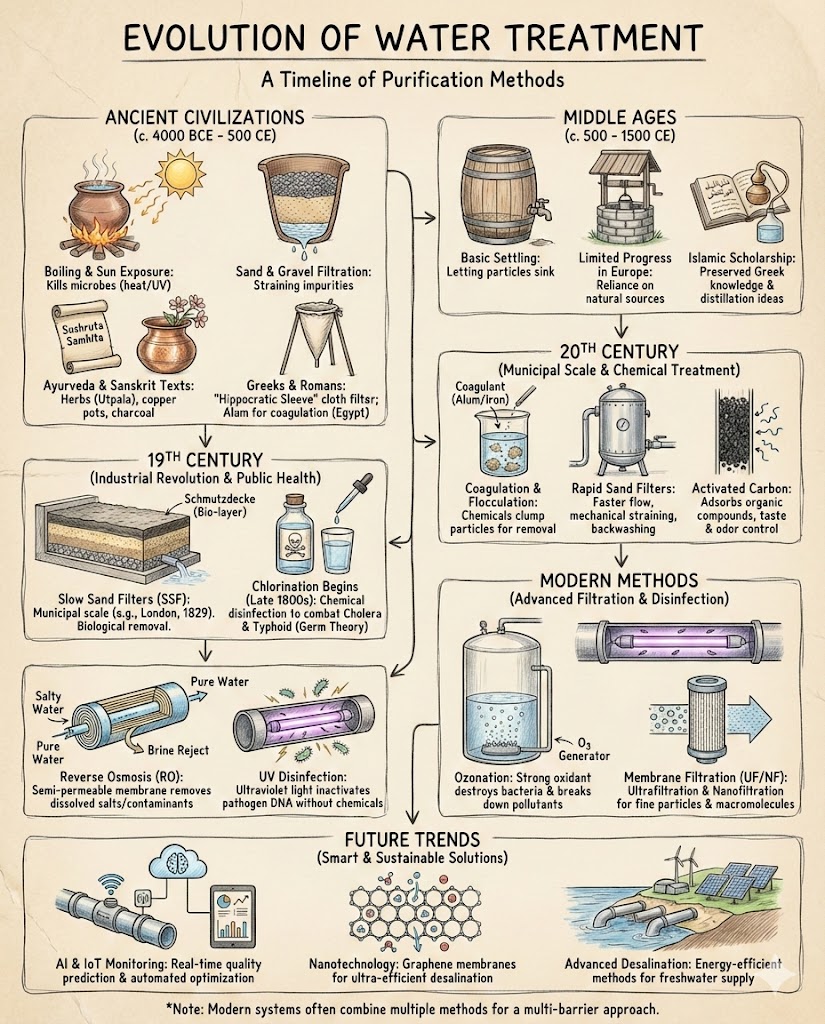
Clean water is one of the most critical foundations of human health, economic development, and environmental sustainability. The evolution of water treatment reflects humanity’s continuous effort to protect this essential resource from contamination and scarcity. From simple filtration methods used by early civilizations to today’s advanced membrane systems and smart monitoring technologies, water treatment has undergone remarkable transformation.
Understanding how these systems developed provides valuable insight into modern infrastructure, public health progress, and future innovations in water management.
Early Beginnings of Water Treatment
The earliest evidence of water treatment dates back more than 4,000 years. Ancient societies recognized that untreated water could cause illness, even if they did not understand bacteria or viruses.
Some of the earliest practices included:
-
Boiling water to remove visible impurities
-
Filtering water through sand and gravel
-
Storing water in copper or silver vessels to reduce spoilage
-
Using charcoal for odor and taste improvement
Ancient Egyptian texts described filtration methods using porous materials. In India, Sanskrit writings from 2000 BCE recommended boiling and filtering water before consumption. The Greeks and Romans later expanded on these techniques by constructing aqueducts and settling basins to improve water clarity.
These early solutions laid the foundation for structured water management systems.
The Middle Ages and Early Scientific Advancements
During the Middle Ages, urbanization increased the need for organized water distribution. However, limited understanding of disease transmission slowed progress. Many cities relied on wells and rivers that were easily contaminated by waste.
By the 17th and 18th centuries, scientific experimentation began to influence water purification:
-
Francis Bacon explored sand filtration
-
Antonie van Leeuwenhoek discovered microorganisms
-
Researchers identified relationships between water quality and health
The introduction of slow sand filtration in the early 1800s marked a turning point. London adopted this method following repeated cholera outbreaks, significantly reducing disease transmission.
This era marked the beginning of water treatment as a public health necessity rather than a convenience.
Industrial Revolution and Municipal Water Systems
The Industrial Revolution dramatically reshaped the evolution of water treatment. Rapid population growth and industrial pollution made traditional methods insufficient.
Key developments during this period included:
-
Large-scale sand filtration plants
-
Chlorination for disinfection
-
Pressurized piping systems
-
Regular water quality testing
In 1908, Jersey City became one of the first cities to implement continuous chlorination. This innovation revolutionized municipal water safety and remains a cornerstone of water treatment today.
Chlorine dramatically reduced outbreaks of typhoid and cholera, establishing modern standards for drinking water quality.
Modern Water Treatment Technologies
The 20th century introduced technological breakthroughs that expanded the scope of water purification beyond basic filtration and disinfection.
Modern treatment typically involves multiple stages:
-
Coagulation and flocculation to remove suspended particles
-
Sedimentation for particle settling
-
Filtration through sand, carbon, or membranes
-
Disinfection using chlorine, ozone, or ultraviolet light
Advanced technologies now include:
-
Reverse osmosis systems for desalination
-
Activated carbon adsorption for chemical removal
-
Ultraviolet purification for pathogen control
-
Ion exchange for heavy metal reduction
These innovations support everything from municipal water supplies to industrial processing and residential filtration systems.
The Role of Regulation and Environmental Awareness
Regulatory frameworks have played a major role in shaping the evolution of water treatment. Governments established strict standards to protect public health and ecosystems.
Notable milestones include:
-
The Safe Drinking Water Act in the United States
-
European Union water quality directives
-
World Health Organization drinking water guidelines
Environmental awareness has also influenced modern practices. Water reuse, wastewater treatment, and conservation strategies are now integral components of sustainable water management.
Wastewater treatment plants remove:
-
Organic matter
-
Nutrients like nitrogen and phosphorus
-
Harmful pathogens
-
Toxic industrial chemicals
Treated wastewater is increasingly reused for agriculture, cooling systems, and groundwater replenishment.
Digital Transformation and Smart Water Treatment
Recent decades have introduced digital technologies that optimize water treatment efficiency and reliability.
Smart water systems now utilize:
-
Real-time sensors for contaminant detection
-
Automated chemical dosing
-
Predictive maintenance algorithms
-
Remote monitoring platforms
These tools reduce operational costs, improve compliance with regulations, and prevent system failures before they occur.
Artificial intelligence and data analytics are beginning to assist utilities in forecasting demand, detecting leaks, and optimizing purification processes.
Future Trends in Water Treatment
The evolution of water treatment continues as new challenges emerge. Climate change, population growth, and industrial expansion place unprecedented pressure on freshwater supplies.
Future developments are expected to focus on:
-
Energy-efficient desalination
-
Nanotechnology-based filtration materials
-
Decentralized treatment systems
-
Advanced water recycling methods
-
Carbon-neutral treatment facilities
Sustainable innovation will be critical to ensuring global access to safe drinking water over the next century.
Why the Evolution of Water Treatment Matters Today
Modern society often takes clean water for granted, yet billions still lack reliable access to safe drinking water. The ongoing advancement of treatment technologies directly impacts:
-
Public health outcomes
-
Food security
-
Economic productivity
-
Environmental protection
-
Disaster resilience
Understanding this evolution helps policymakers, engineers, businesses, and consumers make informed decisions about infrastructure investment and water usage.
Conclusion
The evolution of water treatment represents one of humanity’s most important technological journeys. From primitive filtration techniques to sophisticated digital purification systems, each stage has built upon the last to protect public health and sustain growing populations.
As global water challenges intensify, continued innovation and responsible management will determine the quality of life for future generations. Water treatment is no longer simply a technical process. It is a cornerstone of civilization itself.
Frequently Asked Questions
What is meant by the evolution of water treatment?
The evolution of water treatment refers to the historical development of methods used to clean and purify water, ranging from ancient boiling and filtration techniques to modern chemical, membrane, and digital purification systems.
How has water treatment technology changed over time?
Water treatment technology has progressed from simple physical filtration to complex multi-stage systems involving chemical disinfection, membrane separation, ultraviolet light, and automated monitoring. These advancements significantly improve water safety and efficiency.
Why is modern water treatment more effective than early methods?
Modern systems target a wider range of contaminants including bacteria, viruses, heavy metals, and industrial chemicals. Advanced testing, regulation, and automation ensure consistent water quality and public safety.
What role will innovation play in the future of water treatment?
Innovation will drive more sustainable, energy-efficient, and accessible solutions. Emerging technologies will support desalination, water reuse, and decentralized treatment systems to meet global demand and climate challenges.