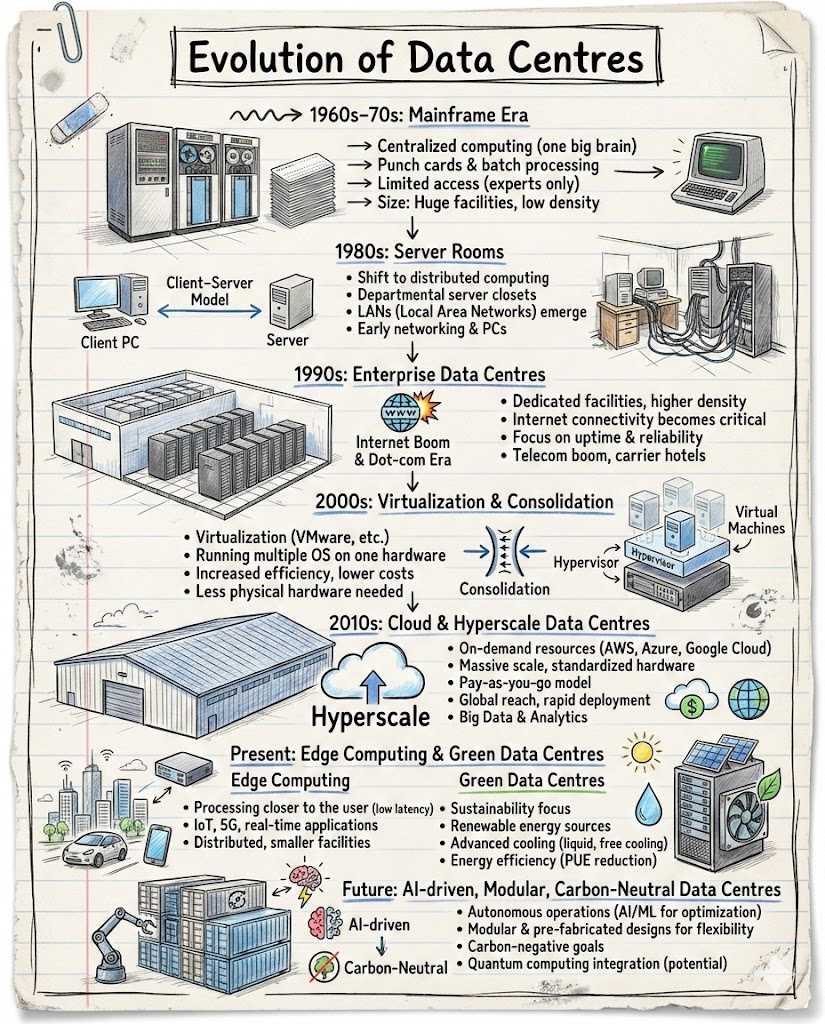
The evolution of data centres reflects the broader transformation of modern technology. What began as simple rooms housing large computers has become a complex ecosystem supporting cloud computing, artificial intelligence, global commerce, and real-time digital services. Understanding this progression is essential for businesses, IT professionals, and decision-makers seeking reliable, scalable, and secure infrastructure.
This article explores how data centres have evolved over time, the technologies that shaped their development, and what the future holds for this critical digital backbone.
Early Foundations of Data Centres
The earliest data centres emerged in the 1940s and 1950s, alongside the first mainframe computers. These machines were massive, expensive, and consumed significant power. Organizations dedicated entire rooms to housing them, with strict environmental controls to prevent overheating.
Key characteristics of early data centres included:
-
Centralized computing systems
-
Limited processing capabilities
-
Manual monitoring and maintenance
-
High operational costs
-
Minimal redundancy or backup systems
At this stage, data centres were exclusive to government agencies, research institutions, and large corporations.
The Rise of Enterprise Computing
During the 1980s and 1990s, personal computers and client-server architectures reshaped how organizations handled data. Businesses began deploying localized data centres to support internal networks, enterprise applications, and growing digital workloads.
This phase of the evolution of data centres introduced:
-
Smaller, distributed server rooms
-
Improved cooling technologies
-
Structured cabling systems
-
Network connectivity between departments
-
Early disaster recovery planning
Data centres transitioned from isolated computing environments to operational hubs supporting everyday business processes.
Virtualization and Efficiency Gains
The early 2000s marked a turning point with the introduction of virtualization technology. Instead of running one application per physical server, multiple virtual machines could operate on a single system.
This innovation dramatically changed data centre design and management:
-
Reduced hardware requirements
-
Improved resource utilization
-
Lower energy consumption
-
Faster deployment of new applications
-
Simplified system administration
Virtualization laid the groundwork for modern cloud computing and transformed how organizations viewed infrastructure investment.
Cloud Computing and Hyperscale Facilities
Cloud computing represents one of the most significant milestones in the evolution of data centres. Major providers built massive hyperscale facilities capable of serving millions of users worldwide.
These modern data centres offer:
-
On-demand scalability
-
Pay-as-you-go pricing models
-
High availability and redundancy
-
Global geographic distribution
-
Automated resource management
Instead of maintaining private infrastructure, businesses increasingly rely on cloud platforms to host applications, manage data, and support remote operations.
Edge Computing and Decentralization
While cloud data centres centralize computing power, edge computing moves processing closer to end users. This approach reduces latency and improves performance for applications such as:
-
Internet of Things devices
-
Autonomous vehicles
-
Smart cities
-
Real-time analytics
-
Augmented and virtual reality systems
Edge data centres are smaller, strategically located facilities that complement traditional cloud infrastructure. Together, they form a hybrid architecture optimized for speed, efficiency, and reliability.
Sustainability and Energy Innovation
As data centres grew in size and number, their environmental impact became a major concern. Power consumption, carbon emissions, and water usage are now critical factors in facility design.
Modern data centres increasingly focus on sustainability through:
-
Renewable energy integration such as solar and wind power
-
Advanced cooling methods including liquid cooling and free-air systems
-
Energy-efficient server hardware
-
AI-driven power optimization
-
Carbon neutrality initiatives
Sustainability is no longer optional but a competitive advantage and regulatory necessity.
Automation and Intelligent Operations
Automation is another defining feature in the evolution of data centres. Artificial intelligence and machine learning tools now manage many operational tasks, including:
-
Predictive maintenance
-
Workload optimization
-
Security threat detection
-
Energy usage management
-
Capacity planning
These technologies reduce human error, improve uptime, and lower operational costs while increasing overall performance.
Security Evolution in Modern Data Centres
As cyber threats become more sophisticated, data centre security has evolved significantly. Early physical locks and firewalls are no longer sufficient.
Modern facilities implement layered security strategies:
-
Biometric access controls
-
Encrypted data storage and transmission
-
Zero-trust network architecture
-
Continuous monitoring systems
-
Regulatory compliance frameworks
Security is now integrated into every aspect of data centre design and operation.
The Business Impact of Data Centre Evolution
The evolution of data centres has reshaped industries across the globe. Companies now benefit from:
-
Faster product development cycles
-
Global digital service delivery
-
Reduced capital expenditure
-
Enhanced disaster recovery capabilities
-
Improved customer experiences
From e-commerce to healthcare, finance to entertainment, modern data centres enable continuous innovation and operational resilience.
Future Trends in Data Centre Development
Looking ahead, several trends will further redefine data centre infrastructure:
-
Modular data centres for rapid deployment
-
Increased adoption of edge computing networks
-
AI-powered facility management
-
Greater reliance on renewable energy
-
Advanced cooling technologies such as immersion cooling
-
Integration with 5G networks
These advancements will support the growing demand for data-intensive services and digital transformation initiatives.
Conclusion
The evolution of data centres illustrates how technology adapts to changing demands. From simple mainframe rooms to intelligent, globally distributed digital ecosystems, data centres have become the foundation of modern society.
Today’s facilities are more efficient, secure, sustainable, and scalable than ever before. As emerging technologies continue to push boundaries, data centres will remain central to innovation, economic growth, and digital connectivity.
Organizations that understand this evolution are better equipped to make strategic infrastructure decisions that support long-term success.
Frequently Asked Questions
What is the evolution of data centres?
The evolution of data centres refers to the transformation from early mainframe computer rooms into advanced facilities that support cloud computing, edge processing, automation, and global digital services.
How have data centres changed over time?
Data centres have progressed from centralized physical servers to virtualized environments, hyperscale cloud facilities, and decentralized edge networks. They now emphasize efficiency, security, sustainability, and automation.
Why is the evolution of data centres important for businesses?
Modern data centres enable scalability, cost efficiency, high availability, and rapid innovation. They allow businesses to deploy applications faster, serve global customers, and maintain reliable operations.
What are the future trends in data centre infrastructure?
Future developments include modular facilities, AI-powered management systems, renewable energy integration, edge computing expansion, and advanced cooling technologies designed to support growing data demands.
By understanding the evolution of data centres, organizations and technology leaders can better navigate the digital landscape and build infrastructure strategies that are both resilient and future-ready.