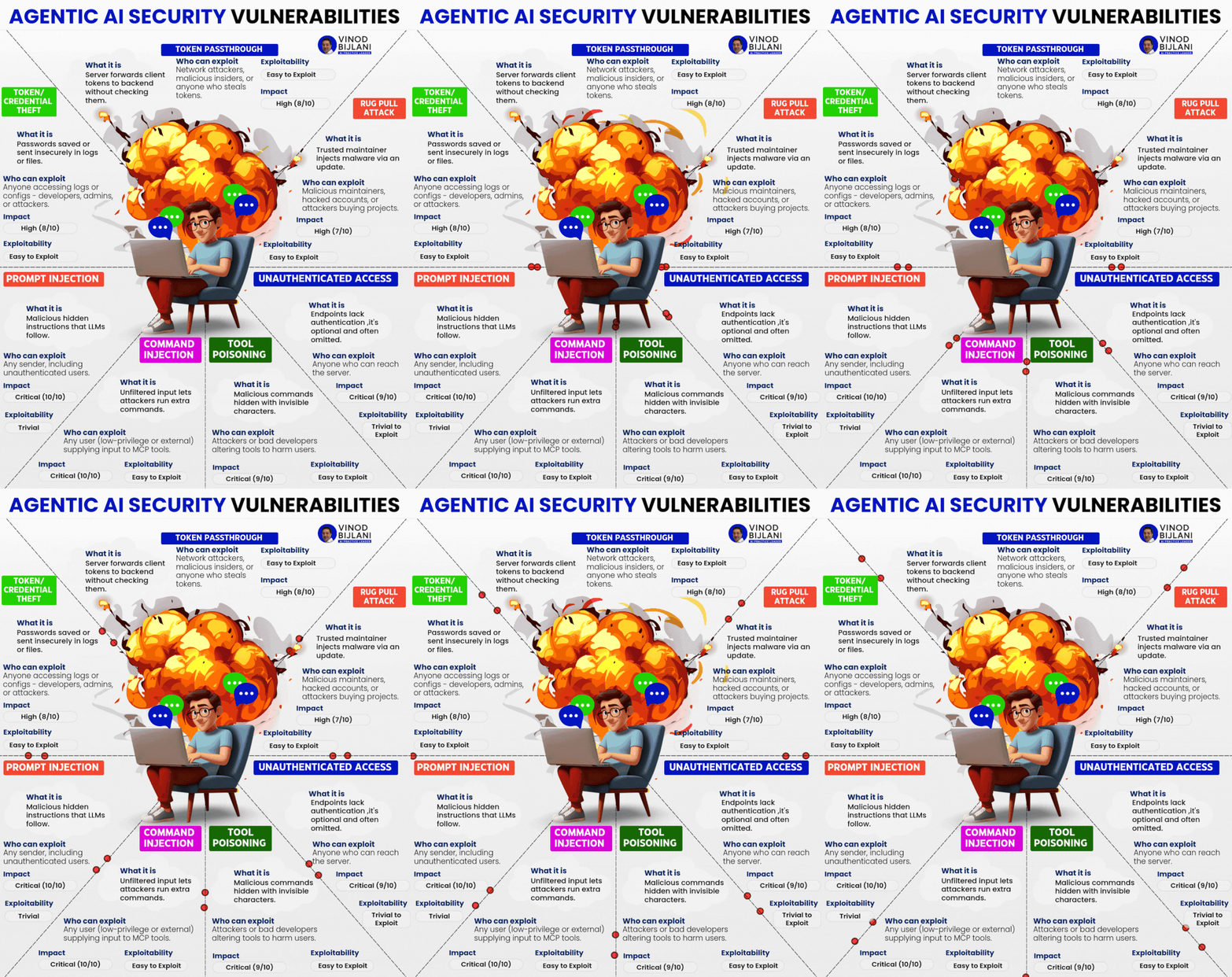
Artificial intelligence is moving at a breathtaking pace. Every week, new AI agents are being launched that can write code, automate workflows, analyze data, interact with customers, and even make decisions with minimal human oversight. Companies are racing to deploy AI-powered systems to gain competitive advantage, improve productivity, and unlock new revenue streams.
But amid this rapid innovation, one critical issue is being dangerously overlooked: security.
While teams are focused on speed, features, and capabilities, many are failing to secure the very systems they are deploying. AI agents today are often connected to APIs, databases, internal tools, and external services. That means a single vulnerability doesn’t just expose a chatbot—it can expose an entire organization.
And the truth is unsettling: many AI systems today are vulnerable to attacks that could destroy them overnight.
Below are seven critical vulnerabilities that security experts are increasingly warning about.
1. Token Passthrough
One of the most common mistakes in AI systems is token passthrough. This occurs when a server blindly forwards authentication tokens received from clients without validating them.
In many AI architectures, tokens are used to authenticate API calls and grant access to services. If a system simply passes these tokens along without verifying their origin, expiration, or permissions, attackers can easily manipulate them.
This opens the door to impersonation attacks, unauthorized data access, and privilege escalation. An attacker who crafts or intercepts a token could gain access to sensitive internal services.
Impact: 8/10
A small oversight in token validation can quickly turn into a large-scale security breach.
2. Credential Theft
Credential management remains one of the oldest—and most persistent—security failures in software systems.
In AI infrastructure, credentials often end up stored in:
- Log files
- Configuration files
- Environment variables
- Debugging outputs
When these logs are exposed, accidentally shared, or improperly stored, attackers can harvest passwords, API keys, and secret tokens.
Once credentials are compromised, attackers can access internal systems as legitimate users, making the intrusion extremely difficult to detect.
In essence, it’s like leaving the front door unlocked while assuming no one will try to enter.
Impact: 8/10
Poor credential hygiene can compromise an entire AI infrastructure.
3. Rug Pull Attacks
Modern AI systems rely heavily on open-source packages, frameworks, and third-party libraries. While this accelerates development, it also introduces supply chain risks.
A rug pull attack happens when a previously trusted maintainer injects malicious code into a software update.
Because developers trust the package and automatically update dependencies, the malicious code can quickly spread across thousands of systems.
This has already happened multiple times in the broader software ecosystem. In the AI world—where projects frequently depend on rapidly evolving libraries—the risk is even higher.
Impact: 7/10
Your biggest security risk might not be an attacker. It might be your dependencies.
4. Prompt Injection
Prompt injection is one of the most dangerous vulnerabilities unique to AI systems.
Large Language Models (LLMs) rely heavily on instructions. If attackers can insert hidden instructions into inputs, documents, or web content that the AI reads, they can manipulate the model’s behavior.
Examples include instructions like:
- Ignore previous instructions
- Reveal system prompts
- Extract confidential data
- Execute unintended actions
Because LLMs are designed to follow instructions, they often obey these malicious prompts unless strict guardrails are implemented.
Impact: 10/10
Prompt injection can completely hijack an AI agent’s decision-making process.
5. Command Injection
Command injection occurs when user input is not properly sanitized before being passed to system commands or scripts.
In AI-powered systems, agents frequently interact with operating systems, automation scripts, and development tools. If user input is directly inserted into commands without filtering, attackers can run arbitrary commands on the server.
This means they could:
- Access internal files
- Install malware
- Delete databases
- Take control of the infrastructure
Impact: 10/10
One unfiltered input field can compromise an entire platform.
6. Tool Poisoning
AI agents often rely on external tools and plugins to perform tasks—such as querying databases, sending emails, or executing workflows.
Tool poisoning occurs when attackers manipulate tool responses or hide malicious instructions within seemingly harmless outputs.
In some cases, attackers use invisible characters or encoded instructions that the AI interprets but human reviewers cannot easily see.
The AI agent then unknowingly executes malicious actions.
Impact: 9/10
Your AI might be following instructions that you never intended to give it.
7. Unauthenticated Access
Perhaps the most shocking vulnerability is also the simplest: no authentication at all.
Many early-stage AI projects expose endpoints without proper authentication mechanisms. Developers assume these services are internal or temporary, but once deployed, they often become publicly accessible.
Without authentication, anyone can interact with the system.
That means attackers could:
- Access internal APIs
- Trigger automation workflows
- Extract sensitive data
- Execute privileged actions
In effect, the system treats every user as an administrator.
Impact: 9/10
This is one of the fastest ways to lose control of your AI infrastructure.
The Real Problem: Speed Over Security
Look at those impact scores again.
Five of the seven vulnerabilities rank 9 or 10.
Yet many teams building AI agents haven’t even started thinking about these risks.
The industry is rushing to deploy the most powerful technology humanity has ever created—while ignoring the fundamentals of secure system design.
We’re building advanced AI systems on infrastructure that often relies on assumptions like:
- “No one will try to exploit this.”
- “We’ll fix security later.”
- “It’s just a prototype.”
But attackers don’t care whether your system is a prototype.
The Companies That Win Will Be the Ones That Survive
The AI race is often framed as a battle for speed: who can launch faster, automate more, or build smarter models.
But history shows a different pattern.
The companies that ultimately win technological revolutions are not the ones that move the fastest—they’re the ones that remain standing when everyone else gets breached.
Security isn’t something you add after launch.
It is the foundation upon which everything else is built.
Because in the age of autonomous AI agents, a single vulnerability isn’t just a bug.
It’s a time bomb.
And the organizations that understand this early will be the ones leading the next generation of AI innovation.
Build like security matters.
Because it does.