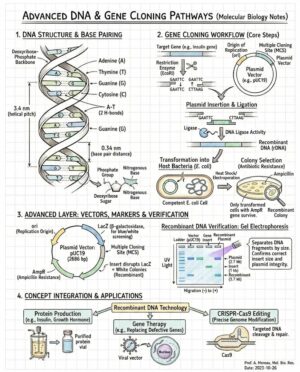
DNA and gene cloning stand as pillars of modern molecular biology, revolutionizing our ability to understand, manipulate, and utilize genetic material. At its core, gene cloning is a process used to create numerous identical copies of a specific gene or DNA fragment. This capability, formally known as recombinant DNA technology, is foundational to biotechnology, medicine, and research, enabling the large-scale production of valuable proteins, the study of complex genetic disorders, and the development of genetically modified organisms.
The concept hinges on the fundamental understanding of how DNA works and the development of a suite of molecular tools. The process requires several key components: the target DNA fragment (the gene of interest), a vector (a DNA molecule capable of autonomous replication, typically a bacterial plasmid), and a host organism (usually a bacterium like *Escherichia coli*). The successful combination of these elements allows scientists to isolate a specific segment of the genome, insert it into a manageable carrier, and then mass-produce it inside living cells.
The history of gene cloning began in the early 1970s with the discovery and application of restriction enzymes. These remarkable proteins, derived from bacteria, act as “molecular scissors,” recognizing and cleaving DNA at specific nucleotide sequences. The subsequent development of DNA ligase, the “molecular glue,” allowed scientists to join DNA fragments together, regardless of their origin. This breakthrough meant that a gene from a human, a plant, or a virus could be physically spliced into a bacterial plasmid, effectively overcoming species barriers at the molecular level.
The first critical step in gene cloning is the isolation and preparation of the DNA fragments. The gene of interest must be precisely excised from its source genome, typically using specific restriction enzymes chosen to flank the desired sequence. Simultaneously, the circular DNA plasmid vector is cleaved using the *same* restriction enzyme. This ensures that both the gene insert and the vector possess complementary “sticky ends”—short, single-stranded overhangs of nucleotides—which are essential for the next stage of assembly.
The second stage, known as ligation, involves mixing the prepared gene insert and the linearized vector in the presence of DNA ligase. The complementary sticky ends anneal through hydrogen bonding, and the ligase enzyme then forms phosphodiester bonds along the DNA backbone, permanently fusing the foreign gene into the vector. The resulting DNA molecule is a recombinant plasmid, sometimes referred to as a chimera, as it contains genetic material from two different sources.
Following ligation, the recombinant plasmid must be introduced into a living host cell in a process called transformation. While there are various methods, one common approach for bacterial hosts involves heat shock or electroporation, which temporarily increases the permeability of the bacterial cell membrane, allowing the large plasmid DNA molecules to enter the cytoplasm. The goal is for the host cell to adopt the recombinant plasmid and, crucially, treat it as its own genetic material, replicating it faithfully every time the cell divides.
However, transformation is inefficient; only a small fraction of host cells successfully take up the plasmid, and even fewer take up the *recombinant* plasmid containing the intended gene. Therefore, a selection process is mandatory. Vectors are engineered to contain selectable marker genes, most commonly genes conferring resistance to a specific antibiotic (such as ampicillin or tetracycline). After transformation, the host cells are cultured on a medium containing this antibiotic. Only cells that successfully internalized any plasmid (recombinant or non-recombinant) will survive, while non-transformed cells are killed.
Screening is the subsequent step required to differentiate between colonies containing the desired recombinant plasmid (vector plus insert) and those containing only the original, non-recombinant vector. This often employs techniques like Blue/White screening or PCR screening. In Blue/White screening, the foreign gene is inserted into a site within a gene that codes for an enzyme involved in color production. If insertion is successful (recombinant plasmid), the color gene is disrupted, leading to white colonies; if insertion fails (non-recombinant vector), the color gene remains functional, producing blue colonies. Scientists select the white colonies for further propagation and verification.
Once successfully cloned, the host bacteria are grown in large fermenters. As the bacteria rapidly multiply, they replicate the recombinant plasmid millions of times. This exponential increase yields a large quantity of the purified DNA fragment (the gene clone) for use in research, or, if the plasmid is designed for expression, the host cell machinery is hijacked to produce the protein coded by the cloned gene.
The applications of gene cloning are vast and permeate almost every facet of modern life science. In medicine, cloning paved the way for the pharmaceutical industry to produce human therapeutic proteins previously difficult or impossible to obtain. For example, before recombinant technology, insulin for diabetic patients was sourced from the pancreases of pigs or cows, often triggering allergic reactions. By cloning the human insulin gene into *E. coli*, pharmaceutical companies now produce vast quantities of pure, bio-identical human insulin, eliminating supply issues and immunological risks. Similarly, human growth hormone, clotting factors, and many monoclonal antibodies are manufactured using cloned genes.
Gene cloning is also indispensable in the development of gene therapy. Although still an emerging field, the fundamental process relies on cloning a functional copy of a mutated or missing gene into a viral vector. This engineered vector is then introduced into a patient’s cells to correct a genetic defect, promising cures for diseases like cystic fibrosis, sickle cell anemia, and certain forms of muscular dystrophy. The precision required for engineering these therapeutic gene constructs necessitates robust cloning techniques.
In agriculture, cloning allows for the precise modification of crops. Genes conferring resistance to pests (like the *Bt* toxin gene) or tolerance to herbicides can be cloned and introduced into plant genomes. This leads to genetically modified crops that improve yield, reduce the need for certain chemical sprays, and increase global food stability. While controversial, these techniques rely entirely on the foundational methods of isolating and replicating specific traits using cloning.
For fundamental research, gene cloning is a daily necessity. Cloning allows scientists to isolate and study single genes in isolation, determining their exact sequence, their regulation, and the structure and function of the resulting protein product. By creating mutants of cloned genes, researchers can systematically investigate the roles of specific amino acids or regulatory regions, providing deep insights into metabolic pathways, disease mechanisms, and basic cellular architecture. Furthermore, cloned genes are often used to create comprehensive libraries—genomic libraries or cDNA libraries—which serve as extensive catalogues of all the genetic information within an organism, aiding large-scale sequencing and mapping projects.
A modern complementary technique often used alongside classical cloning is the Polymerase Chain Reaction (PCR). While PCR rapidly amplifies a specific DNA sequence *in vitro* (in a test tube) without needing a host organism, classical cloning remains essential for large-scale protein production, creating stable cell lines, and generating large amounts of highly purified DNA free from contaminants inherent in PCR reactions. Often, PCR is used as a preliminary step to quickly amplify a gene of interest before it is cloned into a plasmid vector for stability and expression.
Despite its tremendous benefits, gene cloning, like all genetic technologies, raises significant ethical and safety concerns. The safety imperative requires rigorous containment protocols to prevent the accidental release of genetically engineered organisms, particularly those that might contain genes conferring antibiotic resistance or virulence factors. Strict international and national guidelines, overseen by bodies like the NIH in the United States, govern the design of laboratory environments and the handling of recombinant organisms.
Ethically, the technology prompts discussions about the ownership of life forms (patenting genes), the long-term ecological impact of GMOs, and the potential for misuse in human genetic engineering, particularly concerning germline editing. Public education and transparent regulatory frameworks are vital to address these concerns, ensuring that the power of gene cloning is harnessed responsibly for the betterment of human health and the environment.
In summary, gene cloning is not merely a laboratory technique; it is a transformative technology based on the precise chemical manipulation of DNA. By combining the specificity of restriction enzymes, the carrying capacity of vectors, and the amplification power of microbial hosts, scientists can create bespoke genetic constructs. Whether utilized for mass-producing life-saving pharmaceuticals, engineering resilient crops, or unraveling the complexities of the human genome, the cycle of isolation, ligation, transformation, and selection remains the essential, powerful core of modern molecular biotechnology.
The future of gene cloning continues to evolve, integrating with technologies like CRISPR-Cas9 genome editing, which allows for highly targeted modification directly within the cell. However, even with these advances, the foundational principles of DNA cloning—isolating and propagating specific genetic information—are required to prepare the components necessary for these cutting-edge applications, cementing its status as an enduring, foundational skill in all biological disciplines.