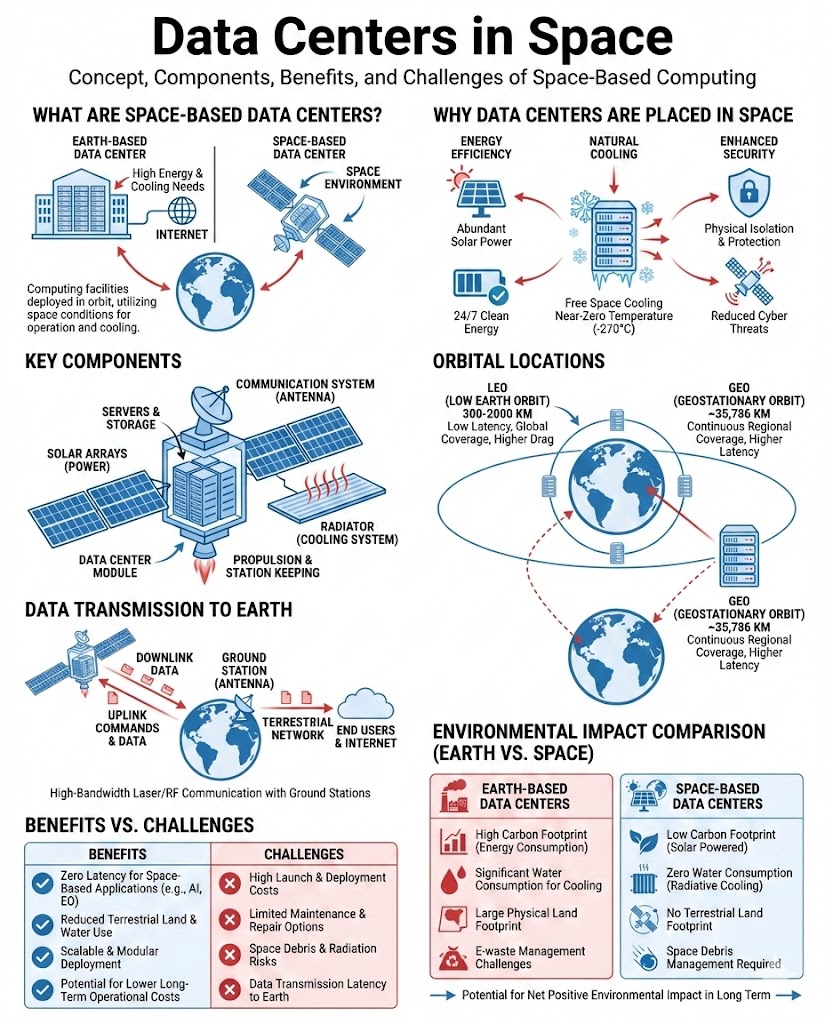
Data centers in space refer to the concept and emerging practice of deploying data storage, processing, and computing infrastructure in Earth orbit or beyond, rather than relying exclusively on terrestrial facilities. These space-based data centers aim to leverage unique environmental conditions in space—such as microgravity, near-vacuum, and extreme thermal gradients—to address challenges faced by conventional data centers, including energy consumption, cooling requirements, latency for spaceborne data, and environmental impact. While still largely experimental, data centers in space are increasingly discussed as a future component of global digital infrastructure.
Background
Traditional data centers are ground-based facilities that house servers, networking equipment, and storage systems. They consume significant amounts of electricity, both to power computing hardware and to cool it. As global data generation grows rapidly—driven by cloud computing, artificial intelligence, the Internet of Things (IoT), and satellite constellations—the scalability and sustainability of terrestrial data centers have become major concerns.
The idea of placing data centers in space has been explored intermittently since the late 20th century, but it has gained renewed attention in the 2020s due to advances in reusable launch vehicles, miniaturized electronics, and space-based communications. The increasing volume of data generated by satellites has also strengthened the case for processing data closer to its source, rather than transmitting all raw data back to Earth.
Concept and Architecture
A space-based data center typically consists of modular computing units placed in low Earth orbit (LEO), medium Earth orbit (MEO), geostationary orbit (GEO), or potentially at Earth–Moon Lagrange points. These units may be free-flying satellites, attached to space stations, or integrated into large orbital platforms.
Key architectural components include:
-
Computing hardware: Radiation-hardened or radiation-tolerant processors, memory, and storage systems.
-
Power systems: Solar panels combined with energy storage solutions such as batteries or supercapacitors.
-
Thermal management: Passive radiators that dissipate heat into space via thermal radiation.
-
Communication links: High-bandwidth laser or radio-frequency links to Earth and to other satellites.
-
Autonomous management: AI-driven systems for fault detection, workload scheduling, and self-repair.
Potential Advantages
Energy Efficiency and Cooling
One of the most frequently cited advantages of space-based data centers is cooling. In space, heat can be radiated directly into the cold vacuum, potentially reducing or eliminating the need for energy-intensive mechanical cooling systems used on Earth. Solar power can also be harnessed continuously in certain orbits, reducing dependence on terrestrial power grids.
Proximity to Space Data Sources
Modern Earth-observation satellites, communication satellites, and scientific missions generate vast amounts of data. Processing this data in orbit—rather than transmitting raw datasets to Earth—can reduce bandwidth requirements, lower latency, and enable near-real-time decision-making for applications such as disaster monitoring, climate analysis, and defense.
Environmental Considerations
Terrestrial data centers contribute to carbon emissions through electricity consumption and construction. Advocates argue that space-based facilities could reduce land use and shift some energy demands away from Earth. However, the environmental impact of rocket launches and space debris remains a significant concern.
Security and Resilience
Data centers in space may offer enhanced physical security against certain terrestrial threats, such as natural disasters or localized conflicts. Distributed orbital infrastructure could also improve redundancy and resilience for critical global services.
Challenges and Limitations
Launch and Deployment Costs
Despite declining launch costs, placing hardware into orbit remains expensive compared to building facilities on Earth. Large-scale deployment would require frequent launches and robust in-orbit assembly capabilities.
Radiation and Reliability
Space environments expose electronics to cosmic radiation and solar particle events, which can cause hardware degradation and data corruption. Designing systems that can operate reliably for long durations remains a technical challenge.
Maintenance and Upgrades
Unlike terrestrial data centers, space-based facilities cannot be easily accessed for repairs or hardware upgrades. This necessitates highly reliable components, modular designs, and possibly robotic servicing.
Space Debris and Orbital Congestion
Adding large data center platforms to Earth orbit increases concerns about space debris and congestion. Effective debris-mitigation strategies and end-of-life disposal plans are essential.
Current Research and Initiatives
Several organizations have explored or announced early-stage projects related to space-based computing and data centers. Agencies such as NASA have tested in-orbit computing on the International Space Station, while private companies including Microsoft and Amazon have expressed interest in space-edge computing for satellite data processing. Launch providers like SpaceX have indirectly enabled these concepts by reducing launch costs and expanding satellite deployment capabilities.
Academic research institutions are also studying orbital cloud computing, focusing on thermal modeling, distributed systems, and secure space-based networks.
Use Cases
Potential applications of data centers in space include:
-
Earth observation and climate monitoring: Real-time processing of satellite imagery and sensor data.
-
Global communications: Supporting next-generation satellite internet and inter-satellite routing.
-
Scientific research: On-orbit data analysis for astronomy, physics, and space exploration missions.
-
Defense and security: Secure, low-latency processing for surveillance and reconnaissance systems.
-
Artificial intelligence at the edge: Running AI models directly in orbit for object detection and anomaly analysis.
Legal and Regulatory Considerations
Space-based data centers operate within a complex legal framework governed by international space law, including the Outer Space Treaty. Issues such as data sovereignty, jurisdiction, liability for debris, and spectrum allocation require clarification as commercial activities in orbit expand. National regulations may also apply to data handling, encryption, and privacy, even when infrastructure is located beyond Earth’s surface.
Future Outlook
While fully operational, large-scale data centers in space remain largely theoretical, incremental progress in space computing suggests that hybrid architectures—combining terrestrial, airborne, and orbital computing—may emerge first. In such models, space-based data centers would complement rather than replace Earth-based facilities, handling specialized workloads that benefit most from orbital deployment.
Advances in reusable launch systems, autonomous robotics, and radiation-resistant electronics are expected to play a crucial role in determining the feasibility and economic viability of space-based data centers. As global data demands continue to rise, the concept is likely to remain an active area of research and debate.