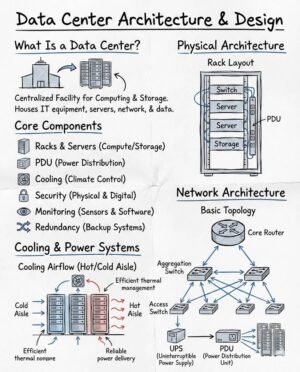
The architecture and design of a modern data center represent a complex synthesis of electrical engineering, mechanical engineering, telecommunications, and information technology. A data center is not merely a room filled with servers; it is a mission-critical facility designed to house and operate an organization’s most vital digital assets, demanding meticulous planning to ensure uninterrupted service, robust security, and operational efficiency. The foundational goal of data center architecture is achieving the ‘five nines’—99.999 percent availability—a metric that signifies less than six minutes of downtime per year, though design must also balance this goal against constraints like cost, energy consumption, and geographical location.
Effective data center design begins with a holistic assessment of business requirements, often translating into specific objectives regarding power density, physical footprint, and desired Tier classification, as defined by organizations like the Uptime Institute. These Tiers (I through IV) dictate the level of redundancy and fault tolerance built into the infrastructure, influencing every subsequent design choice, from the number of utility feeds to the complexity of the cooling plant. A Tier IV facility, for instance, requires full fault tolerance, meaning any single failure, planned or unplanned, will not impact operations, demanding 2N (fully redundant) or 2N+1 architecture for critical systems.
The physical infrastructure forms the backbone of the data center. Site selection is paramount, factoring in proximity to power grids, fiber optic routes, minimal risk of natural disasters, and long-term land use. The internal layout, often referred to as the ‘white space,’ must optimize cabinet placement for efficient cable management and thermal regulation. Key design decisions involve standardized rack widths, aisle dimensions, ceiling heights, and floor type—raised access floors or slab construction—each impacting cooling distribution and cabling pathways.
Power architecture is arguably the most critical element. The design must accommodate the massive energy requirements of modern high-density racks while incorporating multiple layers of protection against utility failure. This typically involves Uninterruptible Power Supplies (UPS) systems, often configured in redundant parallel or distributed parallel architectures, providing instantaneous backup power. Further upstream, large diesel or natural gas generators provide long-term power autonomy. The power distribution system, extending from the medium-voltage switchgear down to the Rack Power Distribution Units (PDUs), must be designed for flexibility and rapid scalability, minimizing conversion losses to maintain a low Power Usage Effectiveness (PUE) score, which measures overall energy efficiency.
Cooling systems must manage the immense thermal load generated by IT equipment. The industry standard remains the hot aisle/cold aisle containment strategy, which physically separates the exhaust air from the supply air, drastically increasing cooling efficiency. Computer Room Air Conditioners (CRAC) or Computer Room Air Handlers (CRAH) remain common, utilizing chilled water loops or direct expansion methods. Advanced designs are increasingly adopting in-row cooling units or rear-door heat exchangers to target heat sources more closely. Furthermore, liquid cooling, including direct-to-chip or immersion cooling, is becoming essential for managing extreme power densities (30kW+ per rack) common in high-performance computing and AI environments, requiring specialized plumbing and fluid management within the architectural plan.
Network architecture dictates the speed and reliability of data transfer. Modern data centers overwhelmingly employ a spine-and-leaf topology, replacing traditional three-tier hierarchical models. The leaf layer connects directly to servers, while the spine layer provides high-speed, non-blocking connectivity between the leaf switches, ensuring low latency and high bandwidth across the entire fabric. Careful consideration must be given to cabling infrastructure—fiber optic for high-speed inter-rack connectivity and copper for shorter distances—with cable trays and patch panels managed meticulously to simplify moves, adds, and changes (MACs).
Security is deeply embedded in the data center architecture, encompassing both physical and cyber dimensions. Physical security requires layers of defense: perimeter fencing, video surveillance, mantraps, biometric access control, and 24/7 security personnel. The building structure itself must resist unauthorized entry and provide fire suppression (e.g., inert gas systems like FM-200 or clean agents, or pre-action sprinklers). Logically, the architecture must support robust network segmentation, firewall deployment, intrusion detection systems, and strict access controls to protect data at rest and in transit.
Scalability and modularity are crucial design tenets ensuring the data center can evolve with technology and business growth. Modular design allows for the phased deployment of infrastructure (e.g., prefabricated power skids or cooling modules), minimizing initial capital expenditure and reducing construction timelines. Scalability allows the facility to expand its capacity incrementally without requiring significant redesigns or service interruption. This planning is critical for long-term viability, moving away from monolithic designs towards dynamic, adaptable spaces.
Modern data center architecture heavily emphasizes sustainability and operational efficiency. The pursuit of a PUE score closer to 1.0 drives innovation in cooling, notably through the use of free cooling techniques (using outside air temperature) and optimizing mechanical plant operation. Energy efficiency is now a primary design driver, influencing choices such as high-efficiency UPS systems, variable speed drives on fans and pumps, and maximizing the use of renewable energy sources, often requiring architectural compliance with green building standards like LEED.
Operational design considerations include maintenance accessibility and automation. Critical infrastructure components must be arranged to allow for maintenance or replacement without downtime, fulfilling the redundancy requirements of higher Tier standards. Furthermore, Data Center Infrastructure Management (DCIM) tools are integrated into the architecture to provide real-time monitoring of power, cooling, and environmental conditions, enabling automated responses to anomalies and optimizing resource utilization through predictive analytics. This integration of IT and facilities management systems is essential for minimizing human error and maximizing efficiency.
The future trajectory of data center architecture is influenced by emerging technologies such as edge computing and cloud integration. Edge data centers require smaller, rapidly deployable, and highly standardized architectural templates, often housed in pre-engineered micro data centers or containers, focusing on proximity to end-users rather than centralized scale. Hybrid cloud architecture demands seamless, secure, and high-speed network integration between on-premises data centers and public cloud providers, influencing core network design and security policy enforcement.
Designing a data center is a strategic investment that defines an organization’s technological capabilities for decades. It requires detailed engineering calculations, from stress testing structural load capacity to simulating thermal dynamics and calculating fault currents. The final architecture must represent a meticulously engineered balance between initial capital cost, long-term operating expense, and the absolute assurance of service availability. Successful design anticipates technological shifts, regulatory changes, and evolving business demands, ensuring the facility remains a robust and reliable platform for digital operations.
The selection of specific materials and technologies must also be integrated into the architectural plan. Fire-rated walls, cable pathway segregation, and specialized grounding systems are non-negotiable safety and reliability features. Furthermore, the material choices often impact structural integrity and thermal properties. For instance, reflective roofing materials can reduce solar heat gain, contributing positively to the overall cooling load and PUE, demonstrating how architectural decisions directly influence mechanical and electrical system performance.
In summary, data center architecture and design are multidisciplinary endeavors focused on creating a resilient, scalable, and efficient environment. By focusing on layered redundancy in power and cooling, adopting modern networking topologies like spine-and-leaf, integrating stringent physical and logical security measures, and prioritizing sustainability metrics like PUE, architects ensure the facility can consistently meet the high demands of continuous digital operation while remaining adaptable to future technological advancements.
Considering the detailed requirements for reliability and the integration of multiple complex systems, the design process often follows stringent methodologies, including iterative reviews and validation phases. Computational Fluid Dynamics (CFD) modeling is routinely used during the design phase to simulate airflow and heat distribution within the white space, identifying potential hot spots before construction begins. Similarly, detailed electrical load forecasting ensures that the power infrastructure (UPS, switchgear, generators) is correctly sized to handle peak loads and future expansion without risking cascading failures, confirming the vital role of simulation and testing in establishing a resilient final architecture. Ongoing maintenance planning, capacity management, and disaster recovery protocol integration are all architectural considerations that move the facility from a static build to a dynamic, managed asset.
The critical choice of cooling methodology, whether air or liquid-based, profoundly shapes the architectural layout. Air-cooled systems necessitate vast plenum spaces and complex ductwork or raised floors, while liquid cooling minimizes airflow requirements but introduces plumbing and water management complexity. The architectural team must coordinate closely with mechanical engineers to integrate these systems seamlessly, ensuring structural support for heavy equipment like chillers and water storage tanks, and designing the building envelope to withstand the pressures and temperatures associated with the chosen cooling technology. This integration must also account for energy recovery systems, such as utilizing waste heat for facility heating or adjacent processes, further enhancing sustainability.
Finally, regulatory compliance extends beyond security and purity standards to include building codes, zoning regulations, and environmental impact assessments. Architectural plans must meticulously adhere to fire safety standards, accessibility requirements, and local electrical codes. Failure in any of these areas can lead to significant delays or operational limitations. Therefore, data center architecture functions as the master document that integrates business strategy, operational goals, engineering specifics, and legal compliance into a single, functional, and highly reliable infrastructure.