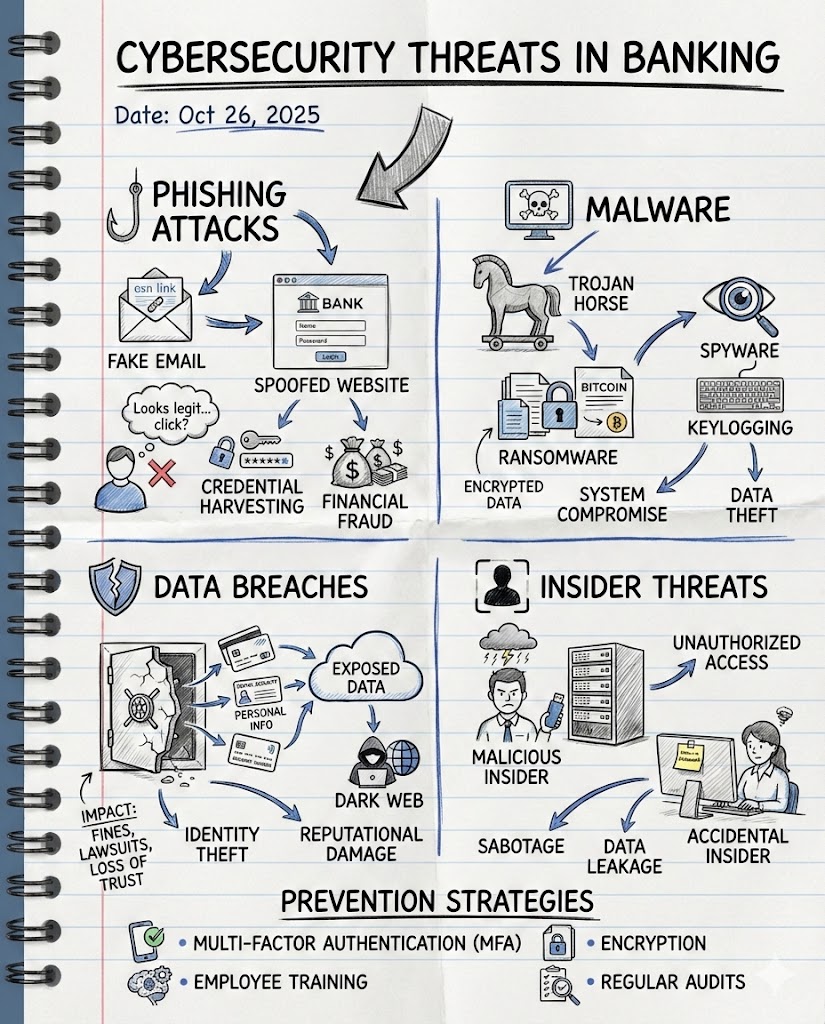
The banking sector has undergone a massive digital transformation over the past two decades. Online banking, mobile applications, digital wallets, cloud computing, and real-time payment systems have significantly improved customer convenience and operational efficiency. However, this increased reliance on digital technologies has also made banks prime targets for cybercriminals. Cybersecurity threats in banking are growing in both frequency and sophistication, posing serious risks to financial stability, customer trust, and national economies.
Why Banks Are Prime Targets
Banks handle vast amounts of sensitive data, including personal identification information, financial records, and transaction details. They also manage large volumes of money, making them attractive targets for financially motivated cyberattacks. A successful breach can yield immediate monetary gains for attackers or valuable data that can be sold on the dark web. Additionally, the interconnected nature of banking systems means that even a small vulnerability can have far-reaching consequences.
Common Cybersecurity Threats in Banking
1. Phishing and Social Engineering Attacks
Phishing remains one of the most common and effective cyber threats faced by banks. Cybercriminals use deceptive emails, text messages, or phone calls to trick customers or employees into revealing login credentials, one-time passwords (OTPs), or sensitive information. Social engineering exploits human psychology rather than technical weaknesses, making it difficult to eliminate entirely. Even well-trained staff and customers can fall victim to highly convincing scams.
2. Malware and Ransomware
Malware attacks, including ransomware, pose a significant threat to banking operations. Ransomware encrypts critical systems and data, rendering them inaccessible until a ransom is paid. In recent years, ransomware attacks have become more targeted, focusing on banks and financial institutions where downtime can be extremely costly. Beyond financial loss, these attacks can disrupt services, damage reputations, and expose sensitive customer data.
3. Distributed Denial-of-Service (DDoS) Attacks
DDoS attacks aim to overwhelm banking websites or online services by flooding them with excessive traffic. While these attacks may not always result in data theft, they can cause service outages, prevent customers from accessing accounts, and erode trust. In some cases, DDoS attacks are used as a diversion while attackers carry out more damaging intrusions elsewhere in the system.
4. Insider Threats
Not all cybersecurity threats originate from outside the organization. Insider threats—whether malicious or accidental—pose a serious risk to banks. Employees with access to sensitive systems may intentionally misuse data for personal gain or unintentionally cause breaches through poor security practices. Weak password management, unsecured devices, or falling for phishing attacks can open the door to larger cyber incidents.
5. Advanced Persistent Threats (APTs)
APTs involve highly skilled attackers who infiltrate banking systems and remain undetected for extended periods. These attackers often have significant resources and may be linked to organized crime or state-sponsored groups. Their goal is not immediate theft but long-term access to sensitive data, financial intelligence, or critical infrastructure. Detecting and removing APTs is particularly challenging due to their stealthy nature.
Emerging Cybersecurity Risks
As banks adopt emerging technologies such as artificial intelligence, blockchain, and open banking APIs, new cybersecurity risks continue to emerge. Open banking, which allows third-party providers to access customer data with consent, increases the attack surface if APIs are not properly secured. Similarly, the growing use of cloud services introduces risks related to misconfiguration, shared responsibility, and third-party vulnerabilities.
Mobile banking is another area of concern. With customers increasingly relying on smartphones for financial transactions, attackers are developing mobile-specific malware and fake banking apps to steal credentials and financial data.
Impact of Cybersecurity Threats on Banks
The consequences of cyberattacks in banking extend beyond immediate financial losses. Regulatory penalties for data breaches can be substantial, especially under strict data protection laws. Reputational damage can lead to loss of customer confidence, reduced market value, and long-term brand harm. In extreme cases, large-scale cyber incidents can threaten financial stability and disrupt national payment systems.
Strategies for Mitigating Cybersecurity Threats
To combat these threats, banks must adopt a multi-layered cybersecurity approach. This includes:
-
Strong authentication mechanisms, such as multi-factor authentication and biometric verification
-
Regular security awareness training for employees and customers
-
Advanced threat detection systems, including AI-driven monitoring and anomaly detection
-
Robust incident response and recovery plans to minimize damage during an attack
-
Compliance with regulatory standards and regular security audits
Collaboration with regulators, cybersecurity firms, and other financial institutions is also essential to share threat intelligence and improve collective defenses.
Conclusion
Cybersecurity threats in banking are an evolving and persistent challenge. As banks continue to innovate and digitize, cybercriminals will adapt their methods to exploit new vulnerabilities. Protecting financial systems requires not only advanced technology but also a strong security culture, continuous vigilance, and proactive risk management. In an increasingly digital financial world, cybersecurity is no longer just an IT issue—it is a fundamental pillar of trust and stability in the banking sector.